
Baby Rash: How to Tell What's Mild and What Needs the ER (with the Glass Tumbler Test)
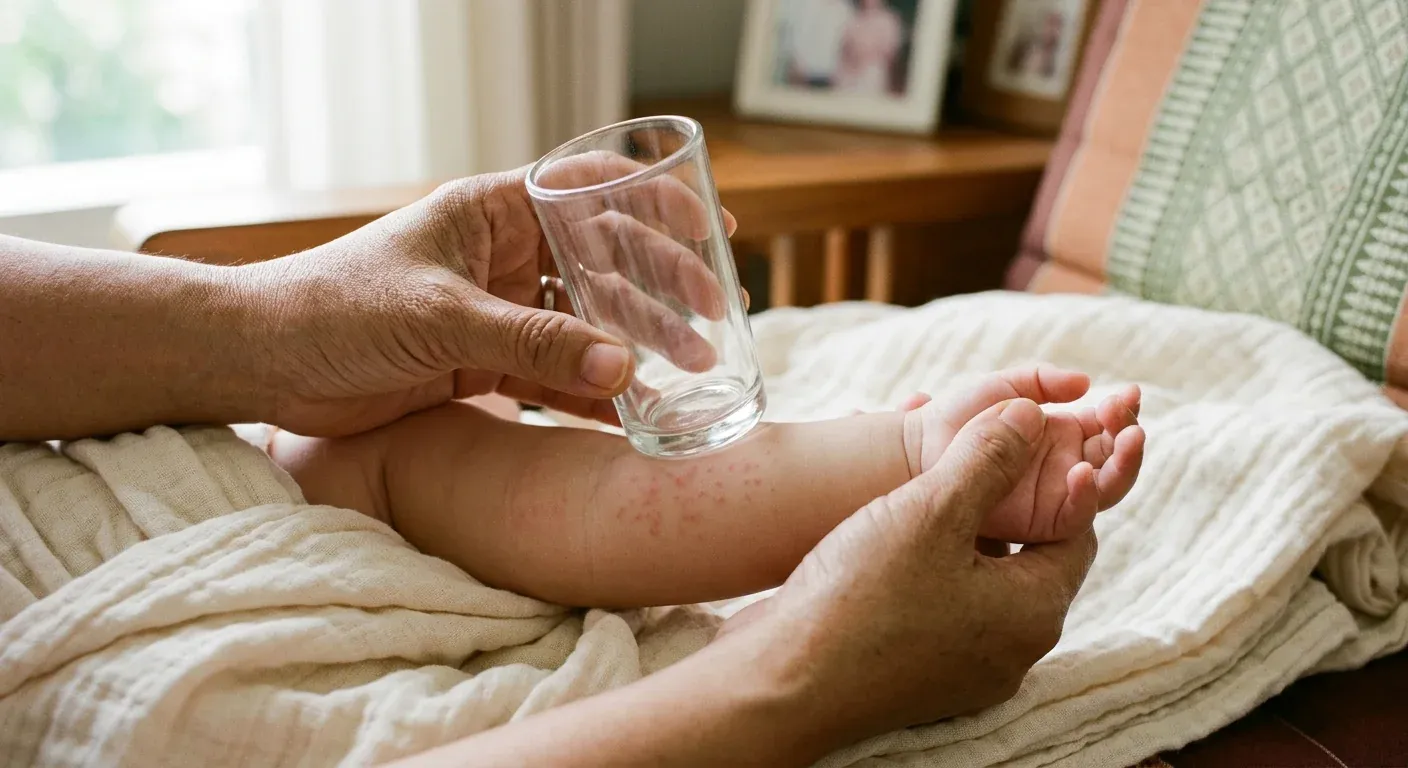
Most baby rashes aren't serious — but a rash that doesn't fade when you press a glass on it is meningitis until proven otherwise. Go to the ER immediately. Press a clear glass firmly on the rash. If you can still see the spots through the glass, call 1669 (or 999/911) now. Don't wait.
Your baby has a rash — is it heat rash, eczema, or something dangerous? It's the most-asked baby question — because there are dozens of baby rashes, some clearing within an hour, others requiring an ER visit within minutes.
This article distils NHS [1], [2], AAP [3], AAD [4], and Samitivej Hospital [5] — sorting the 12 most common baby rashes and the red flags every parent has to know.
🚨 Read This First — The Glass Tumbler Test
Before sorting types, do the glass tumbler test:
- Get a clear drinking glass (no patterns)
- Press the side of the glass firmly on the rash until you can see skin through the glass
- Check whether the rash fades or stays
NHS [2]: a normal rash (allergy, heat, viral) fades under glass pressure. A meningitis rash "does not fade if you press the side of a clear glass firmly against the skin" — it stays visible.
If the rash doesn't fade AND your baby has any of these → call 1669 / emergency number now:
- High fever, stiff neck
- Unusually irritable, can't be settled, high-pitched cry
- Floppy, drowsy, unresponsive
- Refusing feeds
- Bulging soft spot
NHS [2]: "Trust your instincts and do not wait for all the symptoms to appear or until a rash develops."
The glass test takes 5 seconds. Do it every time your baby gets a rash, even if you think it's just heat.
Baby Rashes Fall into 4 Groups
- Viral rashes (usually with fever) — hand-foot-mouth, measles, chickenpox, slapped cheek, scarlet fever
- Itchy rashes from inside — eczema (atopic dermatitis), hives (urticaria)
- Heat / irritation rashes — heat rash, diaper rash, baby acne, cradle cap
- Skin infections / parasites — impetigo, scabies, molluscum
Group 5 = the meningitis rash — separated out because it is an emergency.
Group 1 — Viral Rashes (with Fever)
Hand, Foot, and Mouth (HFMD)
NHS [1]: "mouth ulcers, which can be painful" + "a raised rash of spots on the hands and feet"
Common age: 6 months – 5 years. Peaks in the rainy season (May–Aug in Thailand).
Read more: Hand-foot-mouth: symptoms, care, and when to go to the ER
Measles
NHS [1]: "a spotty rash that appears on the head or neck and spreads to the rest of the body"
A child fully vaccinated with MMR almost never gets measles. An unvaccinated child catches it easily.
Measles is not benign — it can cause death or permanent brain injury. See a doctor immediately if suspected.
Chickenpox
NHS [1]: "small, itchy spots that turn into blisters and scabs"
Starts as red spots, becomes clear blisters, breaks into sores, dries to scabs — comes in waves, not all at once.
Usually self-limiting in 1–2 weeks. Don't let your baby scratch (trim nails). See a doctor if blisters become pus-filled (bacterial superinfection).
Slapped Cheek (Fifth Disease)
NHS [1]: "a rash on 1 or both cheeks plus a high temperature, runny nose, sore throat and headache"
Bright red cheeks like a slap, then a lacy rash on arms and legs. Self-limiting — but if a pregnant mother has been exposed, contact a doctor (risk to the foetus).
Scarlet Fever
NHS [1]: "small, raised bumps that feels rough, like sandpaper"
Fine red bumps that feel like sandpaper + sore throat + fever + bright red "strawberry" tongue.
Caused by Group A Strep — needs antibiotics. See a doctor any time it's suspected.
Group 2 — Itchy Rashes
Eczema / Atopic Dermatitis
NHS [1]: "itchy, dry and cracked"
Common spots: inside elbows and knees, face, cheeks, neck — dry, itchy, red, flaking; comes and goes with seasons.
AAD [4] on day-to-day care:
- Warm baths, not hot — "Bathe your child in warm — not hot — water" and "Limit your child's time in the bath to 5 or 10 minutes". Hot water + long soaks dry skin further.
- Moisturise immediately after bathing, at least twice daily — use "a thick cream or ointment"
- Petroleum jelly — "an inexpensive, fragrance-free product that works well for many children". Plain Vaseline is fine.
- Trim fingernails so scratching doesn't break the skin and cause infection
- Soft cotton clothes, washed before first wear, sensitive-skin detergent, fully rinsed
For flares: hydrocortisone cream as prescribed by a doctor or pharmacist — strength and frequency are individual, ask first; don't self-prescribe.
See a paediatric dermatologist if eczema doesn't improve within 2 weeks of basic care, or if there's pus or weeping (suspect superinfection).
Read more: Baby month 6 — skin and bathing
Hives (Urticaria)
NHS [1]: "raised, itchy patches or spots"
Raised, itchy welts of varying sizes. Often resolve in hours and reappear elsewhere.
Common triggers: food allergy (egg, peanut, cow's milk, fish), drugs, insect stings, viruses.
⚠️ Hives + swelling of face/lips/tongue + trouble breathing → anaphylaxis → call 1669 / 999 / 911 immediately.
Scabies
NHS [1]: "very itchy raised spots" + "lines with a dot at one end"
Intense itching at night, between fingers, armpits, groin — small burrows with a dot at the end (the mite).
Spreads through close contact — everyone in the household needs treatment together. See a doctor for prescription topical treatment.
Group 3 — Heat / Irritation Rashes
Heat Rash (Miliaria)
NHS [1]: "small, raised spots" + "itchy, prickly feeling"
Tiny clear or red bumps on neck, back, chest, groin — clogged sweat ducts.
In Thailand, heat rash is very common, especially March–May, and in babies who are tightly swaddled or left in cars.
Treatment: cooler clothes, air-conditioned rooms, cool sponging — usually resolves in 1–2 days.
Read more: Baby heat rash: prevention and care in Thai weather
Diaper Rash
Red rash limited to the diaper-contact area — change diapers more often, apply zinc-oxide cream.
Read more: Diaper rash: prevention and treatment
Baby Acne
Small red bumps on cheeks, nose, forehead. Starts 2–4 weeks after birth, resolves in 1–4 months.
Read more: Baby acne: why it happens, how to care
Cradle Cap
Yellow greasy scales on scalp and eyebrows — usually resolves on its own by 6–12 months.
Read more: Cradle cap: how to care
Group 4 — Skin Infections
Impetigo
Red sore with golden-yellow crust around nose, mouth, arms.
Highly contagious — see a doctor for antibiotic treatment (topical or oral).
Molluscum Contagiosum
Small skin-coloured bumps with a central dimple — spreads by contact, usually self-resolves in 6–12 months.
⚠️ Red Flags — When to Go to the ER Now
NHS [1] says call 999 (in Thailand: 1669) if:
- ❌ Rash that doesn't fade under glass pressure — "the rash looks like small bruises or bleeding under the skin and does not fade when you press a glass against it" — possible meningococcal sepsis, fatal within hours
- ❌ Stiff neck
- ❌ Difficulty breathing, wheezing, gasping
NHS [2] for babies, also watch for:
- ❌ Refusing feeds repeatedly
- ❌ Unusually irritable, high-pitched cry, can't be settled
- ❌ Floppy, drowsy, unresponsive
- ❌ Bulging soft spot
See a doctor within 2–4 hours (urgent but not immediate):
- A rash spreading rapidly
- Rash + fever > 39°C
- Rash + facial/lip swelling
- Rash with pus or weeping (suspect bacterial infection)
Routine doctor / pharmacist visit:
- Persistent rash not improving in a week
- Rash itchy enough to disrupt sleep
- Recurrent rashes in the same spot
Summary
- Most baby rashes aren't dangerous — but always do the glass tumbler test (5 seconds)
- Viral rashes (with fever) = HFMD, measles, chickenpox, slapped cheek, scarlet fever — sort by location and pattern
- Itchy rashes = eczema, hives, scabies — manage skin / find trigger. Hives + breathing difficulty = emergency
- Heat / irritation rashes = heat rash, diaper rash, baby acne, cradle cap — change environment, self-resolves
- Skin infections = impetigo, scabies, molluscum — see a doctor
- Emergency — call 1669 / emergency number now: rash that doesn't fade under a glass, stiff neck, breathing difficulty, refusing feeds, floppy, bulging soft spot
- Trust your instincts — if your baby seems wrong, even without all the symptoms, see a doctor. NHS [2]: "do not wait for all the symptoms to appear"