
Baby at 6 Months: Starting Solids, Sitting, Key Vaccines
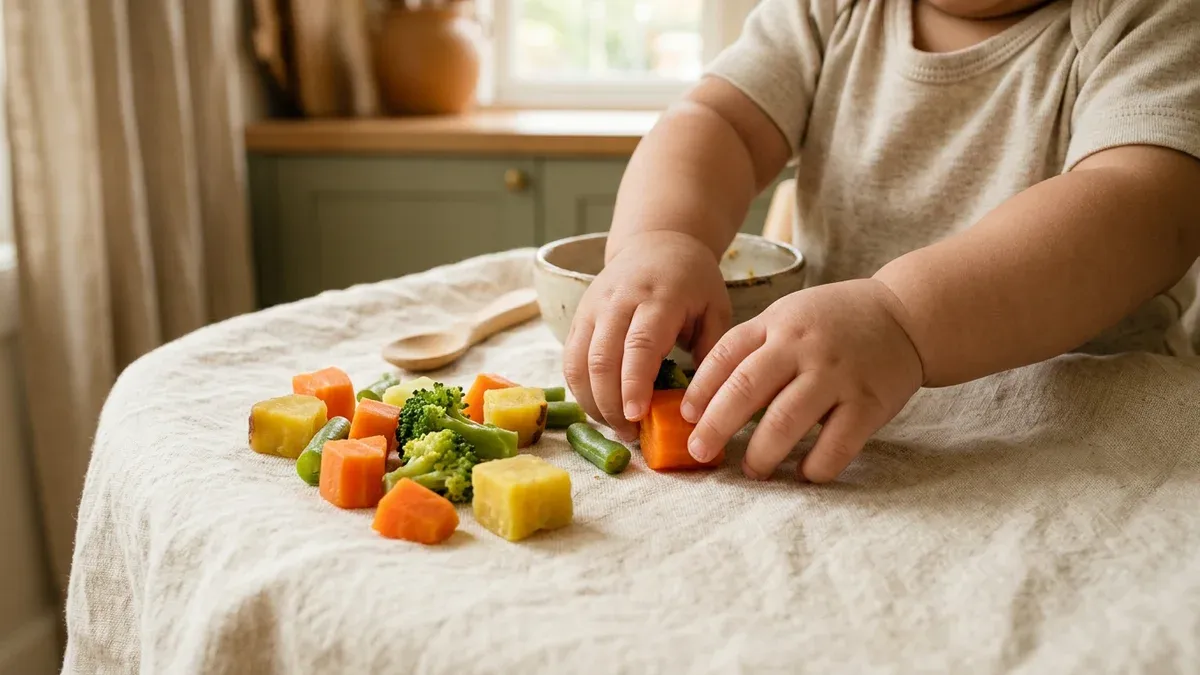
Your baby's world gets bigger this month First taste · First sit · First syllables — six months is the start
Six months is a major turning point — time to introduce solids per WHO [1], and a leap forward in motor, vision, and communication skills.
This article draws on WHO [1], AAP [2] [3], and the Department of Health, Thailand [4].
Milestones at 6 months
Per AAP [3]:
Motor
- Sits without support — may still tip slightly at first
- Rolls over in both directions
- Pushes up on extended arms during tummy time
- Transfers objects from one hand to the other
- Reaches with both hands — more accurate grasp
Communication
- Babbles in repeated syllables — "ba-ba", "ma-ma"
- Turns to their name
- Expresses emotion through sound — laughter, excitement, anger
- Imitates sounds that you make
Vision
- Sees colors clearly
- Tracks faster-moving objects at varied distances
- Recognizes familiar faces and may show stranger anxiety
Social
- Responds to others' emotions — smiles when you smile
- Plays simple games like peek-a-boo
- Shows attachment — clear preference for caregivers
Starting solids at 6 months
WHO [1] and AAP [2] recommend introducing solids at 6 months while continuing breastfeeding through 2 years or beyond.
Signs your baby is ready
- Sits with or without support, head steady
- Shows interest in food — watches what you eat
- Tongue-thrust reflex has faded — doesn't push food out with tongue
- Opens mouth for the spoon
- Has roughly doubled birthweight
How to introduce
- Start with soft, finely mashed foods mixed with breast milk or vegetable broth
- One new food at a time, wait 3 days before adding another — watch for allergies
- Gradually increase texture from purees → mashed → finely chopped → soft chunks
- Offer before milk at meal times; nurse afterwards
- No salt, sugar, or seasoning before age 1
- No honey before age 1 — risk of Infant Botulism
Recommended food groups
Per the Department of Health, Thailand [4]:
- Mashed rice — rice porridge with broth, often a first food
- Leafy greens — finely mashed
- Root veg and fruits — pumpkin, carrot, sweet potato, ripe papaya, banana
- Egg yolk at 6 months; whole egg (with white) at 7–8 months
- Liver and meat — chicken liver, fish, chicken — key sources of iron and zinc
- Fish — choose low-mercury species like tilapia
- Legumes and grains — mashed soybeans, sesame
Foods to avoid before age 1
- Honey — Infant Botulism risk
- Cow's milk as a primary drink — but in cooked foods, yogurt, cheese is fine
- Salt and sugar — infant kidneys can't handle high sodium
- Small round hard foods — whole nuts, whole grapes, hard candy, popcorn — choking hazards
- High-mercury fish — shark, swordfish, yellowfin tuna
Key vaccines at 6 months
Per Thailand's EPI schedule [5]:
- DTP-HB-Hib3 — third dose of the 5-in-1
- OPV3 — third oral polio
- IPV — injectable polio
- Rota3 (if using a 3-dose schedule)
- Influenza — first dose now eligible (optional but recommended)
Warning signs to flag
- Not sitting at all by 8–9 months, or not rolling
- Not vocalizing or not babbling
- No response to sound or name
- Muscle tone unusually stiff or floppy
- Failure to gain weight or weight loss
- Food allergy signs — full-body rash, breathing difficulty, swelling, vomiting
- Anaphylaxis — go to the ER immediately
Summary
Six months is when the world opens up — new flavors, textures, and freedom of movement.
Key principles this month:
- Start solids at 6 months exactly — not earlier, not later
- One new food, wait 3 days to spot allergies
- Continue breastfeeding through age 2 or beyond
- Iron-rich foods first — liver, egg yolk, leafy greens to prevent anemia
- Vaccines on schedule — DTP-HB-Hib3 + OPV3 + IPV
If you're worried about milestones — not sitting, not vocalizing, not responding — talk to your pediatrician. Early detection of developmental delays leads to better outcomes.
แหล่งอ้างอิง
- WHO — Complementary feeding
- AAP HealthyChildren — Starting Solid Foods
- AAP HealthyChildren — Developmental Milestones: 6 Months
- Department of Health, Ministry of Public Health, Thailand
- Royal College of Pediatricians of Thailand — Vaccination Schedule
- CDC — Foods and Drinks to Encourage and Limit