
Raising Children With Grandparents: A Practical Guide for Thai Families
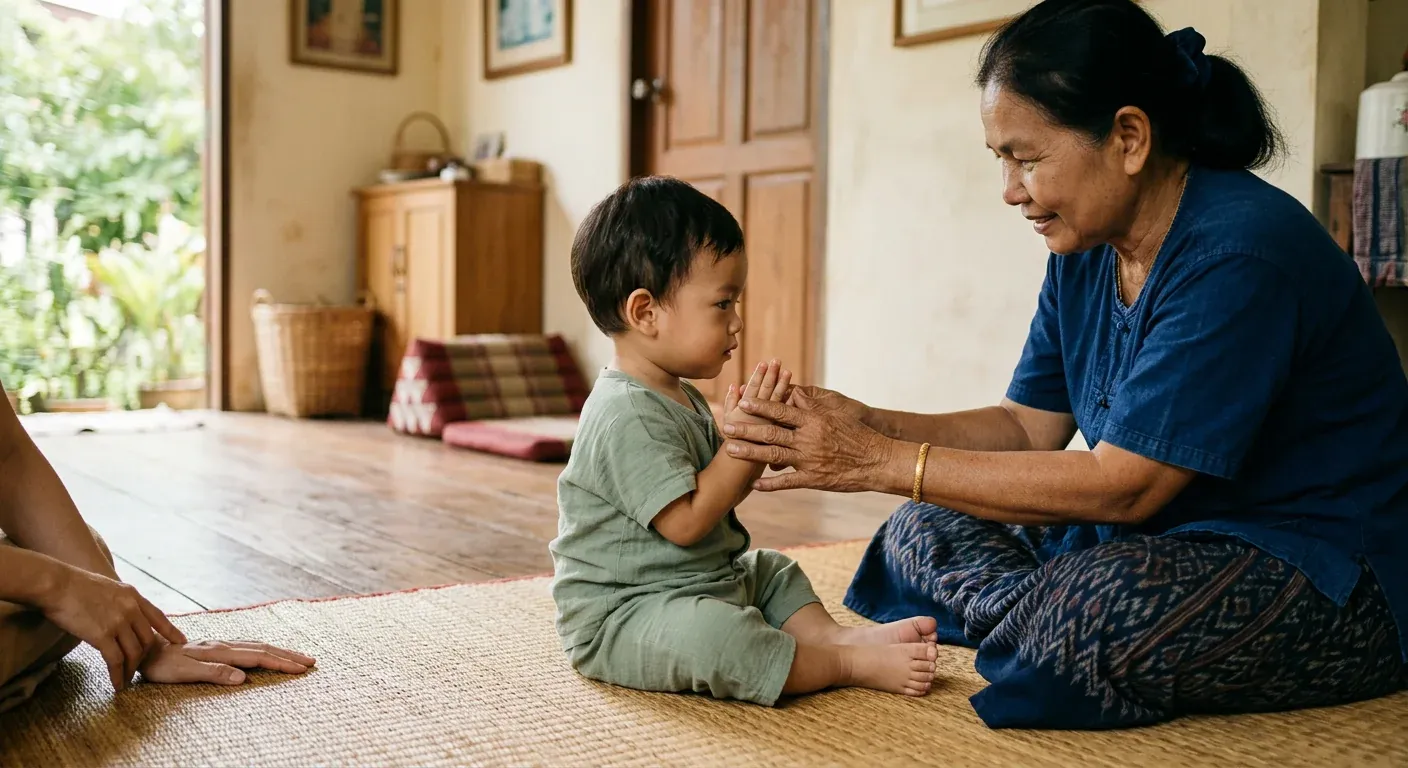
Grandparents are not a backup plan — they are a foundation Multigenerational caregiving works when parents and elders understand each other's roles
Many Thai parents grew up in households where grandparents were present under the same roof or close by. Leaving a child with grandmother or grandmother-in-law while both parents work is not unusual — it is the structure that has kept Thai families running for generations.
But when two generations raise the same child, tension is inevitable: a sweet before dinner, a different screen-time approach, a discipline style that doesn't match, or updated medical guidance that the grandparent generation may not have encountered yet. This article is not written to help you "correct" grandparents — it is written to help everyone in the household actually work together.
What Grandparents Provide That Nothing Else Can
Before talking about alignment or boundaries, it matters to name the genuine, irreplaceable value of elder family caregiving.
Consistent secure attachment. Grandparents who care for a grandchild daily build deep, stable attachment. Unlike daycare settings where staff turnover disrupts continuity, a beloved grandparent provides predictability. Research on child development is clear that children can build secure attachment with multiple primary caregivers — each one can serve as the stable base the child needs.
Cultural and language transmission. Grandparents are the channel for Thai language, Thai food, family stories, and traditions that no book or app can replicate. Children who spend time with family elders often speak Thai more fluently and have a deeper sense of identity.
Emergency flexibility. A sudden illness, an urgent meeting, unexpected travel — grandparents are a safety net that formal childcare cannot provide.
Unconditional love without performance pressure. The love a grandparent has for a grandchild has a particular quality: no developmental milestones to hit, no assessment rubric, no comparison with other children. This gives the child an emotionally safe space that is distinct from both home and school.
Cost savings. In many families, grandparent care reduces or eliminates the childcare expense that is one of the largest line items in a family budget.
The Conversation That Needs to Happen Before You Begin
The AAP recommends that grandparents who provide regular care "educate themselves on modern medical discoveries," specifically mentioning updated guidance on safe infant sleep and over-the-counter medications [1] — this is the heart of preparation: agree first, troubleshoot later.
Before care starts, find time to discuss these topics clearly:
- Sleep — when does the baby nap, how many times, where, and for infants under 12 months: what are the safe-sleep rules? (see next section)
- Feeding — what foods, when, how much, and what is off-limits
- Discipline — how to respond when the child cries, has a tantrum, or refuses — agree on a shared approach
- Screen time — the framework the family uses (see next section)
- Emergencies — who to call first, when to take the child to a doctor without waiting for parents to come home
- Communication channel — LINE group, daily photos, or whatever works for everyone
Clarity on day one prevents conflict in month three.
Safety Updates: What Has Changed Since You Raised Your Children
This is the most sensitive topic, because childcare guidelines change as medical evidence accumulates. The grandparent generation did not raise children wrong — they used the best knowledge available at the time. But some guidance has changed.
Safe sleep (for babies under 12 months) [2]
The AAP is explicit: babies should sleep on their backs for every nap and every night — to reduce the risk of SIDS (Sudden Infant Death Syndrome). A firm, flat surface (a crib — not a soft mattress, a sofa, or an adult chest) and a clear sleep environment without pillows, soft blankets, or toys in the sleep area is the current standard.
On co-sleeping (sharing a bed): the AAP recommends room-sharing but separate sleep surfaces for at least the first 6 months. Bed-sharing with an adult carries risks, particularly when the caregiver is heavily tired.
How to bring this up: "The doctor said the current guidance recommends back-sleeping, and the Department of Health also recommends it. Could you please use this approach with the baby?"
Foods that are off-limits in the first year
- Honey is absolutely off-limits for children under 1 year — the risk of infant botulism is real and serious, whether it is pure honey, honey in tea, or honey-flavored snacks
- Cow's milk as the main drink is not appropriate before 12 months — kidneys and the digestive system are still developing
- Salt and added sugar in food — infant kidneys cannot process high sodium amounts; the baby's food should be portioned out before family seasoning is added
Discipline: what the current evidence says [3]
The AAP is explicit: "spanking, slapping and other forms of physical punishment don't work well to correct a child's behavior" and "parents and caregivers should not spank or hit children" — not because the previous generation raised their children wrong, but because decades of accumulated research shows long-term effects that no one wants. The alternatives the AAP recommends — redirection, clear consistent limits, time-out used consistently — are more effective.
Screen time [4]
AAP guidance for young children: avoid screens in all forms for children under 18 months (video calls with family are an exception); for 18–24 months, choose quality content and watch together; for ages 2–5, no more than 1 hour per day. Grandparents who use a phone or TV to quiet a child usually do it with love — but a shared Family Media Plan agreed on in advance helps everyone stay in the same frame.
A Communication Framework: Request, Don't Command
Filial piety (ความกตัญญู — deep respect for elders) is a core value in Thai culture. Honoring elders is not merely courtesy — it is a meaningful value with real weight. Raising a child together must work within this frame, not against it.
Principles that work in any conversation:
- Credit the doctor, not yourself. "The doctor said..." or "The Department of Health recommends..." reduces the feeling that a younger generation is lecturing an elder. The conflict becomes "we both need to follow what the doctor says" — not "I am right, you are wrong."
- Private conversations only. Never correct or comment in front of the child, no matter how concerning what you see is. Wait until the child is out of the room.
- Thank before you ask. "Thank you for taking such good care of the baby. There's one thing I'd like to ask for your help with..." The sequence matters.
- Choose your battles carefully. Not every issue is worth raising. One sweet before dinner is not the same battle as the back-to-sleep rule. Weight the safety issues first; be flexible about the rest.
- Check in regularly, not only when there's a problem. A brief weekly "How are you doing? Is there anything I can help with?" works better than accumulating concerns for a month and raising them all at once.
A practical script:
For things that need to change: "I wanted to ask for your help with something — the doctor told us that the current guidance on topic has changed. Could you please do it this way with the baby? Thank you so much for everything you do."
For things that can flex: let them go. Save relationship capital for the things that matter.
A Clear Division of Responsibilities
Many conflicts arise not from unwillingness but from the absence of clarity about who is responsible for what.
Examples of a division that works in practice:
- Grandmother handles meals, nap schedule, and daytime activities — parents handle bath and bedtime when they are home
- Grandmother handles weekday daily care — parents take responsibility for all medical decisions and doctor's appointments
- Grandmother runs daily life — parents set the major policies (discipline, nutrition, screen time)
Clarity in roles allows elders to care for the child with confidence, and allows parents not to second-guess every detail.
On compensation: In most Thai families, grandparents are not paid in cash but receive support in other forms — household expenses, gifts, reciprocal care. There is no formula that fits every family, but ambiguity about this creates resentment over time. A direct conversation about this — whatever arrangement you land on — is better than leaving it unspoken.
Family Dynamics: Maternal vs. Paternal Grandparents
In many Thai families, both sets of grandparents are present. Navigating this relationship requires care.
In many Thai traditions, the maternal grandmother (ยาย) plays the primary role in caring for the new mother and baby in the postpartum period, while the paternal grandmother (ย่า) may have a different role. Both are valuable and can complement each other — but clarity about timing and roles prevents the feeling of being excluded.
Useful principles:
- Speak with both sets separately or together when setting important agreements — do not let one side hear from the other
- Acknowledge and thank each grandparent explicitly; what each does is different and valuable, not competing
- If the two sets have different approaches to something important, parents must set one standard for both — not let each side do it differently
On "spoiling" grandchildren: The pattern of grandparents indulging grandchildren more than they indulged their own children is found in families everywhere — it is a love language, not a problem. Small daily indulgences (a special treat, an off-schedule nap, a favorite toy) do not undermine the structure parents build. The boundaries that matter are the safety ones and the ones with long-term effects — not every detail.
Caregiver Burnout: The Overlooked Issue
Caring for a young child is physically and emotionally exhausting regardless of age. A grandparent at 60 or 70 who cares for a toddler every day has limits — and those limits are entirely normal.
Signs to watch for:
- Chronic fatigue that doesn't improve with rest
- Noticeably decreased patience
- Neglecting their own health in order to care for the grandchild
- Expressing regret or resentment about the care arrangement
What parents can do:
- Ask directly and regularly: "Are you tired? Is there anything I can do to help?"
- Plan days off for grandparents — not only an annual trip, but regular short breaks in the weekly rhythm
- When circumstances allow, bring in paid help on some days rather than relying on grandparents every day
- Express gratitude in concrete ways and consistently — not only on special occasions
Taking care of the caregiver is not softness — it is an investment in the sustainability of the whole system.
When It Is Not Working
In some situations, co-caregiving creates more problems than it solves.
Signs that another arrangement may be right:
- Safety disagreements that cannot be resolved (especially sleep and infant feeding)
- Cognitive or physical decline in the grandparent that affects their ability to care safely
- The child showing clear and persistent signs of distress in the grandparent's care
- The family relationship deteriorating significantly because of the care arrangement
Transitioning to a childcare setting or other arrangement is not "punishing" the grandparent — it is making the right decision for the child, and it should be communicated with respect and genuine acknowledgment of what the grandparent has given. See guides/daycare-readiness for a framework for choosing a childcare setting.
Summary
Multigenerational caregiving is one of the most clearly documented strengths of Thai family structure. When it works well, it gives a child something no institution can replicate: connection to roots, love from the family line, and a stability network deeper than any schedule.
Key principles:
- Affirm grandparent value first — secure attachment, cultural transmission, emergency flexibility are real strengths that deserve naming before you raise any concern
- Agree on the important things before care starts — don't wait for a problem: sleep, feeding, discipline, screen time, emergency contact
- Safety is non-negotiable — back-to-sleep in year one, no honey before 12 months, positive (non-physical) discipline — these don't flex [1] [2] [3]
- Use "the doctor said" framing when requesting changes — filial piety and updated knowledge coexist; the third-party authority is the bridge
- Divide roles clearly — who does what, who decides what; clarity prevents conflict better than correction after the fact
- Take care of the caregiver — grandparent burnout is real and parents share responsibility for preventing it
- Thank explicitly and often — the daily work grandparents do has enormous value and deserves to be said out loud
For separation anxiety in the context of multigenerational care, see guides/separation-anxiety. For planning when a child is ready to move to a daycare setting, see guides/daycare-readiness. For grandparent roles in the postpartum period, see lifestyle/postpartum-customs-thai.
แหล่งอ้างอิง
- AAP HealthyChildren — Tips for Grandparents Who Provide Child Care (grandparent role, staying current on safety guidance)
- AAP HealthyChildren — A Parent's Guide to Safe Sleep (back-to-sleep, SIDS risk reduction, co-sleeping guidance)
- AAP HealthyChildren — Disciplining Your Child (positive discipline, physical punishment ineffective and harmful)
- AAP HealthyChildren — How to Make a Family Media Use Plan (Family Media Plan, screen time guidance for young children)
- กรมอนามัย กระทรวงสาธารณสุข — Thai Department of Health, maternal and child health promotion
- Royal Thai College of Pediatricians (ราชวิทยาลัยกุมารแพทย์แห่งประเทศไทย)