
Daycare Readiness: Starting at 2 vs 3 Years — A Guide for Thai Families
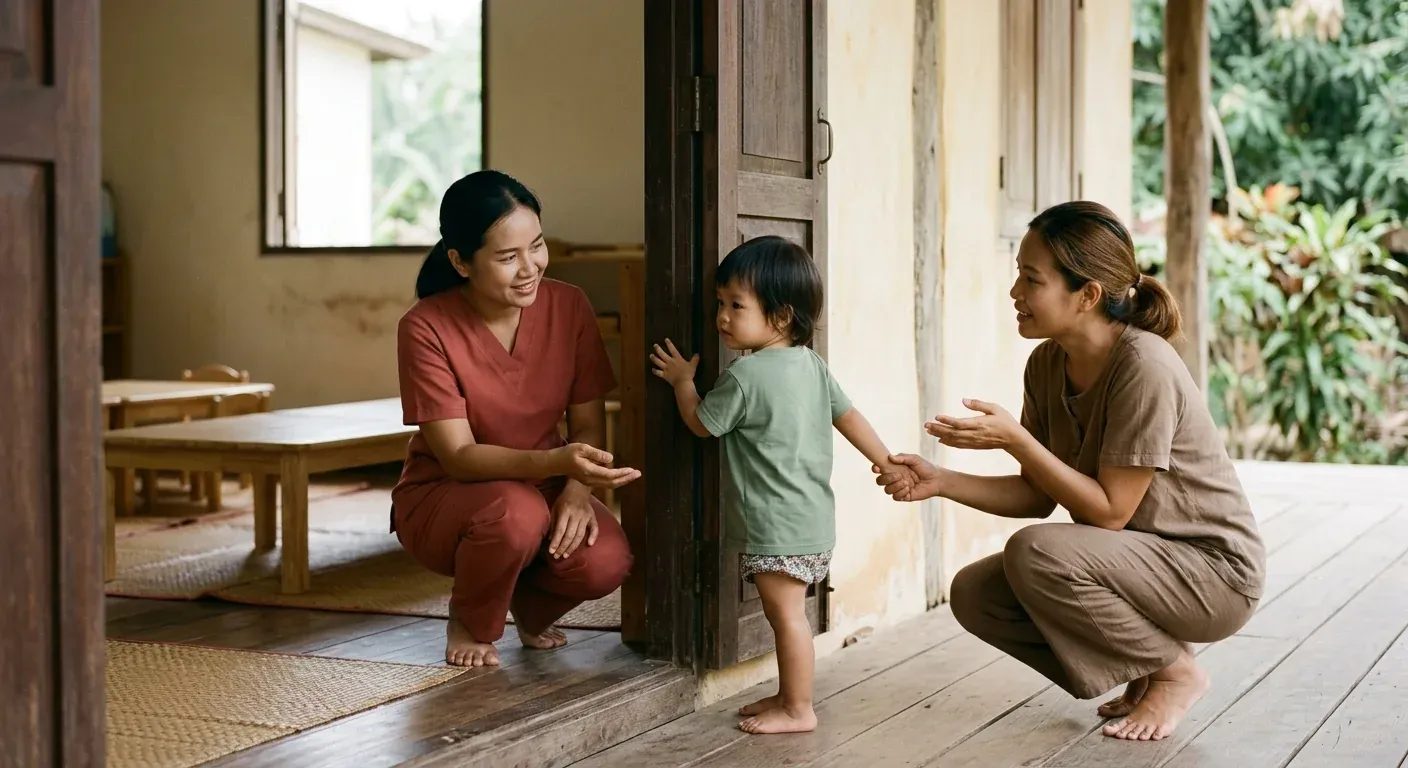
There is no universally "right age" to start daycare — there is only the right readiness. And readiness belongs to your child, your family, and the setting — not to the calendar.
Deciding when to enroll a toddler in daycare or preschool (เตรียมอนุบาล) is one of the hardest calls Thai families make. There is workplace pressure, relatives asking "why not let grandma keep watching?" and genuine uncertainty about whether a child is "ready yet." This article does not tell you when your child should start — it gives you a framework to decide for yourself, grounded in your child's actual development rather than averages you may have heard.
Understanding the Thai School Structure
Before deciding, it helps to know which level you are actually choosing between:
- Nursery / สถานเลี้ยงเด็กเล็ก: Typically accepts children from around 6 months to 2 years. Emphasis on care rather than structured learning. Mostly private.
- Pre-Kindergarten / เตรียมอนุบาล: Roughly ages 2–3. A bridge between home care and a more structured classroom environment. Mostly private (fees apply, varying widely).
- Kindergarten 1–3 / อนุบาล 1–3 (ages 3–6): Under compulsory education law, public kindergarten is free. More formal curriculum.
The question most Thai parents search is: "Is my 2-year-old ready for เตรียมอนุบาล? Or better to wait until age 3?" — and that is the core decision this article addresses.
Timing note: Most Thai schools open in May (the start of the academic year). Applications typically run in March–April. If you are reading this in January or February, this is the right time to start visiting schools and asking questions.
2 Years vs 3 Years: An Honest Comparison
There is no single correct answer for every family — but there are factors worth weighing honestly.
Starting at Age 2 (เตรียมอนุบาล)
Advantages:
- Exposure to peers and structured parallel play (การเล่นคู่ขนาน) — a developmental milestone that is prominent at this age [6]
- A structured daily schedule helps build routines and basic self-management skills
- Allows parents to return to work sooner — a genuine economic reality that should not carry shame
- Time for the family to settle into a school routine before Kindergarten 1
Disadvantages:
- Age 2 is a peak period for separation anxiety (กังวลเมื่อต้องห่างแม่) [1] — the transition is often harder
- The immune system is still developing; the first year in group care typically brings more illness than home care
- A 2-year-old's nap schedule is often longer than most preschools allow
- If toilet training is not yet underway, school deadlines can create pressure for both child and parent
Waiting Until Age 3 (อนุบาล 1)
Advantages:
- Language is more developed — the child can express needs and navigate new situations better
- Separation anxiety naturally decreases; the AAP notes that "separations should be much easier by the time they're three" [1]
- Most children are reliably toilet trained by this age, reducing friction on both sides
- Fewer illnesses due to a more mature immune system
Disadvantages:
- The family needs an interim care solution — grandparents, a nanny, or a smaller group setting — all of which carry their own costs
- Less time to build peer social skills before Kindergarten 1, which has more children and more structure
- For two-income families, waiting until age 3 may not be practically possible
A more useful frame than age: This is a decision that weighs the child's developmental readiness, the family's practical constraints, and the quality of the settings available — not a competition over who starts earlier or later.
Readiness Signs: What to Observe in Your Child
Per AAP developmental guidance [1] [2] [3], these factors matter more than the number on the birth certificate.
Social Readiness
- Stays calm with familiar adults who are not parents (grandparent, relative, regular sitter)
- Has stretches of parallel play alongside peers without distress at every exchange [6]
- Recovers from minor frustration within about 10 minutes with comfort
- Tolerates being held or touched by familiar non-parent adults
Language Readiness
- Can communicate basic needs by word, sign, or consistent gesture ("potty," "hungry," "tired")
- Follows simple two-step instructions ("put your shoes away and come sit here")
Self-Care Readiness
- Self-feeds with a spoon or fork, messily is fine
- Attempts to put on or remove clothing and shoes, even without success
- Washes hands when prompted
- Is toilet trained or actively training
Sleep Readiness
- Down to one nap per day — a child still needing two naps may not fit most school schedules
- Can fall asleep without nursing or rocking on every occasion
- Sleeps through the night most nights (sleep deprivation increases illness susceptibility in group care)
Health Readiness
- Age-appropriate vaccines complete per the Thai EPI schedule (check the pink vaccination book and confirm with your pediatrician)
- If the child has a history of frequent ear infections, an ENT check before starting is worthwhile — group settings can increase exposure
The most important single signal: Can your child separate from the primary caregiver for 30+ minutes without distress that keeps escalating? Some initial protest is normal and expected — but if the child is still in full distress 30 minutes in, day after day, that signals this readiness area needs more time.
On Grandparent Care: It Is Not a Competition
A common conversation in Thai families: "Why put them in school? Let grandma keep caring for them — they're still so small."
The honest answer: grandparent or close-family care is genuinely valuable. The love, emotional warmth, and consistent attachment a child develops with a grandparent are real developmental goods.
What group childcare and เตรียมอนุบาล offer additionally:
- Peer play — home environments dominated by adults provide limited practice interacting with same-age children [2] [3]
- Structured transitions — moving through a sequence of activities (snack → play → tidy-up) builds the transition management skills that Kindergarten 1 requires
School does not replace grandparent love — the two work together. Grandparent care during afternoons and weekends continues to matter enormously.
How to Evaluate a Daycare or เตรียมอนุบาล
Visit in person before deciding. Here is what to observe and ask:
Staff-to-Child Ratio (อัตราส่วนผู้ดูแลต่อเด็ก)
The AAP recommends that for children aged 13 to 35 months, one trained caregiver should oversee no more than 4 children, and that no more than 8 children in this age band should share a single room [7]. Thai childcare settings operate under their own ministry rules, so use these AAP figures as a comparative frame and ask the setting directly what the actual in-classroom ratio is — including who covers ratios during staff breaks and transition times.
Staff Qualifications
- Child development training credentials
- First aid and CPR certification
- Low staff turnover — teachers who stay build consistency, which children need
Daily Schedule
Ask to see the daily programme. Look for balance across: free play / learning activity / nap / meals / outdoor time. Either extreme — rigidly structured all day or completely unstructured — affects development differently.
Sick-Child Policy
- At what point does the school call you to come immediately? (Fever over 38.5°C? Vomiting? Rash?)
- What is the communication channel when a child falls ill mid-day?
- Is there a clear policy about keeping sick children home to protect the group?
Parent Communication
- Daily report, photos, or app updates?
- Can you schedule a conversation with the teacher when you have a concern?
- Are teachers genuinely open to parent questions, or do they discourage them?
Thai culture places high respect on teachers (ครู) — which is a positive thing. But that respect should not prevent you from asking important questions about your child's health and wellbeing. Good two-way communication is a responsibility on both sides.
Physical Environment
- Railings, table corners, play surfaces — are they clean and safe?
- Toys: age-appropriate and clean?
- Natural light and outdoor space?
New Child Orientation Protocol
- Do they allow trial visits before the formal start?
- Can a parent stay for part of the session during the settling-in period?
- How does the school handle children who are still upset after drop-off?
Discipline Philosophy
Ask directly how teachers handle tantrums and conflict between children. The approach should align with your family's values. Confirm that no physical discipline is used — see the companion guide on positive discipline.
The First Month Reality: Your Child Will Get Sick More Often
Parents who are not warned about this are often blindsided. So it is worth stating plainly:
During the first year of group care, the immune system gets an intensive workout. Children encounter strains of common viruses they have not previously met. Increased illness during the first year of daycare is normal — not a sign of a bad school or a fragile child.
Normal: runny nose, mild cough, low-grade fever, viral rashes Red flags requiring medical evaluation: fever above 38.5°C in children under 2, difficulty breathing, signs of dehydration, persistent lethargy, persistent vomiting
Prepare in advance:
- Have a backup care plan for sick days — a partner's flex leave, a grandparent on standby, or a trusted backup sitter
- Do not send a sick child to school — it protects others and helps your child recover faster
Preparing Your Child: A Gradual Ramp, Not a Plunge
2–4 Weeks Before Start
- Talk about school naturally — name the teachers if you have been introduced: "Your teacher's name is Khru Malee, she'll be with you there"
- Visit the school beforehand — let your child see the playground and classroom without any pressure to "like it," just familiarity
- Picture books about school — toddlers understand the world through stories; books where characters go to school provide language and a framework before the real experience
- Weekend separation practice — let your child spend 1–2 hours with a grandparent or relative without you, to reinforce the pattern that "parents leave and come back"
Week 1
- Short visits (1–2 hours) with a parent present
- Let the child explore the environment, engage with toys, observe peers — no performance expected
Week 2
- Half-days; parent drop-off and pick-up
- Consistent goodbye ritual: hug, say "I love you," name when you will return, then go — brief, warm, and firm [1]
- Never sneak out — even if watching your child cry at drop-off is painful, disappearing without warning teaches the child the environment is unpredictable, which deepens separation anxiety over time
Week 3 Onward
- Full days
- Expect regression: sleep disruption, clinginess, increased tantrums — this is normal for the first 4–6 weeks
- Follow your child's pace — if adjustment is slower than expected, talk with the teacher about gradual modifications, rather than pushing through alone
The Reunion Ritual
The first 10 minutes after pick-up are the most important of the day. Put the phone away. Give full, undivided attention. Ask "what was something fun today?" — not "did you cry?" This reconnection moment shapes how easily tomorrow's drop-off goes.
Practical Realities for Working Parents
- Drop-off timing discipline: Arriving rushed and harried amplifies separation anxiety [1]. Build in enough time for a calm transition — waking 20 minutes earlier may be worth it
- Pack the night before: Lunchbox, spare change of clothes, nap mat or sheet — do this the night before so the morning is not chaotic
- Respect the pick-up window: Late pick-ups erode the child's trust in the setting and create friction with staff
- Phone-free reunion: 10 minutes of undivided attention at pick-up settles the nervous system and makes the next morning's drop-off go more smoothly
- Weekend separation practice: Maintain separation during weekends — a grandparent outing, a cousin's house visit — to keep separation tolerance from eroding
Warning Signs: When to Consult a Doctor or Pediatrician
Separation protest is normal — but some patterns warrant a conversation with your pediatrician [4] [5]:
- Crying every day without a single better day after 4–6 weeks of settling time
- Significant weight loss or dramatically reduced appetite due to stress
- Regression in multiple areas — language, toileting, sleep — beyond the typical adjustment range
- After 6–8 weeks, the teacher reports the child has not engaged in any play and will not eat at all
- Daily physical symptoms (stomach pain, vomiting) specifically before school that resolve during school holidays
Summary
- No universal "right age" — 2 years vs 3 years is a family decision, not a medical prescription
- Watch for readiness across five areas: social (can separate), language (can communicate needs), self-care (can feed and wash hands), sleep (one nap), health (vaccines current)
- Age 2 has real advantages and real disadvantages — peer exposure and working-parent logistics on one side; peak separation anxiety, illness, and nap-schedule conflicts on the other [1]
- Age 3 is easier in several ways — better language, lower separation anxiety, usually toilet trained — but the family needs an interim care plan [1]
- Choose the setting carefully: staff ratio, qualifications, sick policy, communication, and physical environment all matter more than reputation or price [7]
- Prepare gradually: 2–4 weeks of verbal preparation, school visits, and weekend separation practice before day one
- Consistent goodbye ritual: brief, warm, firm — never sneak out; name your return time and keep it [1]
- Expect 4–6 weeks of adjustment: regression, increased illness, post-pickup clingy behaviour are all normal
- Grandparent care and school are not competitors — they work best when every adult in the child's life understands their complementary roles
For more on managing the separation anxiety peak that overlaps with this transition, see guides/toddler-tantrums. For toilet training readiness before the school start deadline, see guides/potty-training.
แหล่งอ้างอิง
- AAP HealthyChildren — Emotional Development: 2 Year Olds (separation easier by age 3, tantrum during separation, goodbye-ritual guidance)
- AAP HealthyChildren — Developmental Milestones: 2-Year-Olds (parallel play, mid-year separation anxiety peak then fades, enthusiastic about peers)
- AAP HealthyChildren — Social Development in Preschoolers (transition from side-by-side to cooperative play at age 3)
- กรมอนามัย กระทรวงสาธารณสุข — Maternal and Child Health resources
- ราชวิทยาลัยกุมารแพทย์แห่งประเทศไทย (Thai Pediatric Society)
- AAP HealthyChildren — Social Development: 2-Year-Olds (side-by-side play without cooperation, small playgroup recommendation)
- AAP HealthyChildren — Why Quality Matters in Early Child Care & Preschool (1:4 trained-caregiver ratio for 13–35 months, max 8 children per room in this age band, low staff turnover, health-consultant access)