
Thai Postpartum Customs: Yu Fai, Food Taboos, and What Doctors Agree With
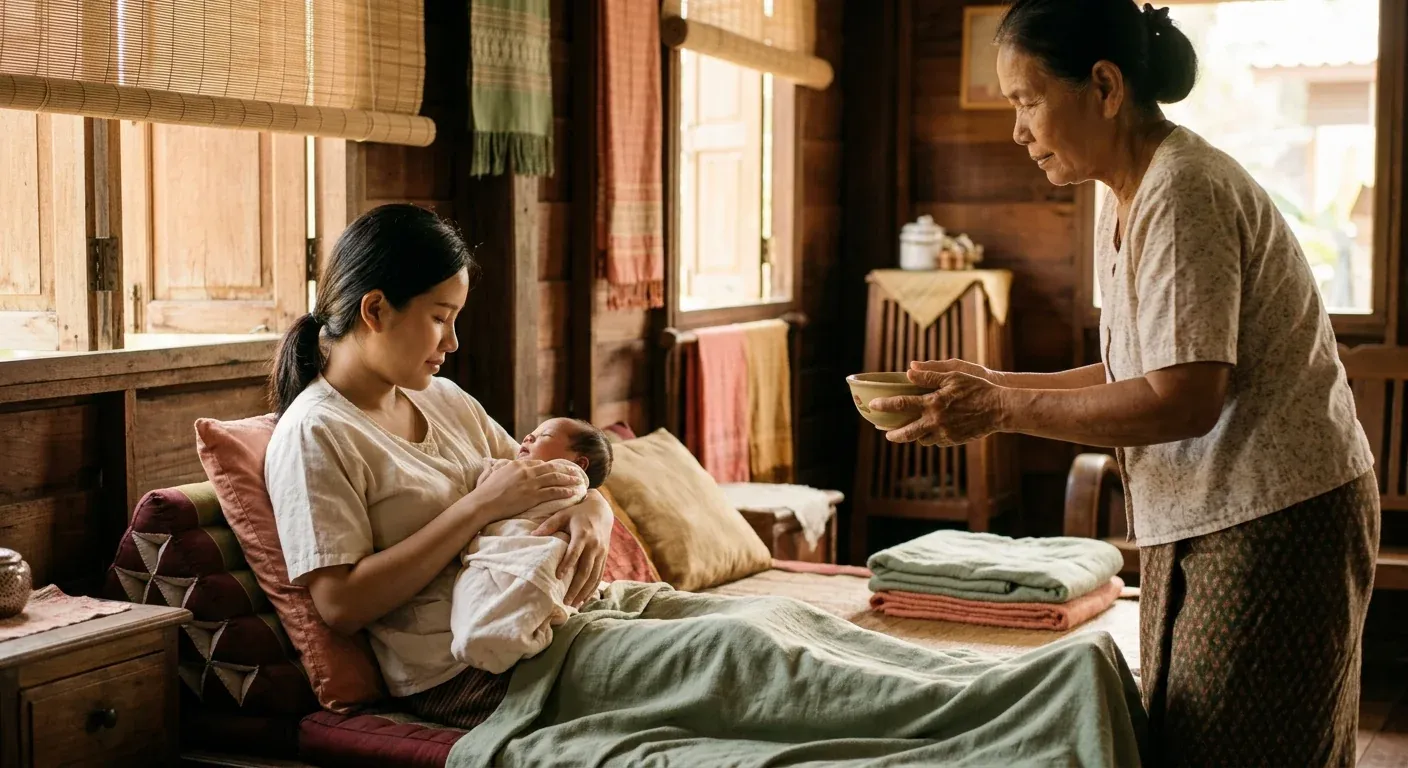
Yu fai isn't superstition — it's an inherited wisdom about rest, warmth, and letting the family care for the mother after birth. Our job is to keep what helps and watch out for what can harm.
If you are preparing to give birth — or you just gave birth and your grandmother already has the hot bricks ready — this article is for you. อยู่ไฟ (yu fai) and the long list of "postpartum taboos" remain a living tradition in many Thai families, especially in rural households and homes led by grandmothers. Some of what the tradition prescribes lines up with what doctors recommend; some is neutral; some, taken to the extreme, can hurt a recovering mother.
The goal here is not to "stop doing yu fai," and not to "do every old rule." It is to help you and your family decide together, drawing on WHO [1], CDC [2], ACOG [3], Thailand's Department of Health (กรมอนามัย) [4], and the Royal Thai College of OB-GYN [5].
Related reading: Postpartum recovery (vaginal birth), Perineal care, C-section recovery, Postpartum depression
What yu fai is — and why families still practise it
อยู่ไฟ (yu fai) is Thailand's traditional postpartum recovery practice. It varies by region and household, but the typical components are:
- Warmth — sitting or sleeping near a fire, heated bricks, warm herbal compresses, herbal steam tents.
- Rest — no housework, extended bed-rest, family taking over both the mother and the newborn.
- Nourishing food — warm dishes, ginger, warm herbal soups (like gaeng liang), avoiding "cooling" foods such as watermelon, cucumber, ice.
- Restrictions on water/bathing — only warm-water bathing, no hair washing for 7–30 days, herbal bath water using bai yor or bai lep-khrut leaves.
- Movement restrictions — no stairs, no lifting, no prolonged standing.
- Ritual and protection — avoiding funerals, avoiding "wind exposure," tham khwan blessings, sacred white thread.
Duration varies: 30 days in rural settings, often shortened to 7–14 days in urban Thai households, sometimes skipped entirely.
Why it endures: under the rituals and rules sits a real value — the mother actually rests, the family rallies around her, warm food is always there, and she does not have to think about chores. That is exactly what modern guidance from WHO says — the first six weeks postpartum is a critical period for the mother's physical and mental recovery, and family support matters [1].
What doctors agree with: the good in yu fai
Before listing what to be careful about, let us name what the evidence does support — because yu fai is not folk error.
1. Rest and family caregiving
WHO recommends "person-centred and respectful care" in the postnatal period, with active family support [1]. That is exactly the spine of yu fai — the mother does not work, the household serves her, sleep is protected. Adequate rest speeds physical recovery and lowers the risk of postpartum depression.
2. Warmth and warm food
After birth, the mother's body has undergone enormous hormonal and energetic loss. Warm, easily digestible, nutrient-dense food — gaeng liang, ginger broths, chicken congee — fits standard postpartum nutrition advice. Ginger has long been used in Thai practice for digestion and to support lactation, and that is not in tension with modern recommendations [6].
3. Specific nourishing dishes
Thai postpartum cuisine emphasises protein, iron, and warming fluids (chicken broth, eggs, dark leafy greens) — these align with the international recommendation to replace iron and replenish energy lost during birth and lactation.
4. Belly binding
The abdominal binder worn during yu fai gently supports the loose abdominal wall — not to "shrink the belly" but for comfort, especially after a c-section. Ask your OB about the right timing.
5. Tham khwan and emotional/spiritual ritual
Tham khwan duean (one-month blessing), sacred thread, family prayers — these have no medical downside, give real psychological comfort, and bind the family together. Keep them.
What to watch for: the parts that can harm
This is the most delicate section. None of what follows is a rejection of yu fai — these are the places where taken to extremes the practice puts the mother at risk.
1. Heat that is too high (hot bricks, prolonged steam)
Sitting close to fire or steaming under herbs for long periods in Thailand's heat can cause:
- Dehydration
- Hyperthermia (dangerously high body temperature)
- Burns from hot bricks or boiling steam
And critically: if you have an unhealed perineal wound, direct heat to that area can worsen swelling and slow healing. For the first 24–48 hours after vaginal birth the perineum should be treated with cold compresses, not heat [6]. See perineal care for the full protocol.
2. Alcohol-soaked compresses on perineum or nipples
Some traditions use cloth soaked in yaa dong (traditional alcohol liquor) as a wound compress. This is not recommended because:
- Alcohol irritates healing tissue and can sting open wounds.
- If used on the breast or nipple, the baby will ingest residue during feeds.
- There is no medical evidence it speeds healing.
Use plain warm water instead, with ice packs (wrapped in cloth) in the very first hours [6].
3. Restricting drinking water
Some yu fai teachings restrict cold water — or restrict water altogether — out of concern that "cold water cools the body." This is harmful to the recovering mother:
- The postpartum body needs ample fluid for healing and milk production.
- Breastfeeding adds roughly 700–1,000 mL of daily fluid loss.
- Dehydration increases the risk of deep vein thrombosis (DVT) — blood clots in the legs, one of the most dangerous postpartum complications.
Recommendation: drink enough fluid. The temperature does not have to be cold — room-temperature or warm water is fine — but do not restrict the amount.
4. Lying still too long (more than 1–2 weeks)
Traditional yu fai emphasises lying-in — and rest is good. But bed-rest extending beyond 1–2 weeks with no walking at all increases:
- DVT — one of the leading causes of postpartum maternal death.
- Slower pelvic-floor recovery.
- Postpartum depression, driven by isolation.
CDC lists one-sided swelling, redness, or pain in the leg or calf as a postpartum warning sign that needs urgent care [2].
Modern guidance: gentle walking around the house is encouraged from day 1–2 (vaginal) or as soon as your team clears it (c-section), expanding gradually over the six-week recovery. See postpartum exercise for the safe progression.
5. Refusing the 6-week postpartum checkup
Some families believe "you cannot leave the house during yu fai." The 6-week postpartum check cannot be skipped — yu fai or not.
ACOG, WHO, and the Royal Thai College of OB-GYN all recommend a postpartum visit within 6 weeks (sooner after c-section or if complications arose) [1][3][5]. Thailand's universal health coverage (สปสช.) covers this visit — families on the bat thong gold card pay nothing.
At this visit the doctor will:
- Check your wound (perineal or c-section)
- Examine the vagina, uterus, and pelvic floor
- Discuss contraception (breastfeeding is not a reliable contraceptive)
- Screen for mental health concerns
- Advise on breastfeeding and gradual return to exercise
If your family worries about "leaving home during yu fai," tell your grandmother that the doctor has called you in for an appointment and you will return to finish yu fai afterward. A short hospital visit does not "make the khwan leave."
6. Not telling your doctor what herbs you are taking
The food and herbs of yu fai may have pharmacological activity that can interact with prescribed medications — antibiotics for perineal repair, contraceptives, blood pressure drugs. Always tell the prescribing doctor what you are taking, not so they can judge your tradition, but for safety.
"Hot" and "cold" foods: understand the logic, do not treat it as binding
The tradition of of saleng (forbidden / "wrong" foods) after birth divides food into "hot" (eat) and "cold" (avoid), with roots in Ayurveda and Thai traditional medicine and their concern for elemental balance.
What the modern evidence can say:
- There is no medical evidence that watermelon, cucumber, or other "cold" foods delay wound healing.
- Fresh fruit and vegetables provide fibre and vitamin C essential for wound healing and for preventing the constipation that plagues so many postpartum mothers, especially after a perineal tear.
- A diverse diet supports milk supply and the mother's mood.
Practical balance: keep the warm, nourishing dishes your grandmother prepares — gaeng liang, ginger broth, chicken congee — as the backbone. Then add fresh fruit and vegetables on top. If concern about "coldness" remains, eat fruit at room temperature instead of chilled. Do not let an entire produce section disappear from your diet.
Breasts: a section to read closely
Some yu fai traditions include warm compressing and massaging the breast — these are generally compatible with breastfeeding recommendations. Gentle warm compresses help milk flow; gentle massage relieves engorgement [7].
Things to watch for:
- Do not place hot bricks or extremely hot herbal balls directly on an engorged breast — risk of blistering and worsened inflammation. Use a warm wet cloth instead.
- Do not put alcohol or concentrated herbal extracts on cracked nipples — the baby will swallow residue, and the skin will likely react.
- If a breast is red, hot, and painful together with a fever of 38°C or higher, this may be mastitis and needs medical care, not just compresses or massage. See breastfeeding basics.
Mental health: where Thai tradition is strongest — and where it can mislead
This is the most sensitive and most important section.
The strength of yu fai
The Thai extended family — and the tradition of the household caring for the mother during yu fai — is a real protective factor against postpartum depression. A mother who has people around her, who does not face the chores alone, who can actually sleep, has measurably lower PPD risk. Grandmother's presence is a resource that nuclear families in the West often do not have.
Where to stay alert
Yu fai is not a shield against everything. These signs need help, regardless of how perfectly yu fai is going:
- Persistent sadness, hopelessness, or crying beyond 2 weeks after birth
- Thoughts of harming yourself or the baby — even a fleeting thought needs telling someone
- Inability to sleep when the baby sleeps
- Feeling detached from the baby — not wanting to hold them, not feeling bonded
- Excessive worry — anxiety running all day about what might happen
These are not weakness, and they are not "the khwan has left, tham khwan will fix it" — these are medical conditions that respond to treatment. See postpartum depression for the screening details and red flags.
Resources in Thailand:
- Mental health hotline 1323 — 24/7, free
- The hospital where you delivered usually has a social work department you can reach
- Tell your OB directly at the 6-week visit if you are struggling
When grandmother is strict: how to talk so both sides feel respected
Khun yai (your mother) or khun ya (your husband's mother) often leads the household's yu fai — and that is appropriate. She has done this herself, she knows the family's specific traditions, she wants to take care of her child and grandchild as well as she possibly can.
Sometimes her advice will clash with what the doctor said — not because she is wrong, but because medicine has updated.
Conversation principles
1. Credit her first. Before pushing back on anything, thank her for being there, acknowledge that this is her area.
2. Cite the doctor, not yourself. Useful phrasings:
- "Mum, you are so much better at this than I am, but the doctor said..."
- "The doctor at the hospital told me I have to drink plenty of water, no restriction"
- "On day 30 the doctor has called me in for a check; I will come straight back to yu fai"
3. Find the middle ground. Yu fai is not all-or-nothing — choose the safe parts and keep them:
- Tham khwan and rituals ✓
- Gaeng liang and ginger broth ✓
- Real rest ✓
- Hot bricks on the perineum ✗
- Plenty of water ✓ (even if grandmother worries about "cold body")
- Going to the 6-week check ✓
4. Let your partner help. If your partner is your mother-in-law's child, they can have the conversation. Some things are heard more easily from a son than from a daughter-in-law.
5. Bring a paper from the doctor. One piece of paper from the hospital carries more authority than an argument.
Cross-cultural families: when your partner is not Thai
If your partner is Chinese, Western, Muslim, or another background, they may bring their own postpartum tradition:
- Chinese families have 坐月子 (zuò yuè zi), close cousin to yu fai — warmth, nourishing food, 30 days of confinement.
- Western families often have no specific confinement custom but emphasise the "fourth trimester" — the first 12 weeks of adjustment.
- Thai-Muslim families have lieng fai, structurally similar but with its own details.
Principle: you do not have to pick one tradition. Keep what helps from both cultures, and let medical guidance be the safety floor that runs underneath both.
Summary: yu fai — keep, adjust, avoid
| Practice | Keep | Adjust | Avoid |
|---|---|---|---|
| Rest, family caregiving | ✅ Yes | ||
| Warm nourishing food, ginger, gaeng liang | ✅ Yes | ||
| Abdominal binder | ✅ Ask OB about timing | ||
| Tham khwan, sacred thread, ritual | ✅ Yes | ||
| Gentle warm compresses on torso/back | ✅ Watch temperature | ||
| Cutting all fruit & vegetables | ⚠️ Keep warm dishes as backbone, add fresh produce | ||
| No bathing or hair-washing for 30 days | ⚠️ Warm bathing/washing earlier once wounds are dry | ||
| Bed-rest for 30 days unbroken | ⚠️ Gentle walking from day 1–2 | ||
| Skipping the postpartum checkup | ❌ Never — the 6-week check is non-negotiable | ||
| Hot bricks or steam on the perineum | ❌ Risk of burn and swelling | ||
| Alcohol compress on wound or nipple | ❌ No evidence, risk to baby | ||
| Restricting drinking water | ❌ Raises DVT and lowers milk supply |
Urgent warning signs needing immediate medical care — yu fai or not [2]:
- Fever 38°C (100.4°F) or higher
- Soaking a pad every hour for 2 hours in a row
- One-sided leg or calf swelling, redness, pain (DVT)
- Difficulty breathing or chest pain
- Severe headache, vision changes
- Thoughts of harming yourself or the baby — call 1323 or go to the emergency room
แหล่งอ้างอิง
- WHO — Maternal health (health-topics/maternal-health): WHO's main hub for maternal health during pregnancy, childbirth, and the postnatal period, including the 'Recommendations on maternal and newborn care for a positive postnatal experience' (2022) — the first six weeks postpartum is critical for maternal survival and recovery, person-centred respectful care, family support, mental health screening, and respect for cultural contexts.
- CDC HEAR HER — Urgent maternal warning signs during pregnancy and in the year after delivery: fever ≥38°C (100.4°F), severe headache, vision changes, leg/calf swelling and pain (DVT), difficulty breathing or chest pain, thoughts of self-harm or harming baby, heavy bleeding (soaking a pad every hour for 2 hours), severe abdominal pain, overwhelming tiredness.
- ACOG — Optimizing Postpartum Care (Committee Opinion 736): the fourth-trimester framework treating postpartum care as an ongoing process, with initial contact within 3 weeks and a comprehensive postpartum visit completed by 12 weeks (Thailand standard is 6 weeks), covering physical recovery, mental health, contraception, and breastfeeding.
- Department of Health, Ministry of Public Health, Thailand (กรมอนามัย, anamai.moph.go.th) — Thailand's lead institution for maternal and child public health, institutional reference for postpartum maternal and newborn care.
- Royal Thai College of Obstetricians and Gynaecologists (ราชวิทยาลัยสูตินรีแพทย์แห่งประเทศไทย, rtcog.or.th) — Thailand's specialist college for obstetrics and gynaecology, institutional reference for postpartum clinical practice guidelines.
- Samitivej Hospitals Thailand (samitivejhospitals.com/th) — Thai-language patient education portal, institutional reference for postpartum care terminology, cold/warm compress guidance, abdominal binder use, and perineal-care vocabulary.
- AAP HealthyChildren — Breastfeeding: guidance on early breastfeeding, engorgement management, warm compresses, and warning signs of mastitis (fever + red painful breast).