
Childhood Eczema: Daily Skin Care, Steroid Truth, and When to See a Doctor
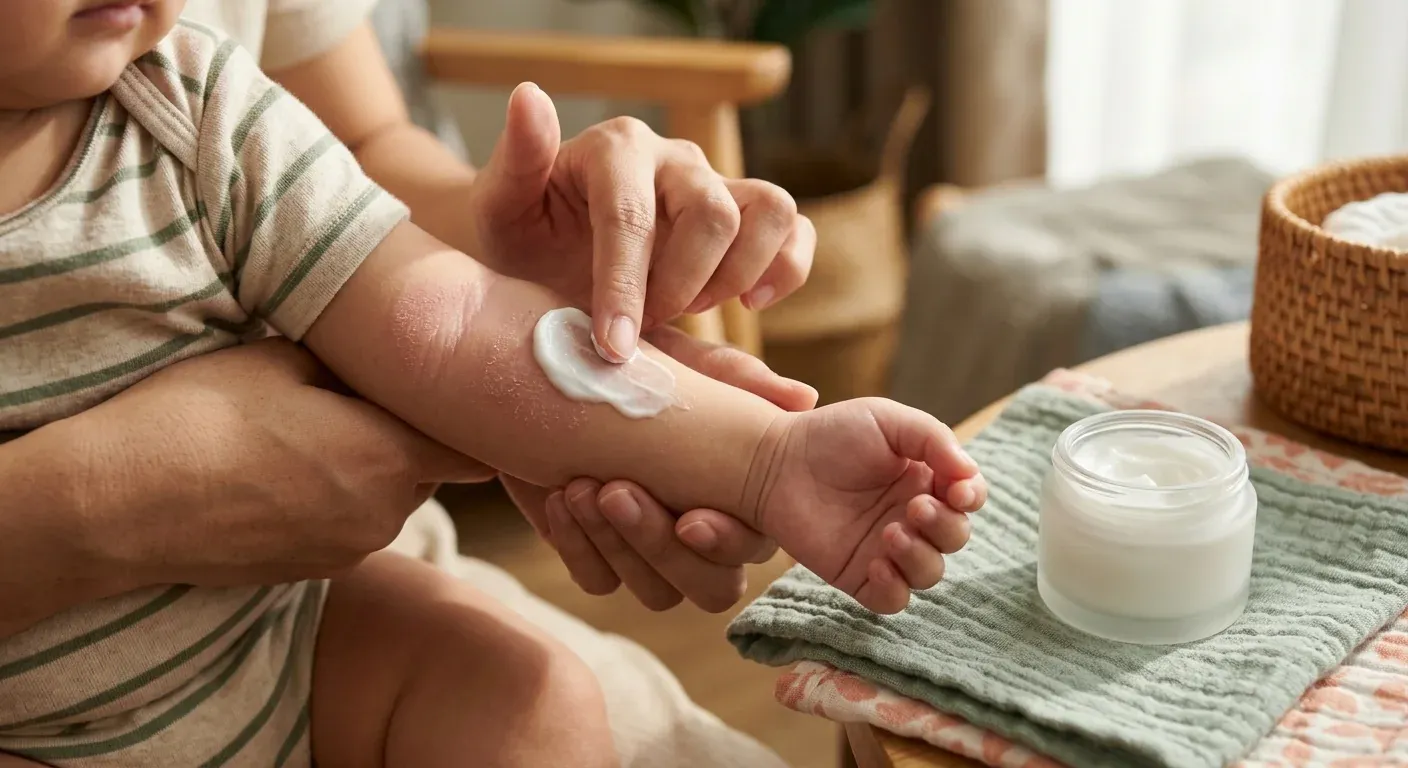
Eczema is a disease of "skin that can't hold water in." The core of treatment is moisturizer, not steroid — apply twice daily, especially within 3 minutes of bathing.
Your child has dry, itchy skin, scratches all night, and the rash comes and goes with the seasons — most likely atopic dermatitis (eczema). Around 10–20% of Thai children get it, and most cases start within the first year of life [5].
The good news: more than 80% of children improve by adolescence [5]. The thing many parents don't know: fear of topical steroids ("steroid phobia" — afraid of "thinning skin") leads to undertreatment, more frequent flares, and worse control over time.
This article distills guidance from AAD [1], AAP [2], NHS [3], [4], and Samitivej Hospital [5] — daily care done right, telling a flare from an infection, and knowing when to see a doctor.
What Is Eczema?
AAP [2]: "Eczema causes dry, red, itchy patches on the skin. Kids with eczema have more sensitive skin than other people."
Eczema is a chronic condition where the skin barrier doesn't work properly. Skin can't hold water in → dries out → develops tiny cracks → irritants and microbes penetrate easily → immune system reacts → itch, swelling, redness.
AAP [2]: many children with eczema "do not have enough of a special protein called 'filaggrin' in the outer layer of skin. Filaggrin helps skin form a strong barrier between the body and the environment." — this is genetic; it isn't the parent's fault.
Hallmarks:
- Severe itch triggers the cycle — child scratches, skin breaks more, itches more (the itch-scratch cycle)
- Dry, cracked NHS [4]: "dry, cracked, crusty, scaly or thickened"
- Comes and goes with seasons and triggers. NHS [4]: "times where your symptoms get worse (called flare-ups) and times where they are better"
Where the Rash Appears — by Age
AAP [2] is clear that distribution changes with age:
Infants (under 2)
"In babies, eczema usually starts on the scalp and face. Red, dry rashes may show up on the cheeks, forehead and around the mouth."
- Cheeks, forehead, around the mouth, scalp
- Can spread to the outer arms and legs
- Usually spares the diaper area (it stays moist there)
- Yellow scaly scalp could be either cradle cap or eczema — see a doctor if unsure
Older children (2 and up)
"In young school-aged children, the eczema rash is often in the elbow creases, on the backs of the knees, on the neck and around the eyes."
- Inside the elbows and knees, neck, around the eyes, wrists, ankles
- Skin can become thicker and darker (lichenification) from chronic scratching
The Core of Treatment = Moisturizer, Not Steroid
This is where Thai parents (and many parents elsewhere) often misunderstand — they think steroid cream is the main medicine. In fact, moisturizer is the foundation; steroids are an adjunct for flares.
The AAD Rule: Twice a Day, Especially After Bath
AAD [1]:
- "For best results, apply moisturizer at least twice a day."
- "Consider choosing a thick cream or ointment." — a thick cream or ointment, not lotion (lotion is mostly water; it evaporates fast and seals nothing).
NHS [3]: "Apply moisturising treatments (emollients) to your skin as often as possible (at least 2 times a day)." — every 2–3 hours is fine if the skin is very dry.
Petroleum Jelly — the Cheapest Thing That Works
AAD [1] recommends petroleum jelly, "an inexpensive, fragrance-free product that works well for many children." Plain Vaseline is a few dollars a tube, fragrance-free, and safe head-to-toe.
Specialty eczema creams (ceramide-based — Cetaphil Restoraderm, CeraVe Baby) work well too but cost more. Vaseline and Aquaphor do the same job.
The "Soak and Seal" Method — Bath → Cream within 3 Minutes
The most effective routine:
- Warm (not hot) bath, 5–10 minutes (no longer). AAD [1]: "Bathe your child in warm — not hot — water" and "Limit your child's time in the bath to 5 or 10 minutes."
- Pat dry gently with a soft towel — don't rub. Leave the skin slightly damp.
- Apply moisturizer immediately within 3 minutes — locks the water in.
- Apply over the whole body, not just the rash — prevents flares elsewhere.
Samitivej [5] agrees: bathe with water at normal temperature, 5–15 minutes, once or twice daily, and apply cream or lotion every time after bathing.
Other AAD Recommendations
- Trim the child's nails short. AAD [1]: "Keep your child's fingernails short and smooth." Scratched skin = broken skin = infection risk.
- Anti-scratch mittens at night for babies. NHS [4]: "keep nails short and put anti-scratch mittens on babies."
- Sensitive-skin laundry detergent. AAD [1]: "Using a laundry detergent made for sensitive skin may be beneficial." Rinse twice; skip fabric softener.
- Soft cotton, tag-free clothes. AAD: "Buy clothes without tags." Tags scratch the neck and back.
- Fragrance-free products. AAD: "Some children do better with fragrance-free products."
The Truth About Topical Steroids — Don't Be Afraid
This is the most important section of this article.
Common misunderstanding: steroid cream "thins the skin" → fear → applied too sparingly → rash never clears → bigger flare → ends up needing stronger medicine.
Reality: skin thinning is caused by high-potency steroids used for long periods (months to years) on thin skin (face, eyelids, skin folds), continuously. Using low-potency hydrocortisone 1% in short courses (5–7 days) under medical/pharmacist guidance is safe for infants and young children.
How to use it correctly:
- Use during flares only — not every day continuously
- Apply a thin layer to red areas, 1–2 times daily
- Stop when the rash clears — taper rather than stopping abruptly
- Face, eyelids, groin = extra caution, ask a doctor first
- Strength, frequency, duration: ask a pharmacist or doctor first. Don't self-prescribe and don't borrow someone else's tube.
Rule of thumb: apply steroid first → then moisturizer over it. Steroid reduces inflammation; moisturizer locks water in. They do different jobs.
Alternative: Non-Steroid Topicals
For sensitive areas (face, eyelids, skin folds) where long-term steroid use is undesirable, topical calcineurin inhibitors (tacrolimus, pimecrolimus) are prescription options. AAD [1] considers them safe in children under medical guidance.
For severe, hard-to-control cases, the biologic injection Dupilumab (Dupixent) is used — only under specialist care, never self-administered.
Triggers to Avoid
NHS [3] lists common triggers: "coming into contact with an allergen or irritant such as soap, washing detergent, pets, some fabrics, pollen, house-dust mites or certain foods," plus "heat or changes in temperature."
In the Thai context:
- Hot, humid weather; sweat — the #1 trigger. Use AC, fans, cool showers after the sweat dries.
- Dust, dust mites — wash bedding in hot water every 1–2 weeks; reduce dust-collecting clutter.
- Harsh soaps, scented detergent — switch to sensitive-skin formulas.
- Wool, scratchy polyester — soft cotton instead.
- Food allergies (not in every child) — talk to a doctor before eliminating foods on your own; don't follow what worked for someone else's child, since unsupervised elimination can cause nutritional gaps.
Eczema and the Atopic March
AAP [2]: "Eczema tends to occur with other allergic conditions such as asthma and allergic rhinitis (hay fever and seasonal allergies). Many children with eczema also have food allergies."
Children with eczema have higher odds of other allergic diseases — the typical sequence:
- Eczema (infancy)
- Food allergies (especially egg, milk, peanut)
- Asthma (preschool)
- Allergic rhinitis (school age)
This is the atopic march — but "my child has eczema, so they will definitely get asthma" is not true. Most children don't progress through the whole sequence.
Good news: in high-risk infants (severe eczema and/or egg allergy), introducing peanut foods at 4–6 months has been shown to substantially reduce later peanut allergy. Talk to your pediatrician first — some infants need allergy testing before. Read more: Starting solids
Flare vs Infection
A typical flare-up:
- Redder, itchier skin for days to weeks
- Usually triggered: heat, sweat, dust, soap change
- Responds to: more moisturizer + prescribed steroid
Signs of bacterial superinfection (impetiginization):
NHS [3]: warning signs are "Blistered, crusty, leaking fluid or has spots filled with pus" or "painful, swollen or feels warm."
- Golden-yellow crust on top of the eczema
- Weeping fluid or pus
- Unusual swelling, redness, warm to the touch
- Fever in the child
→ See a doctor; antibiotics may be prescribed (read more: Impetigo in baby rashes)
🚨 Red Flags — Go to the ER Immediately
Eczema herpeticum — herpes simplex virus (HSV) infecting eczematous skin — is an emergency:
- Small clear blisters appearing rapidly in clusters
- Painful (ordinary eczema itches but doesn't usually hurt sharply)
- High fever, lethargy, poor feeding
- Blisters break into round "punched-out" sores within days
→ Go to the ER now. Requires systemic antiviral medication (acyclovir), oral or IV. Don't wait until morning.
Other emergencies:
- Bacterial superinfection + high fever + lethargy
- Rash spreading rapidly all over the body within hours
When to See a Pediatric Dermatologist
Not an emergency, but worth booking if:
- The rash hasn't improved in 2–4 weeks of basic care (moisturizer + prescribed low-potency steroid)
- Frequent flares more than once a month
- Repeated infections
- The child can't sleep because of itching — affecting growth and development
- Suspected food allergy (rash flares after specific foods)
A specialist can help with:
- Refining medication (e.g., calcineurin inhibitor on the face instead of steroid)
- Wet wrap therapy (damp gauze layer over moisturizer) for severe flares — under supervision only
- Allergy testing
- In severe cases: dupilumab or other biologics
Summary
- Eczema is a skin barrier disease that can't hold water in — not the parent's fault, and tends to improve with age (>80% improve by adolescence) [5]
- Moisturizer = the core of treatment. Twice daily, especially within 3 minutes of bathing. Use a thick cream or ointment, not lotion. Petroleum jelly is cheap and effective [1]
- Warm baths, 5–10 minutes — not long, not hot. Mild soap or no soap during heavy flares [1]
- Don't fear doctor-prescribed steroids — low-potency hydrocortisone 1% used short-term during flares is safe for children. "Steroid phobia" causes undertreatment.
- Avoid triggers — sweat, heat, dust mites, harsh soaps, scented detergents, scratchy fabrics
- Atopic march — eczema kids have higher odds of food allergy / asthma / rhinitis, but not all do. In high-risk infants, introduce peanuts at 4–6 months (talk to your pediatrician first).
- 🚨 ER right now: eczema herpeticum (cluster of clear blisters + fever + pain), bacterial infection + high fever, rapidly spreading whole-body rash
- Pediatric dermatologist if no improvement in 2–4 weeks, frequent flares, repeated infections, or sleep disruption