
Thailand's First-Month Ceremony (Tham Khwan Duean): A Modern Family's Guide
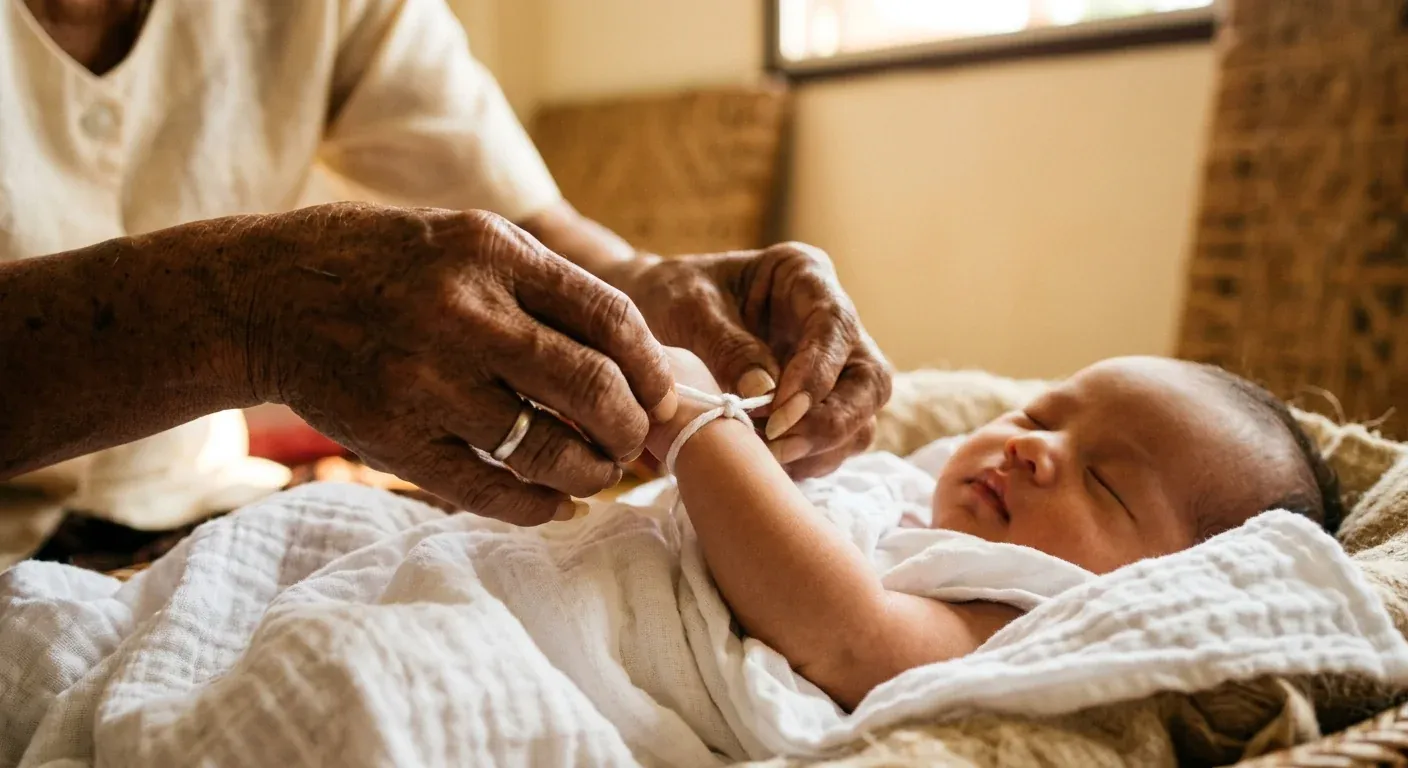
Tham Khwan Duean is not just a ritual — it is the moment a family collectively affirms: this child is ours. You choose how to make that affirmation. That is your right as a parent.
After the postpartum confinement period (อยู่ไฟ, yu fai), when the mother is beginning to recover and the newborn is learning to recognise faces in the household, many Thai families begin asking: "Should we do the first-month ceremony?" — and the harder question follows: do we follow tradition strictly or adapt it? Do we invite monks? Is the hair shaving necessary? Our parents want a large ceremony but we want something quiet — how do we navigate that?
This article draws on documented traditional practice of the ทำขวัญเดือน (Tham Khwan Duean) ceremony within the Thai Buddhist tradition [1] alongside postpartum health context from the Thai Department of Health [2], to help modern families plan a ceremony that feels right for their own household — whether that household is deeply traditional or prefers to adapt.
What Tham Khwan Duean Is: The Traditional Structure and Its Meaning
ทำขวัญเดือน (Tham Khwan Duean) is the first formal ceremony of a newborn's life in Thai society, typically held when the child reaches approximately 30 days of age. It is an announcement to family, community, and the spiritual realm that this baby has arrived, has a name, has a place, and has people who take responsibility for their wellbeing. The traditional practice [1] includes the following components:
โกนผมไฟ — Fetal hair shaving The hair present on the newborn's head since before birth is called ผมไฟ (phom fai — "fire hair"). In the Thai Buddhist-Brahmin belief tradition, shaving this hair away symbolises a new beginning: severing the connection with a previous existence and opening the way for new growth. The shaved hair is traditionally preserved in a cloth or pillow as a protective keepsake.
พระสวด — Monk blessing (chanting) Buddhist monks are invited to chant prayers and offer blessings, representing the family's act of merit-making (ทำบุญ) on the child's behalf and expressing gratitude to protective spiritual forces. The number of monks invited varies by region and family preference.
สายสิญจน์ / ผูกข้อมือ — Blessed-string wrist-tying White string (สายสิญจน์) that has been consecrated through monk chanting is tied around the newborn's wrist for protection and good fortune. Elder family members pass the string along — a moment that is the visual heart of the ceremony: a grandmother's hands gently tying the white thread around a tiny newborn wrist, multi-generational continuity in a single gesture.
ตั้งชื่อตามฤกษ์ — Auspicious naming The formal Thai name is determined by a monk or astrologer according to auspicious timing and the day of birth. Traditional Thai naming uses leading consonants that correspond to the birth day of the week [1]:
| Day of birth | Leading consonant group (examples) |
|---|---|
| Sunday | ส, ร, ว... |
| Monday | ง, ย, ป... |
| Tuesday | ก, ข, ค... |
| Wednesday | พ, ฟ, ม... |
| Thursday | ต, ถ, ท... |
| Friday | จ, ฉ, ช... |
| Saturday | น, อ, ล... |
In modern practice, many families choose preferred names in advance and then ask a monk or astrologer to identify an auspicious timing for announcing that name, rather than having the name determined entirely by others.
จับฉลาก / เลือกของ — Symbolic item ritual Objects are arranged before the baby — a book (wisdom), coins (prosperity), a cloth (beauty), a pen (scholarship) — and the child's apparent interest "predicts" their future inclinations. This component has no fixed religious meaning but is often the most enjoyed part of the ceremony by both children and adults.
เลี้ยงอาหาร — Community feast Food is served to all who attend as an expression of gratitude and welcome of the new child into the community.
Regional variations
Traditional practice [1] varies across Thailand's regions:
- Central Thailand: The core structure described above, with emphasis on monk chanting and blessed string
- Northern Thailand (Lanna): Strong merit-making emphasis; some areas include a บายศรี (bai sri) wrist-tying ceremony with elaborate flower arrangements
- Northeastern Thailand (Isan): Incorporates a Brahmin-influenced "calling the spirit home" (สู่ขวัญ) ritual
- Southern Thailand: In Muslim-majority areas, the equivalent ceremony is the aqiqah (อะกีเกาะฮ์), discussed below
What Matters, What Can Be Adapted
This is the heart of the article: modern Tham Khwan Duean does not mean doing every component — or none at all. The meaning lives in intentional choice.
What carries significant cultural weight (recommended to preserve in some form):
- The naming — whether through a monk, astrologer, or a family announcement, this is the moment the child receives a formal identity
- Family gathering — the essential substance of the ceremony is that the elder generation shows up and receives this child
- A blessing — in any form appropriate to the family's spiritual life: monk chanting, personal prayer, a parallel ceremony from another tradition
What can be adapted without losing the meaning:
- Hair shaving — many modern families skip this (the baby's hair may be very fine) or cut only one symbolic strand rather than shaving the entire head
- The date — the traditional 30 days is a guideline; many modern families hold the ceremony at 1–3 months when the mother has recovered and family scheduling is more feasible
- Monk involvement vs. family blessing — families who observe Buddhism as cultural heritage rather than strict religious practice may choose a quieter home ceremony with elder family members offering blessings
- Location — at home, at the family temple, or at a hotel for large extended-family gatherings; all are valid
- Scale — 10–15 close family members or 50 guests; the meaning does not scale with headcount
The key principle: choosing deliberately what to do and why is itself the ritual. A family that holds a simple ceremony with full intention has more meaning than one that follows every step without knowing why.
The Naming Ceremony: More Than Just Auspicious Timing
The ตั้งชื่อตามฤกษ์ (naming by auspicious timing) component generates the most discussion in modern Thai families. Here are the approaches most commonly in practice today:
Traditional: An astrologer or senior monk determines the name entirely, based on birth stars and birth day. The name will carry Pali-Sanskrit meaning and conform to the leading-consonant system for the day.
Hybrid (most common today): Parents prepare a shortlist of 2–3 names they like, then ask a monk or astrologer to determine an auspicious timing for the announcement — or to select the numerologically strongest name from the list.
Contemporary: Parents choose the name themselves based on meaning, aesthetics, ease of pronunciation, and suitability with the family name. A monk's blessing is sought at the ceremony without transferring naming authority.
Practical notes:
- The legal name (registered at the district office) and the nickname (ชื่อเล่น, chue len) are separate. Thai children typically carry a nickname used in daily life that parents choose freely.
- Legal birth registration must be completed within 15 days of birth — separate from and independent of the Tham Khwan Duean ceremony.
- Bilingual names (Thai + English) are normal in mixed-heritage families or families raising children in bilingual environments.
Practical Preparation: What to Do and When
2–3 weeks before the ceremony
- Contact the temple to invite monks, specifying the number required and type of ceremony. Most mid-to-large temples need at least two weeks' notice. Ask the temple directly for the list of items to prepare — a standard list typically includes: flowers, incense, candles, blessed water, and areca-nut offering sets (ขันหมาก)
- Choose a date that balances auspiciousness with family availability. If you must choose, prioritise a date when out-of-town grandparents can attend and the mother is not exhausted. An auspicious date without the people who matter misses the point.
- Consult an astrologer (if desired) for naming timing or name selection
1 week before
- Prepare ceremony items per the temple's list, plus any objects for the symbolic-item ritual if you are including it
- Arrange food: if monks are present, food offered to monks must be vegetarian (พระฉัน); food for other guests can be anything you choose
- Notify guests: a LINE group message, printed invitation, or phone call are all appropriate
On the day
- Ask the monks about photography before taking photos: some monks prefer not to be photographed during chanting. Asking first is the right etiquette.
- Hair shaving: have someone with experience perform this (a grandmother, aunt, or temple staff). If you are preserving the hair, have a small white cloth or box ready.
- Wrist-tying: invite elder family members to be the ones who tie the sacred string. Giving grandparents this specific role ensures they are genuinely part of the ceremony rather than observers.
Every Family Form Can Do a Meaningful Tham Khwan Duean
Traditional Thai Buddhist family: Follow the framework described above, adjusted to your region and preferred scale.
Thai-Chinese family: Combining incense and red envelopes (แต๊ะเอีย) with Buddhist ceremony components is a long-established practice with no contradiction.
Thai-Muslim family: The equivalent ceremony is the อะกีเกาะฮ์ (aqiqah), typically held on day 7 or 14 after birth. It involves the sacrifice of a goat or sheep, distribution of meat to the community, and formal announcement of the child's name. Aqiqah carries its own full religious significance within Islamic practice and is entirely distinct from the Buddhist-tradition Tham Khwan Duean.
Thai-Christian family: Many families hold a Dedication ceremony at church, which serves the same function in that spiritual framework.
Mixed Thai-foreign family: Tham Khwan Duean is a natural opportunity to introduce Thai culture to non-Thai family members. Many couples opt for a smaller ceremony focused on explaining the meaning of each component, rather than following every procedural step.
Single-parent or same-sex parent families: Every family form can hold a meaningful ceremony. The gathering of family and an expression of blessing are accessible to all family structures, regardless of household composition. Every Thai family deserves to welcome their child in a way that feels true.
Managing Multi-Generational Expectations
This is often the most practically difficult part. Grandparents may have a clear picture in their minds — a full-scale ceremony, monks, complete hair shaving, many guests. Parents may want something different.
Approaches that work:
Talk before the event, not during it. Negotiations during planning leave time to adjust. Negotiations on the day create tension for everyone.
Be specific about what matters to you as parents. "We want to keep the wrist-tying because it has deep meaning for our family. We're skipping the hair shaving because the baby's hair is very fine and we're worried about injury." — Direct, warm, and not a judgment of the older generation's approach.
Give grandparents a role with genuine significance. Rather than cutting them out of an adapted ceremony, ask them to be the ones who tie the sacred string, choose the symbolic items for the prediction ritual, or offer the spoken blessing in front of the guests. These roles carry more meaning than observing from across the room.
Frame adaptations as additions, not subtractions. Instead of "we're not doing that part," try "we want this part of the ceremony to have special meaning for our family."
Document the day. Photographs and video (ask permission before filming monks) can be shared with family members who could not attend, and become keepsakes for the child in years to come.
Scale and Cost
Meaning does not scale with budget. A home ceremony with close family and simple offerings is no less meaningful than a large hotel event. Spiritual significance does not multiply with guest count or production scale.
Scale options:
- Small home ceremony: 10–20 close family members, 1–3 monks — manageable, intimate, full of meaning
- Temple ceremony: using temple space, 20–40 guests — often more affordable than renting another venue
- Hotel event: for families who want catering and space handled, or who are hosting large extended-family gatherings from out of town; higher cost but significantly reduced logistics burden for the host family
Remember: a small ceremony where the mother is present and not exhausted is worth more than a large ceremony followed by a week of recovery.
Summary
Tham Khwan Duean is the first time a Thai family tells the world: "This child is ours." Whether held large or small, strict or adapted, devoutly Buddhist or culturally observed — what endures is the gathering, the blessing, and the child receiving their name and their place in the family.
Key points:
- The traditional structure (hair shaving, monk blessing, wrist-tying, naming, symbolic items, feast) is a framework, not a requirement — choose the components that have meaning for your family
- 30 days is the traditional guideline; 1–3 months is accepted in modern families when maternal recovery and family scheduling warrant it
- The wrist-tying is the heart of the ceremony — a grandmother's hands tying the white string around her grandchild's tiny wrist is the multi-generational image that needs no explanation
- Naming has many valid forms, from full astrologer determination to parents choosing and seeking a blessing; all are legitimate
- Talk to grandparents before the day — open the conversation during planning, give them a meaningful role in the adapted ceremony
- Every family form — Buddhist, Muslim, Christian, mixed-heritage, single-parent, same-sex — can hold a ceremony that is honest to who they are
- Budget does not determine meaning — a small, intentional ceremony outweighs a large one where no one knows what they are celebrating
For postpartum recovery context that affects ceremony planning, see lifestyle/postpartum-customs-thai. For caring for your newborn at the one-month stage, see baby/month-1 and baby/month-2.
แหล่งอ้างอิง
- Department of Religious Affairs, Ministry of Culture Thailand — Thai traditional practices, life-cycle ceremonies (traditional knowledge reference — dra.go.th, browser-accessible)
- Department of Health, Ministry of Public Health Thailand (กรมอนามัย) — Maternal and Child Health