
Preschool in Thailand: A Complete Guide to the School System and How to Choose
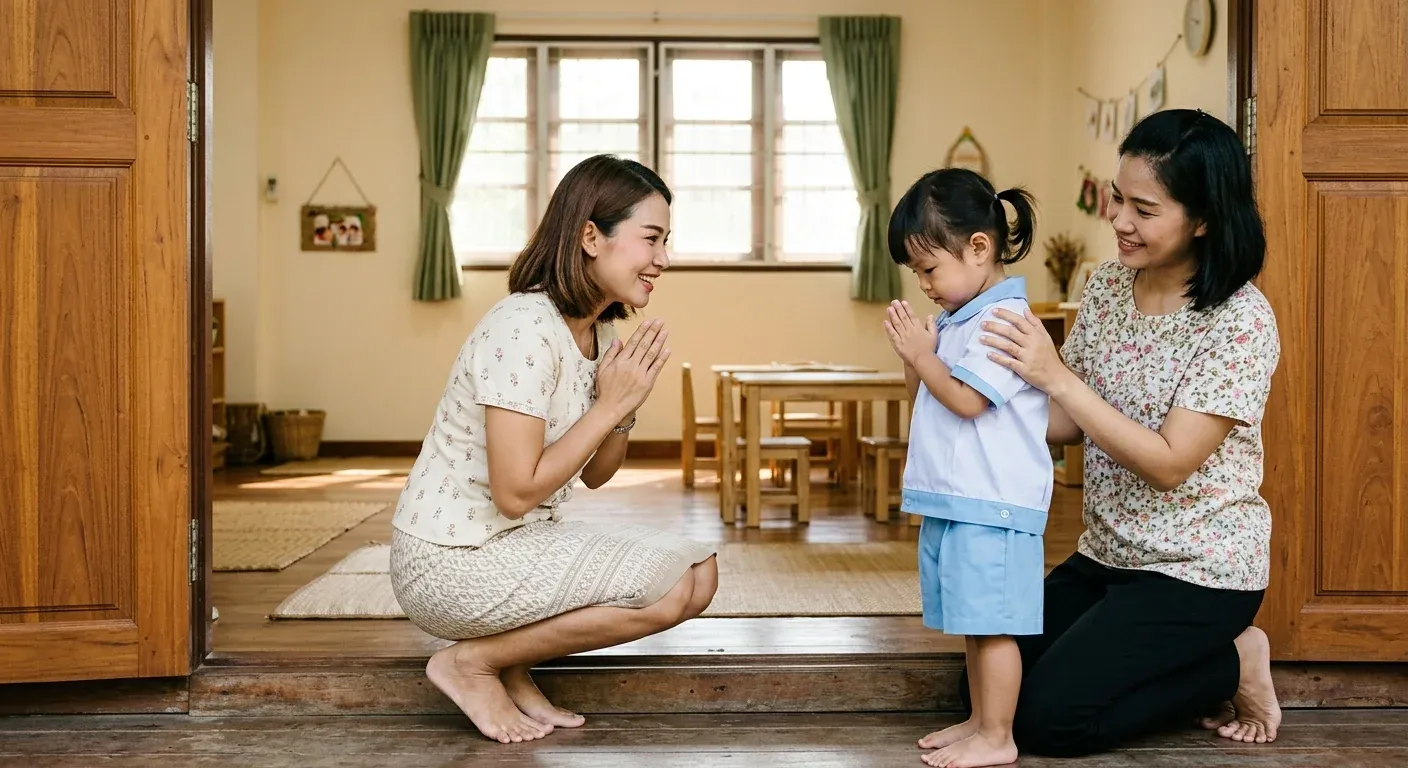
The right school for your child is not the best-ranked school in the city — it is the school that fits this child, this family, and your daily life.
Many parents in Thailand begin searching for kindergarten options feeling overwhelmed. Multiple school types, multiple curricula, wide price ranges, and conflicting advice all compete for attention. This article works as a map: it explains what the system is, how each level differs, what options exist, and how to visit a school and get the information that actually matters.
This article explains the Thai preschool system. For the separate question of whether your child is developmentally ready to start, see Daycare Readiness.
The Thai Early Childhood System: From Nursery to Kindergarten 3
Before deciding, it helps to know exactly what each level is.
Nursery (เนิร์สเซอรี่) — approximately 6 months to 2 years
Care-focused, not instruction-focused. Mostly private, commercially operated. The teacher's role is primarily to ensure safety and meet basic needs, not to teach structured lessons. At this age, the quality of attachment to primary caregivers matters more than any formal learning environment.
Pre-Kindergarten / เตรียมอนุบาล — approximately 2–3 years
The bridge between home or nursery care and a structured classroom. Activity blocks are introduced, basic group routines practiced (snack time, tidy-up, transitions). Mostly private (fees apply, varying widely by school and location).
Kindergarten 1, 2, 3 / อนุบาล 1, 2, 3 — approximately 3–6 years
Under Thailand's compulsory education law, public-school Kindergarten 1–3 is free. All three years follow a Ministry of Education curriculum. Private schools at this level offer wider curriculum variety. The kindergarten years form the foundational platform before primary school.
Primary 1–6 (ประถมศึกษา 1–6) — approximately 6–12 years
The next stage, beyond this article's scope — but worth noting that kindergarten selection often affects access to feeder primary schools in the same network.
Public vs Private: What Thai Parents Need to Understand
This is the central decision for most families.
Public Schools (โรงเรียนรัฐบาล)
- Free from Kindergarten 1 (around age 3) — under the Basic Education Act
- Ministry of Education curriculum, Thai-language primary
- Larger class sizes (typically 30–40 students per room)
- Enrollment based on ทะเบียนบ้าน (house registration) — children are assigned to the school in their registered address district, meaning the neighborhood public school is the system's default
- Quality varies considerably by district — a public school in a well-resourced area may outperform some private schools; do not judge by signage or name
Private Schools (โรงเรียนเอกชน)
- Tuition applies — costs vary enormously by type and location; do not quote or expect a single number here
- Multiple curriculum options (see next section)
- Smaller class sizes (typically 15–25 students per room)
- Not tied to house registration — apply to any school that accepts applications
- Sub-types:
Catholic schools (โรงเรียนคาทอลิก) — established history in Thailand, often academically regarded, religious instruction is part of the curriculum
Christian schools (โรงเรียนคริสเตียน) — values and community grounded in Christian faith
Buddhist temple schools (โรงเรียนวัด) — some temples operate schools with a Buddhist framework; typically lower-cost than mainstream private schools, with religious activities on the schedule
International schools — premium tier using foreign curricula (IB, British, American, Singapore, Japanese). Designed for internationally mobile families or those planning overseas higher education
Bilingual / EP / IP / MEP schools — middle tier: Thai private schools offering English programs in varying immersion ratios. EP (English Program) is heavily English; IP (International Program) similar; MEP (Mini English Program) approximately 50/50
Alternative pedagogy schools — Waldorf, Montessori, Reggio Emilia — small specialist tier, growing in major cities
Curriculum Approaches: Understanding Before Choosing
Curriculum names circulate widely but are not always understood accurately.
Traditional Thai (ระบบไทยดั้งเดิม) — academic, structured, teacher-led group instruction, prepares for examinations and the mainstream Thai education ladder. Suited to families who want continuity with the standard Thai system.
Montessori (มอนเตสซอรี) — child-led learning, mixed-age classrooms, specially designed materials for each developmental domain, freedom of activity within a structured prepared environment. The teacher is a "guide," not a front-of-room instructor [3].
Reggio Emilia (เรกจิโอ เอมิเลีย) — project-based, child as co-constructor of knowledge, the environment (classroom, school, materials) is treated as the "third teacher." Emphasis on expression, creativity, and collaborative inquiry.
Waldorf / Steiner (วอลดอร์ฟ/สไตเนอร์) — rhythmic, nature-based, late introduction of formal academics, emphasis on music, art, and craft, screen-free environment. Suited to families who value an unhurried childhood.
Play-based learning (การเรียนรู้ผ่านการเล่น) — academic content delivered through structured play. Child development researchers consistently support this approach in early childhood [1]. The AAP describes preschool-age children as developing core social and cognitive skills through play with peers — not through front-loaded academic instruction.
Bilingual (สองภาษา) — Thai and English in varying ratios. Bilingual exposure in early childhood has documented benefits, but research on outcomes is mixed and depends heavily on quality. What is clear: strong Thai literacy is foundational; early-English-only environments can disadvantage Thai fluency if not carefully balanced.
The Thai Academic Calendar: Timing That Matters
The Thai academic year typically opens in May and ends around March of the following year.
Key windows:
- November–March: most private schools open applications for the following May start
- March–April: final application window for most private schools; public-school registration opens
- Mid-March to early May: school break
- Songkran (mid-April): major public holiday
- October: short mid-year break
Timing note: If you are reading this in January–February, this is the optimal window for visiting schools — most still have spots available, but popular schools may already be filling. If you are reading in March–April, you are at the last application window; contact schools without delay.
Seven Factors for Choosing the Right School
There is no single "best" school for every family. There is a framework for thinking clearly about the choice.
1. Geography — Always First
Daily commute time for a 3-year-old is not trivial. A school that requires 60 minutes of car travel each morning is a different commitment than one that is 15 minutes away, regardless of its academic reputation. Aim for under 30 minutes of travel if possible.
2. Real, Multi-Year Budget
Private school is a multi-year financial commitment. Calculate the full path from Kindergarten 1 through Mathayom 6 (Year 12) before committing to a school tier. Include not just tuition but also activity fees, uniforms, books, and meals. The ability to sustain the commitment through the full school journey matters more than the first year's costs.
3. Your Child's Temperament
A high-energy child needs outdoor space and physical movement. A quieter child may thrive in a smaller-group, more structured environment. A child with strong particular interests may benefit from specific pedagogical approaches more than others.
4. Language Priority
Strong Thai literacy is a foundational skill. Early English exposure has value, but be cautious of schools that so heavily prioritize English that Thai fluency is underdeveloped. The developing brain can learn multiple languages simultaneously — but needs quality exposure to each. Bilingual research is mixed; the safest position is that both languages deserve genuine support.
5. Educational Philosophy
Academic-rigor vs play-based vs alternative — choose what aligns with your family's values, not what is currently fashionable. Child development researchers have a clear consensus: a strong social-emotional foundation in early childhood produces better long-term outcomes than academic-pushed early learning [1] [2].
6. Cultural and Religious Alignment
Religious schools (Catholic, Christian, Buddhist temple) have religious activities embedded in the school day. The choice should match your family's beliefs. International schools often use an instruction language that parents are not fluent in — which can make meaningful engagement in your child's school life harder.
7. Feeder School Network and Educational Trajectory
Many schools feed into specific primary and secondary networks. Choosing a kindergarten may effectively be planning several subsequent school years. Ask where the school's graduates typically go next.
How to Visit a School: What to Observe and Ask
Visit during operating hours — not a staged Open House day. See real children in real classrooms.
Staff-to-Child Ratio [4]
The AAP recommends that for children aged 13–35 months, one trained caregiver should oversee no more than 4 children, and no more than 8 children in this age band should share one room. As children get older ratios can flex somewhat — but a room of 40 three-year-olds with 2 teachers tells you something important before you decide.
Teacher–Child Interaction
Watch how teachers speak with children. Is there warmth? Eye contact? Do teachers get down to the child's physical level? Fifteen minutes of genuine observation tells you more than a full brochure.
Outdoor Play Space
Many Bangkok-area schools lack adequate outdoor play areas. If your child needs physical movement and outdoor time, treat this as a deciding factor.
Bathrooms and Hygiene
Are toilets child-height and accessible without help? Clean? Is there a handwashing station at child height? These reflect the operational standard of care.
Lunch Programme
Cooked on-site or catered externally? Is there allergen awareness? Ask to see an actual sample menu, not the website photo.
Discipline Policy
Ask directly how teachers handle tantrums and conflict between children. Physical discipline is not completely prohibited in all private schools in Thailand — ask the school explicitly whether their policy prohibits it in all circumstances [4]. The answer should be unambiguous.
Sick-Child Policy
At what threshold does the school call for immediate pickup (fever above 38.5°C? vomiting? rash)? What is the communication channel during the school day? Is there a clear stay-home policy to protect the group?
Parent Communication
Daily reports, photos, or an app? Can you request a conversation with the teacher when you have a concern? Are teachers genuinely open to parent questions, or does the culture discourage them?
Safety and Emergency Procedures
What are the drop-off and pick-up protocols? Is there an authorized-caregiver list? What is the emergency plan?
Religious Instruction
For religious schools: is instruction mandatory? Is there an opt-out option? What does it cover?
Thai School Culture: What Parents Should Know
Wai Khru (ไหว้ครู) — The Teacher-Respect Ceremony
The Wai Khru ceremony is a feature of Thai schools — public, private, and international schools operating in Thailand alike. Near the start of each academic year, children and families bring floral arrangements to present to their teachers. The flowers carry traditional symbolic meanings: eggplant flowers (ดอกมะเขือ — humility), dwarf grass (หญ้าแพรก — resilience), ixora flowers (ดอกเข็ม — sharp mind), popped rice (ข้าวตอก — blooming potential).
For families new to Thailand, this ceremony can feel unfamiliar. Explain it to your child in advance and practice the wai gesture at home before the ceremony. A child who understands what is about to happen goes into the ceremony with confidence rather than confusion. The Wai Khru reflects the relational respect structure that is foundational to Thai school culture.
Grandparent Involvement
Thai families frequently rely on grandparents for pick-up and drop-off. Most schools are flexible about this, but the arrangement should be formally registered with the school and the grandparent added to the authorized-caregiver list. Some schools host "Grandparent Days" — classroom visits specifically designed for extended family.
Religious and Merit-Making Activities
Buddhist schools: morning meditation, monk visits, merit-making days (ทำบุญ) Catholic schools: daily prayer, religious instruction, Catholic calendar observances Secular schools: most still observe Thai public holidays and national ceremonies; overt religious instruction is typically absent
Choose alignment with your family's values and practice.
Addressing Common Misconceptions Directly
International School ≠ Automatically Best
International schools are genuinely the right choice for some families: those planning overseas study, internationally mobile expat families, or families specifically seeking an IB curriculum throughout. For Thai families planning to remain in Thailand long-term, however, a strong EP/IP bilingual school may serve the child better — it preserves Thai literacy, integrates the child into the Thai social environment, and costs considerably less. "International" is a tier, not a quality grade.
Premature Academic Pressure
Some parents worry that their 3-year-old needs to start reading, writing, or doing arithmetic to "keep up." Child development research is consistent here: children who receive a strong social and emotional foundation in early childhood produce better long-term academic and personal outcomes than children whose early years were academically accelerated [1] [2]. Play is not the opposite of learning at this age — it is the mechanism of learning.
Public School ≠ Lower Quality by Default
The assumption that public school is always lower quality than private is not reliable. A well-resourced public school with strong leadership can equal or exceed some private schools. The only way to know is to visit.
Summary
- Know the system first: Nursery (~6mo–2yr) → Pre-Kindergarten / เตรียมอนุบาล (~2–3yr) → Kindergarten 1-3 / อนุบาล 1-3 (~3–6yr) → Primary — each level has a different purpose
- Public Kindergarten 1–3 is free: Under the Basic Education Act, public kindergarten is available to every Thai family — a genuinely viable option
- Geography comes first: Daily travel time affects the child's daily experience more than the school's ranking
- Budget the full journey, not just year one: Sustained commitment matters more than the first enrolment
- Curriculum is a values match: Traditional Thai, Montessori, Waldorf, Reggio, bilingual — none is universally best; all have contexts where they thrive
- Visit during real school hours: Watch the actual teacher–child dynamic; do not decide from brochures or Open House presentations
- Ask directly about discipline: Including whether physical discipline is explicitly prohibited
- Wai Khru is part of school life: Explain and practice in advance so your child arrives confident
- International school is not the default best option: Right for some families, not all
For assessing whether your child is developmentally ready to start school, see Daycare Readiness. For managing the separation anxiety that can accompany the first weeks of school, see Separation Anxiety in Toddlers.
แหล่งอ้างอิง
- AAP HealthyChildren — Social Development in Preschoolers (social-emotional development, cooperative play, conflict resolution at preschool age)
- AAP HealthyChildren — Preschool Hub (developmental milestones and early childhood education overview)
- AAP HealthyChildren — Why Quality Matters in Early Child Care & Preschool (staff-to-child ratios, group size limits, staff stability, health consultant access)
- AAP HealthyChildren — Choosing a Child Care Center (evaluation criteria: ratios, staff qualifications, discipline policy, sick-child policy, parent communication)
- กรมอนามัย กระทรวงสาธารณสุข — Maternal and Child Health resources
- ราชวิทยาลัยกุมารแพทย์แห่งประเทศไทย (Thai Pediatric Society)