
Optional Vaccines for Children in Thailand: What to Prioritise and Where to Get Them
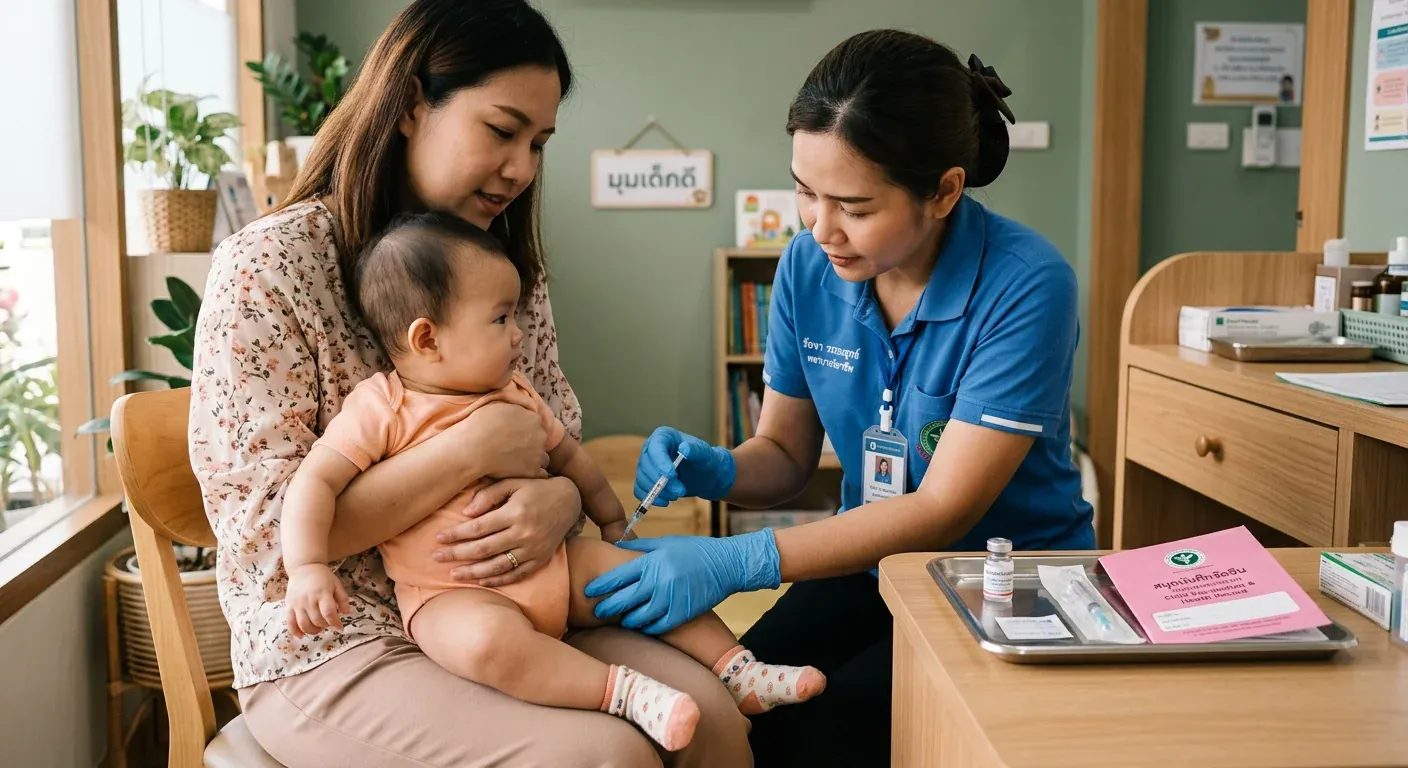
Optional does not mean unimportant The EPI schedule is the "minimum the government funds" — not the medical ceiling for protecting your child
Thailand's free EPI (Expanded Programme on Immunization) vaccines cover the most dangerous diseases at the most vulnerable ages, and that is genuinely excellent. But EPI vaccines are designed within a national budget constraint — not around what is medically ideal for every individual child.
The Royal College of Pediatricians of Thailand (TPS) recommends several vaccines that are not yet included in EPI, or are only partially covered [1]. WHO and CDC support these vaccines in the international evidence base [2][3].
This guide helps parents understand: what optional vaccines are, how they differ from EPI, which ones to prioritise first, and where to access them in Thailand — without confusion from conflicting online sources.
EPI vaccines vs optional vaccines — what's the difference?
| Feature | EPI (basic) vaccines | Optional (supplementary) vaccines |
|---|---|---|
| Cost | Free for all Thai children | Out-of-pocket (some NHSO-covered) |
| Where to get | Public hospitals / health centres | Private hospitals, paediatric clinics |
| Who decides | Ministry of Public Health (EPI) | Thai Pediatric Society (TPS) recommends |
| Selection basis | National budget + highest-burden diseases | Medical evidence + Thailand disease burden |
The key point: a vaccine not in the EPI is not "unimportant" — it means the government has not yet budgeted for it. Rotavirus vaccine is a good example: it was recommended by TPS for years before being added to the free EPI program in 2020 [1].
Currently the NHSO (National Health Security Office) covers some vaccines that were previously "optional" — check current entitlements at NHSO hotline 1330 or nhso.go.th [4].
Optional vaccines recommended by the Thai Pediatric Society
The vaccines below are grouped by priority, based on Thailand's disease burden, vaccine efficacy, and TPS guidelines [1]:
Group 1 — Highly recommended: diseases still active in Thailand with strong protection
PCV — Pneumococcal Conjugate Vaccine
Diseases prevented: pneumonia, meningitis, and bacteraemia caused by Streptococcus pneumoniae (pneumococcal bacteria)
- Schedule: 3 doses at 2, 4, 6 months + booster at 12–15 months (4 doses total)
- Brand: PCV13 (Prevenar 13) or PCV15 — discuss with your paediatrician
- Cost: varies by hospital — contact the clinic before booking
- NHSO coverage: not generally included in Universal Coverage — verify with NHSO 1330
Why it matters: Pneumonia is one of the leading causes of death in children under 5 worldwide, and Thailand still sees significant pneumococcal disease in young children [2].
Influenza (flu) vaccine — annual
Diseases prevented: seasonal influenza (types A and B) and serious complications in young children
- Eligible from: 6 months of age
- Schedule: once a year (first year: 2 doses, 1 month apart)
- Cost: varies by hospital — contact the clinic before booking
- NHSO coverage: partially covered for children 6 months–2 years in some budget years — verify current entitlement
Why it matters: WHO identifies children under 5 as a high-risk group for influenza-related lower respiratory deaths, and notes that 99% of these deaths in children under 5 occur in developing countries [2]. Thailand has an annual influenza season, especially during the rainy months.
Hepatitis A
Diseases prevented: Hepatitis A virus — spread via contaminated food and water
- Schedule: 2 doses, 6–12 months apart, starting at 12 months of age
- Cost: varies by hospital — contact the clinic before booking
- NHSO coverage: not generally included
Why it matters: The CDC recommends hepatitis A vaccination for all children at 12–23 months as part of the routine childhood schedule [3]. In Thailand, where street food and seafood consumption are common, the exposure risk is higher than in countries with uniformly treated water supplies.
Group 2 — Recommended: worth considering
Varicella (chickenpox)
Diseases prevented: chickenpox caused by varicella-zoster virus
- Schedule: 2 doses — first at 12–15 months, second at 4–6 years
- Cost: varies by hospital — contact the clinic before booking
- NHSO coverage: partially covered in some budget years — verify current entitlement
Why it matters: Chickenpox in young children can be more serious than commonly assumed. Complications include bacterial skin superinfection, pneumonia, and encephalitis. A 2-dose vaccine series provides strong protection.
HPV-9 vaccine for boys
Diseases prevented: cancers caused by Human Papillomavirus (mouth, throat, genital) and genital warts
- EPI status: Thai girls receive free HPV vaccine through EPI (from Grade 5 onward) — boys remain on the optional list
- Schedule: 9–14 years: 2 doses 6–12 months apart / 15 years and older: 3 doses
- WHO position: Girls 9–14 are the primary target; WHO acknowledges that many countries have chosen to vaccinate both sexes to further reduce community HPV prevalence [2]
Group 3 — Situational: based on risk profile or travel
Dengue vaccine (Qdenga / TAK-003)
Diseases prevented: dengue fever (all 4 serotypes)
- WHO recommendation: ages 6–16 years in high-transmission settings [2]
- Status in Thailand: Qdenga is licensed in some countries; TPS is evaluating its formal position — consult your paediatrician before deciding (see note below)
- Cost: varies by hospital — contact the clinic before booking
Note on dengue vaccine: WHO currently recommends Qdenga only in high-transmission settings for ages 6–16, without a pre-vaccination serostatus test requirement [2]. However, TPS's specific position for Thailand may differ. Consult your paediatrician for an individual risk-benefit assessment — this is not a one-size-fits-all decision.
Japanese Encephalitis (JE) booster
- JE doses 1 and 2 are in the EPI and free for children in at-risk regions
- Some paediatricians recommend an additional booster for children in rural areas or near rice paddies
Meningococcal vaccine (MCV4)
- Recommended for children travelling internationally, living in dormitories, or in outbreak areas
- Not routinely needed for Thai children with no specific risk factors
Typhoid / cholera vaccines
- Recommended for travel to high-risk areas only — not for the general Thai child population
Rotavirus — now part of free EPI
Rotavirus vaccine is a good example of "optional" becoming standard:
- Rotavirus vaccine is now in the free EPI for all Thai children, added in 2020 [1][4]
- WHO recommends rotavirus vaccine inclusion in all national immunisation programs, with priority given to South and Southeast Asia [2]
- EPI schedule: RV1 (Rotarix) 2 doses at 2 and 4 months, or RV5 (RotaTeq) 3 doses at 2, 4, 6 months
- First dose must be given before 15 weeks of age; series must be complete before 8 months [2]
If your child has not received rotavirus vaccine: ask your paediatrician immediately — there is a strict age window for eligibility.
Decision framework for parents
Not every family needs every optional vaccine. Here are the questions that help:
Ask yourself:
- Disease burden in Thailand — is this disease still circulating in Thailand? (PCV, influenza, hepatitis A — yes)
- Risk profile — does your child have an underlying condition, immunodeficiency, or attend nursery?
- Travel plans — do you travel internationally or to endemic areas?
- Budget — if you must choose: PCV → Influenza (annual) → Hepatitis A → Varicella is the order TPS considers most important in the Thai context
Priority at a glance:
- 🔴 Strongly consider: PCV, annual influenza, hepatitis A
- 🟡 Consider: varicella, HPV-9 for boys
- ⚪ Situational: dengue vaccine, MCV4, typhoid
Contraindications and cautions
Before any vaccine, tell your paediatrician if your child has:
- Immunodeficiency (cancer, immunosuppressants, HIV) — live-attenuated vaccines (rotavirus, varicella, MMR) need case-by-case evaluation
- Egg allergy — most modern influenza vaccines use little or no egg; consult your doctor rather than automatically skipping
- Previous vaccine reaction — report immediately with the vaccine name and reaction description
- Fever ≥ 38.5°C or significant illness — postpone until recovered
What's normal after vaccination — and when to worry
Common, normal side effects (resolve in 1–2 days):
- Low-to-moderate fever ≤ 38.5°C (paracetamol per your doctor's guidance — do not use ibuprofen in infants)
- Redness, swelling, and tenderness at the injection site
- Fussiness and mild drowsiness
Seek care immediately if:
- ❌ High fever > 39.5°C that does not respond to paracetamol
- ❌ Widespread hives or a rash covering the body
- ❌ Wheezing, difficulty breathing, swelling of the mouth or tongue (anaphylaxis signs)
- ❌ Seizure
- ❌ Inconsolable crying lasting more than 3 hours
Standard protocol: stay at the clinic or hospital for at least 30 minutes after every vaccination to observe for immediate reactions.
For fever management after vaccination, see the Infant Fever guide.
Where to get optional vaccines in Thailand
| Location | Free EPI vaccines | Optional vaccines |
|---|---|---|
| Sub-district health centres (รพ.สต./ศสม.) | ✅ | Mostly unavailable |
| Public hospitals | ✅ | Some, per NHSO entitlement |
| Private hospitals | ❌ (fee-based) | ✅ Full range |
| Paediatric clinics | ❌ (fee-based) | ✅ Typically full range |
Check your entitlement: Call NHSO 1330 or Department of Disease Control 1422 to ask which vaccines the current budget year covers [4]. Coverage policy changes each year.
Pricing: Optional vaccine prices vary by hospital — call ahead to compare prices and confirm availability of the specific vaccine you need.
Summary
The free EPI schedule is the essential starting point — not the ceiling of protection.
Priority order for parents in Thailand:
- Complete all EPI vaccines on time — free, most important, no exceptions
- Consider PCV — protects against pneumonia; particularly valuable for young children in Thailand
- Annual influenza vaccine — from 6 months; Thailand has an annual flu season
- Add hepatitis A at 12 months — Thailand's food and water environment raises exposure risk
- Talk to your paediatrician — let them assess whether additional vaccines are appropriate for your child's specific situation
Optional vaccines are not a luxury — they are a targeted investment in protecting your child against diseases that remain active in Thailand. For diseases still circulating locally, "optional" is a budget label, not a medical opinion.
แหล่งอ้างอิง
- Royal College of Pediatricians of Thailand (Thai Pediatric Society / TPS) — Childhood Vaccine Schedule recommendations, including both EPI and supplementary vaccines (PCV, influenza, hepatitis A, varicella, HPV-9 for boys). Rotavirus vaccine entered the free EPI in 2020 following TPS recommendations.
- WHO — Vaccines and immunization: Rotavirus (include in all national programmes, priority for South and Southeast Asia; first dose as early as possible after 6 weeks); Influenza (annual for children 6 months–5 years, 99% of under-5 deaths in developing countries); HPV (priority for girls 9–14; countries may choose gender-neutral vaccination); Dengue/Qdenga (6–16 years in high-transmission settings, no pre-vaccination serostatus test required).
- CDC / ACIP — Hepatitis A vaccination recommendations: all children at 12–23 months as part of routine childhood immunisation; 2 doses at least 6 months apart for complete protection; catch-up for unvaccinated children and adolescents 2–18 years.
- National Health Security Office (NHSO / สปสช.) — Hotline 1330. Thailand's Universal Coverage Scheme benefit package for childhood vaccines. Check current-year vaccine entitlements at nhso.go.th.