
Baby with a Fever: When to Worry and How to Care at Home
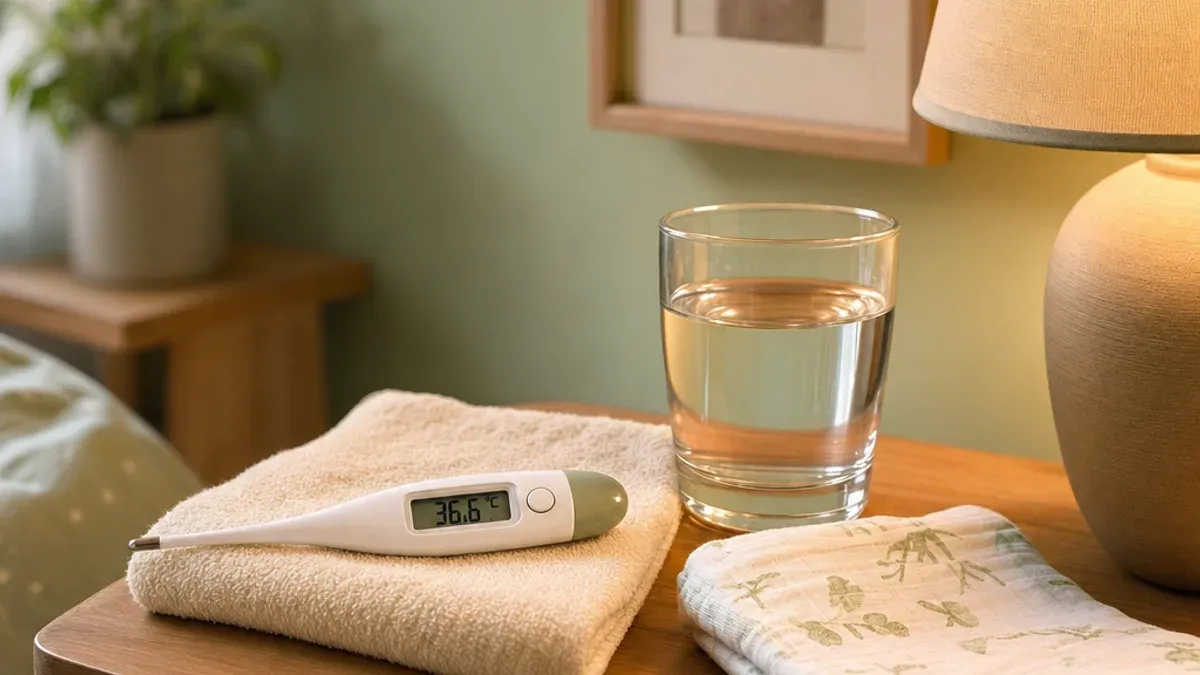
Fever is a friend, not an enemy A signal that your baby's body is fighting an infection. Your job: keep them comfortable and know the signs that need a doctor.
A fever is the body's natural response to infection — not the disease itself. Knowing what's normal, how to measure correctly, and when to seek care helps parents respond confidently.
This article draws on AAP [1], NICE NG143 [2], and the Royal College of Pediatricians of Thailand [3].
What is a fever?
A fever is body temperature above 38.0°C (100.4°F) measured rectally, or 37.5°C (99.5°F) measured under the arm. Fever isn't a disease — it's how the body:
- Raises temperature to fight pathogens — many germs grow slower at higher temps
- Activates the immune system
- Signals that there's an infection or inflammation
Per AAP [1], fever under 39°C (102.2°F) in an otherwise healthy child usually doesn't need to be lowered — the goal is to keep your child comfortable, not normalize the number.
How to measure correctly
By age
- Under 3 months: rectal — most accurate
- 3 months – 4 years: rectal or axillary (armpit)
- Over 4 years: oral, axillary, or ear (tympanic)
Recommended tools
- Digital thermometer — affordable, accurate, can be used everywhere
- Tympanic (ear) thermometer — fast, but less accurate in young babies
- Forehead/temporal thermometer — convenient but less precise
- Avoid old-style mercury thermometers — risk of breakage and poisoning
How to take it
- Rectal: insert about 1 cm, wait 1–2 minutes — most accurate
- Axillary: under a dry armpit, wait 5 minutes (typically 0.5°C lower than rectal)
- Tympanic: gently pull ear up and back, follow device instructions
Concerning fever levels (by age)
Per AAP [1] and NICE NG143 [2]:
Newborn – 3 months
- Fever ≥ 38.0°C (100.4°F) is always an emergency
- Seek medical care immediately, even if baby seems otherwise fine
- At this age, fever may signal serious infection like meningitis or bacteremia
- Don't give fever-reducing medication until a doctor evaluates baby
3–6 months
- Fever ≥ 39.0°C (102.2°F) warrants a doctor visit
- Or fever + unusual lethargy, poor feeding, or inconsolable crying — see a doctor at any temperature
- Below 39°C with normal play and feeding may be observed at home
Over 6 months
- Fever ≥ 39°C (102.2°F) lasting over 24 hours — see a doctor
- Fever + other symptoms — rash, stiff neck, lethargy, seizures, difficulty breathing — see a doctor
- Fever lasting more than 3 days — see a doctor to find the cause
Danger signs — emergency room immediately
Any age — go to the ER if you see [1]:
- Seizure — body stiffening, jerking, eyes rolled back
- Stiff neck — can't bend the head forward — possible meningitis sign
- Non-blanching rash (petechiae/purpura) — sign of severe infection
- Fast or labored breathing, blue lips — respiratory distress
- Severe lethargy — won't wake, won't respond
- Dehydration — dry mouth, no tears, dry diaper for over 8 hours
- Bulging fontanelle in infants — sign of raised intracranial pressure
Caring at home (mild cases)
Keep baby comfortable
- Light clothing — avoid heavy bundling (raises temperature)
- Cool room with a gentle fan — not blowing directly on baby
- Tepid sponging — lukewarm water on forehead, armpits, groin
- Don't use cold water or alcohol — causes blood vessels to constrict and traps heat
Prevent dehydration
- More frequent breastfeeds or formula for under-6-month babies
- Small frequent sips of water for over 6 months
- Oral rehydration solution (ORS) if vomiting or diarrhea is present
Fever-reducing medication
Talk to your pediatrician or pharmacist for the right dose for your child's weight and age. General points:
- Paracetamol (Acetaminophen) is typically the first-choice fever reducer
- Ibuprofen is an option as babies get older
- Don't give aspirin to children — linked to Reye Syndrome, a serious condition affecting brain and liver [1]
Medication safety
- Use a syringe to measure liquid medicine — kitchen spoons vary
- Doses are weight-based — check with a pharmacist before giving
- Consult your doctor before combining medications
- Store out of reach — overdose is toxic
Febrile seizures
- Occur in 6 months – 5 years, in about 2–5% of children
- Body stiffening, jerking, rolled-back eyes — usually under 5 minutes
- Most don't cause brain damage, but every first seizure should be evaluated by a doctor
- If a seizure lasts over 5 minutes, call emergency services
- During a seizure: lay baby on their side, on something soft, don't put anything in their mouth
Summary
Fever is the body's natural response — not every fever needs lowering. But in babies under 3 months or with danger signs, see a doctor immediately.
Care principles at home:
- Under 3 months + fever ≥ 38°C → emergency — go to the hospital now
- Ask your pharmacist or doctor about the right fever reducer and dose
- No aspirin for children — Reye Syndrome risk
- Tepid sponging — not cold water or alcohol
- Watch for danger signs — seizures, stiff neck, non-blanching rash, labored breathing, severe lethargy
Call your pediatrician or local emergency line at any time. There are no small questions when it comes to your child's health.