
Finger Foods for Babies: Safe Textures, Choking Hazards, and First Foods
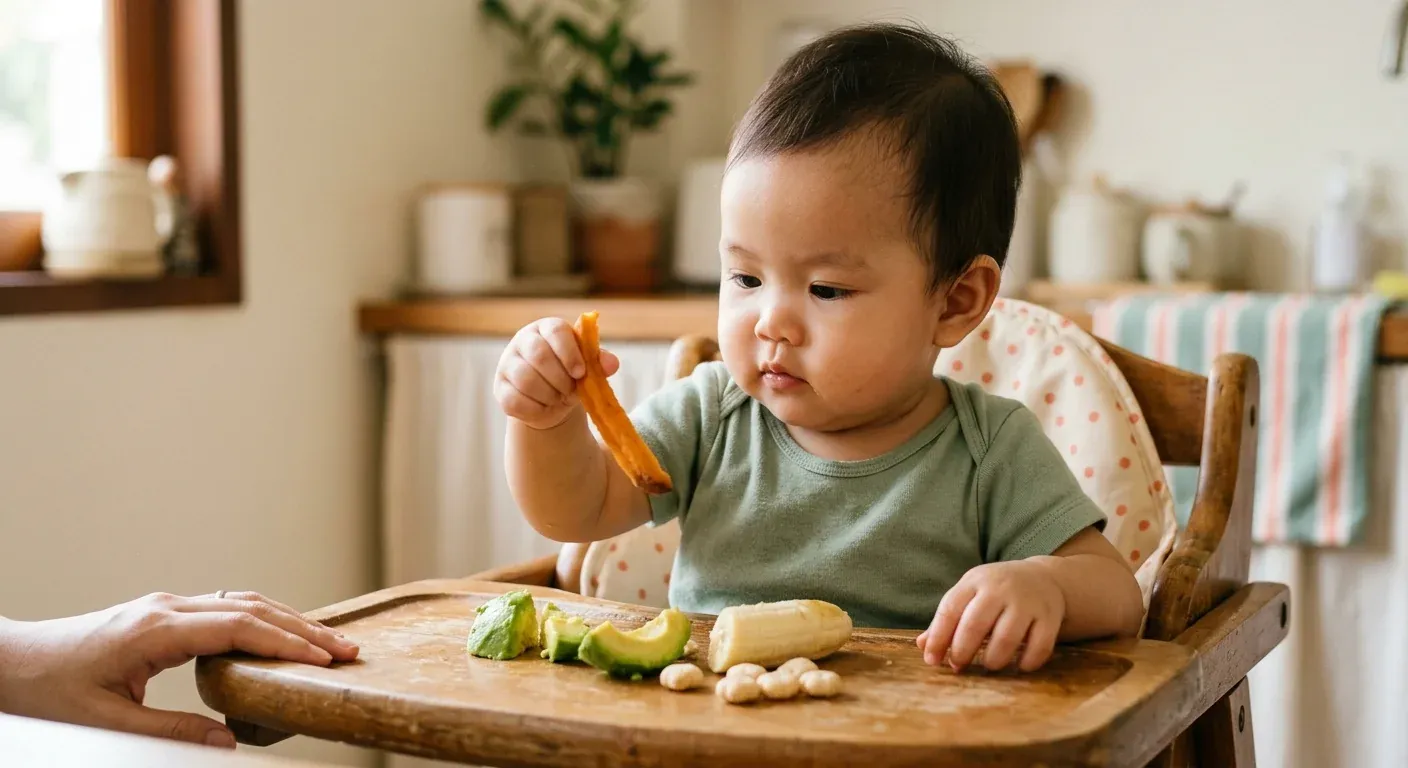
The best finger food is one your baby can gum, not one they have to chew. Soft, grippable, dissolving in the mouth — that is the whole texture rule in one sentence.
Finger foods are small, soft pieces of food that babies can pick up and eat themselves — no spoon, no parent feeding. They are not a separate stage of weaning. They are simply the shape and texture of complementary food that lets your baby practise self-feeding from the moment solids begin, around 6 months [1]. This article covers readiness signs, safe shapes and textures, the complete list of foods to avoid, introducing allergens alongside finger foods, practical meal ideas, and the one distinction every parent must know before mealtime: gagging versus choking.
Signs Your Baby Is Ready for Finger Foods
Age alone is not enough. The AAP states: "Once your baby can sit up and bring their hands or other objects to their mouth, you can give them finger foods to help them learn to feed themselves" [1].
Watch for all three of these together — not just one:
- Sitting upright without support — in a highchair, head steady, not slumping. Upright posture ensures gravity moves food forward, not toward the airway.
- Bringing hands (and objects) to the mouth — intentional, not accidental. This hand-to-mouth coordination is the physical prerequisite for self-feeding.
- Lost tongue-thrust reflex — the automatic reflex that pushes objects out of an infant's mouth fades around 4–6 months. Once it is gone, your baby can move food backward and swallow rather than pushing it out.
Most babies reach all three milestones around 6 months, consistent with WHO's recommendation to begin complementary foods at that age [3]. If your baby is not yet sitting steadily or keeps pushing food back out, wait a week or two and try again.
The One Texture Rule
NHS states the guiding principle clearly: "Finger food is food that's cut up into pieces big enough for your baby to hold in their fist with a bit sticking out. Pieces about the size of your own finger work well" [2].
The goal is a shape that:
- Your baby can grip (not too small to pick up, not too large to hold)
- Breaks apart easily when gummed — a baby's gums exert surprising force, but the food must yield without chunks that could block the airway
- Is long enough to stick out of the fist — this is what makes it a finger food and not a choking risk
The pinch test: Squeeze the food between your thumb and index finger. If it squashes flat easily, it is safe. If it springs back, cook it longer or choose something else.
Safe finger food shapes and textures at 6–8 months
- Well-cooked vegetable sticks (broccoli, cauliflower, carrot, sweet potato) — steamed until they yield to a gentle squeeze
- Ripe banana or avocado, cut into finger-length strips
- Soft ripe pear or peach, skin removed, cut into strips
- Scrambled egg (soft, not dry) or omelette strips
- Well-cooked pasta (penne or wide noodles work better than long spaghetti)
- Small pieces of boneless, well-cooked fish — check meticulously for bones
- Strips of soft well-cooked meat (chicken, pork, beef) — not meatballs (round = risk)
- Soft-cooked lentils or mashed beans spread on a strip of soft bread
As pincer grasp develops (8–10+ months)
As babies develop the pincer grasp — picking up small objects between thumb and forefinger — you can offer smaller pieces [2]:
- Small peas or sweetcorn kernels
- Soft-cooked rice (if it clumps slightly, easier to pick up)
- Small pieces of soft cheese
- Well-cooked pasta shapes
A note on dissolvable puffs: Puffs designed for babies (the kind that dissolve immediately on contact with saliva) can be a useful transition food for younger babies still building motor skills. They are not nutritious staples, but they reduce risk while coordination develops. Look for unsalted varieties with no added sugar.
Foods to AVOID: The Complete Choking Hazard List
The following foods are explicitly listed as choking hazards by the AAP for children under 1 year [1] — and many remain risks up to age 4:
- Whole grapes — must be quartered lengthwise [2]
- Cherry tomatoes — must be quartered
- Hot dogs and sausage rounds — the circular cross-section is the exact shape to seal an airway; if given at all, shred or mince completely
- Nuts and seeds — all whole nuts and seeds, no exceptions; nut butters must be thinly spread, never in chunks
- Chunks of meat or cheese — cut into thin strips, never cubes
- Popcorn — no exceptions for children under 4
- Chunks of peanut butter — a thick spoonful can adhere to the airway; thin spread only, mixed into food
- Raw vegetables — raw carrot rounds, raw apple pieces, raw celery; these must be cooked soft or grated
- Fruit chunks — including large apple chunks; cook or slice thinly
- Hard, gooey, or sticky candy — hard candy, gummies, marshmallows; avoid entirely
The key insight: round and firm is the most dangerous combination. Whole grapes, cherry tomatoes, and round sausage slices can form a seal over the opening of a small airway. Cutting round foods into quarters lengthwise (not in half — halves are still round) changes the shape enough to prevent this.
Gagging vs Choking: Know the Difference
This distinction is the most important safety knowledge for any parent introducing finger foods.
Gagging is normal and protective. NHS describes it: a baby may "push their tongue forward (or out of their mouth)," their "eyes may water," and they may "retch to bring the food forward" [2]. Gagging is loud — your baby is coughing, sputtering, making noise. The gag reflex in infants sits further forward in the mouth than in adults, which is why babies gag frequently when starting solids. This reflex is working exactly as it should. Do not intervene. If you rush to sweep a finger into the mouth, you may push food deeper.
Choking is a silent emergency. Your baby cannot cough, cannot cry, cannot make sound. They may clutch at their throat, turn red then blue, or go limp. Act immediately — infant back blows and chest thrusts (see choking first aid), and call emergency services.
| Sign | Gagging (normal) | Choking (emergency) |
|---|---|---|
| Sound | Loud — coughing, retching | Silent or very weak |
| Breathing | Breathing throughout | Cannot breathe |
| Colour | Red, watery eyes | Turning blue or pale |
| Action | Watch — do not interfere | First aid immediately + call 1669 |
Introducing Allergens With Finger Foods
There is no evidence that delaying the introduction of allergenic foods — eggs, peanuts, cow's milk products, fish, wheat, soy, sesame — beyond 4 to 6 months reduces the risk of allergy [1]. In fact, the LEAP framework supports early, regular introduction of allergenic foods to reduce allergy risk, particularly for peanuts.
Introduce allergens as finger foods, one at a time, with a few days between each new food [2]:
- Egg: Scrambled egg or omelette strips — well cooked, not runny
- Peanut: A thin scrape of smooth peanut butter on a soft bread strip; never whole peanuts or thick spoonfuls
- Fish: Soft boneless fish flakes — check every piece for bones
- Cow's milk products: Soft cheese strips, a small spoon of full-fat yoghurt; note that cow's milk should not replace breast milk or formula as the main drink before 12 months
- Tree nuts: Finely ground nut flour mixed into food; never whole nuts
- Wheat: Soft strips of bread or well-cooked pasta
Once introduced and tolerated, keep offering each allergenic food regularly — NHS is clear that consistent ongoing exposure helps maintain tolerance [2].
Signs of allergic reaction to watch for: Hives or rash around the mouth, vomiting, swelling of the lips or face, difficulty breathing. If breathing is affected, call emergency services immediately (anaphylaxis).
If your baby has severe eczema or a known food allergy, speak to a paediatrician before introducing the most common allergens.
Practical Thai Meal Ideas for Finger Foods
Thai family cooking naturally includes many finger-food-friendly options — the key is adjusting preparation:
6–8 months (first finger foods):
- ฟักทองนึ่งหั่นแท่ง (steamed pumpkin strips) — naturally sweet, soft, easy to grip
- มันเทศนึ่งหั่นแท่ง (steamed sweet potato strips) — iron-complementing, soft texture
- ไข่คนนุ่ม (soft scrambled egg) — high iron; also an allergen introduction opportunity
- เนื้อไก่ต้มนุ่มหั่นเส้น (well-cooked chicken strips) — lean protein + iron; strip shape only
- กล้วยน้ำว้าหั่นแท่ง (ripe banana strips) — naturally soft, easy to grip, high in potassium
8–10+ months (as pincer grasp develops):
- ข้าวสวยปั้นก้อนเล็ก (small soft rice balls) — easy to pick up once clumped
- เต้าหู้นุ่มหั่นสี่เหลี่ยม (soft silken tofu cubes) — plant-based protein, very soft
- แครอทนึ่งนุ่มหั่นแท่ง (well-steamed carrot strips — must pass the pinch test, not raw)
- ปลาต้มเกล็ด (flaked steamed fish) — check every piece for bones
Flavour note: Thai family food is often well-seasoned with fish sauce, salt, and chilli. Prepare the baby's portion separately or before seasoning — no added salt, no spicy heat for infants under 12 months. Thai herbs and aromatics (lemongrass, galangal, kaffir lime) are fine to infuse flavour during cooking before seasoning.
Common Mistakes to Avoid
Waiting too long. Babies who are not offered textured food by 8–9 months can become harder to transition from purée. WHO's guidance is to "gradually increase food consistency and variety" in step with development [3] — do not stay on smooth purée indefinitely.
Making finger foods too small. A pea-sized piece is actually harder for a 6-month-old to pick up (no pincer grasp yet) and easier to swallow whole without chewing. Finger-length strips that stick out of the fist are safer than tiny chunks.
Using round shapes. Balls, cylinders, and thick rounds are the dangerous shapes. Cut everything into strips or flat pieces. This applies to sausage, cheese, fruit, and cooked vegetables.
Leaving baby unattended. Every meal should have an adult present and watching. This is not about hovering anxiously — it is about being able to act in the seconds that matter if choking occurs.
Pressure-feeding. If your baby turns away, closes their mouth, or pushes food away, stop. Responsive feeding — following your baby's cues — applies to finger foods just as to any feeding [3]. Forced eating can create negative associations with mealtimes.
Summary
| Phase | Age | What to offer |
|---|---|---|
| First finger foods | ~6 months, when sitting + hand-to-mouth established | Finger-length soft strips; steamed vegetables, banana, egg, soft meat |
| Growing repertoire | 7–8 months | Same range, more variety; introduce allergens one at a time |
| Pincer foods | 8–10+ months | Smaller pieces as coordination improves; avoid round/hard shapes throughout |
Key takeaways:
- Readiness is developmental, not just age — sitting, hand-to-mouth, no tongue-thrust reflex.
- The shape rule — finger-length strips; no rounds, no balls, no large chunks.
- The pinch test — if it squashes flat between two fingers, it is safe.
- Allergens from 6 months — one at a time, keep offering if tolerated.
- Gagging is normal; choking is silent — know the difference before you start.
- Never leave baby unattended at mealtimes.