
Potty Training: A Readiness-First Guide for Parents
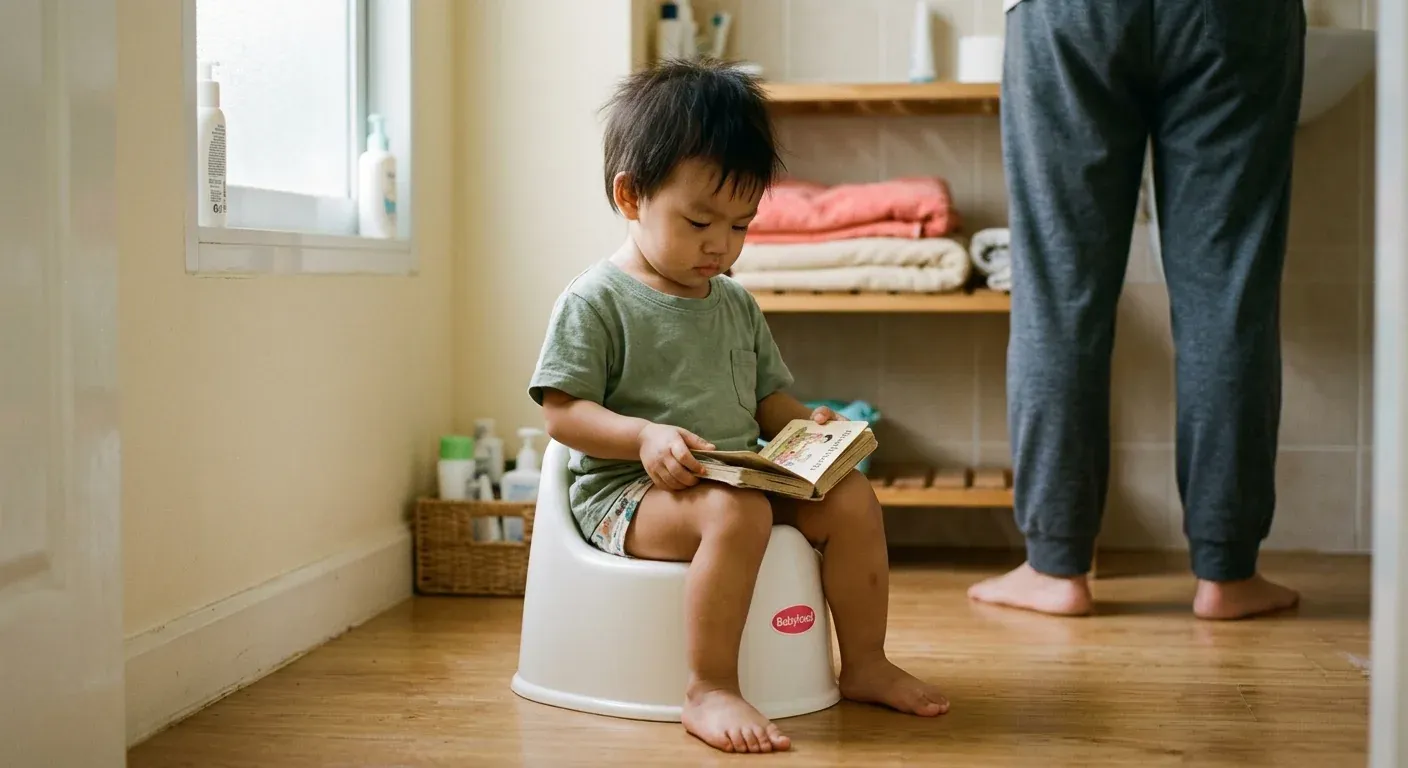
The child who is ready trains in days. The child who isn't ready trains for months. Follow readiness, not the calendar — and the process becomes straightforward for everyone.
Potty training is one of the most searched parenting topics precisely because advice is contradictory: grandmothers say start early, books say wait for "all the signs," daycare has a deadline, and the internet is full of 3-day miracle claims. This guide cuts through the noise using guidance from the American Academy of Pediatrics (AAP) [1] [2] [3] [4] [5] [6], with a dedicated section on the Thai intergenerational context that most English-language guides ignore entirely.
Readiness: the only variable that matters
The AAP is unambiguous: "Waiting until your child is truly ready will make the experience much faster and more pleasant for everyone involved." [1] The question is not which month to start — it is whether your child has developed the physiological, cognitive, motor, emotional, and social capacities the task requires.
Most children reach this readiness somewhere between 18 and 36 months, with wide natural variation. Daytime training typically completes earlier than nighttime dryness; girls often train a few months ahead of boys on average, but the range within each group is large enough that averages are not useful for individual children. The AAP affirms that "it is impossible to compare one child's mastery with another's to determine whether your child's progress is 'normal.'" [6]
What readiness actually looks like
The AAP describes readiness across several domains [3]:
Physiological: The bladder and bowel have matured enough that the child can "delay a bowel movement or urination long enough to get to a potty" — often signalled by staying dry for stretches of two or more hours during the day, or waking dry from a nap.
Cognitive: The child is "able to associate the need to eliminate with potty use, to remember to use it, and to resist distraction long enough to complete the process." In practice: they show awareness that something is happening in their body (a characteristic crouch, going quiet, hiding behind furniture for a bowel movement), and they can follow simple two-step directions.
Motor: The child can walk to the bathroom, manage their own clothing (pulling pants up and down), and sit on a potty independently and get off again.
Emotional: The child shows a desire for independence and self-mastery — and, equally important, enough emotional maturity to relax voluntary control. The AAP notes that toddlers sometimes withhold as an assertion of autonomy, and may even "become seriously constipated in response to emotional stress, parental pressure, or even reluctance to let go" [4]; readiness includes being emotionally settled enough not to do so.
Social/verbal: Interest in watching others use the toilet, wanting underwear like older children or adults, and the verbal ability to communicate urgency — whether in words, signs, or a reliable gesture.
A child does not need to check every box before you start gentle introduction. But trying to train before the foundations are in place produces a longer, more stressful process for everyone.
Methods: four approaches, no single best
The AAP explicitly rejects prescribing one method: "it is not necessary to choose a single method — in fact, your child will benefit from a combination of verbal, physical, social, and other forms of training no matter what his age." [2] The four approaches parents commonly use are:
Child-oriented (Brazelton approach — AAP default)
Wait until the child demonstrates most readiness signs across all five domains, then introduce the potty gently: let them sit on it clothed first, place dirty diapers in it to associate the object with function, and follow the child's pace. The AAP explicitly endorses this framework as its default. No deadline. No pressure. The child leads the pace of each step.
This is the most conservative approach and the one with the broadest pediatric backing. For children who are genuinely ready, progress is often rapid.
Three-day intensive (concentrated home immersion)
A focused 3-day period of staying home, removing diapers entirely, and offering the potty very frequently — often every 20–30 minutes. The theory is that concentrated practice accelerates learning. The AAP does not specifically endorse this method but does describe "immersion training" as one parent-chosen variation, noting that "timing approaches ranging from intensive two-week immersion training to gradual adjustment over months" all appear in the literature. [2]
This method works well for children who are already close to readiness and whose families can commit fully. It tends to be more demanding if the child is not yet physiologically ready, as the number of accidents can frustrate both parent and child.
Scheduled / timed sitting (Azrin-Foxx approach)
An older behaviorist protocol (1970s) in which the child is taken to the potty at regular scheduled intervals throughout the day — every 30 to 60 minutes — combined with positive reinforcement for success. The evidence base is established, if dated, and the method appears in pediatric literature. It is more structured than the child-oriented approach and can work well for children who respond to clear routines.
Elimination communication (infant potty training)
A practice of reading an infant's pre-elimination cues from early infancy — before conventional training age — and positioning them over a potty or basin at predicted moments (after feeding, after waking). This is the basis of the Thai traditional practice described in the next section. The Western evidence base is thinner than for the above methods, but the AAP does not contraindicate early exposure to bathroom routines; what it cautions against is applying pressure or punishment when the child's physiology is not yet capable of voluntary control.
The Thai intergenerational context: อุ้มฉี่ is not early training — it is something else
Many Thai families — and across South and Southeast Asia more broadly — practice อุ้มฉี่ (holding the baby over a basin or squat toilet at predicted times from infancy). Grandmothers typically hold the baby in a squatting position after feeds, after waking, and before sleep, making a distinctive sound cue. The baby's bladder often empties in response to the position and cue.
This is not "potty training" in the sense of teaching voluntary sphincter control, which requires a neurological maturation that does not occur until roughly 18 months at the earliest. What อุ้มฉี่ does is establish very early routine exposure to the bathroom context, cue association, and caregiver attunement to the infant's elimination signals. It is a culturally embedded form of what Western literature calls elimination communication.
How to think about this if you are navigating intergenerational disagreement:
If your mother-in-law practices อุ้มฉี่ from 6 months, and you are planning a Western child-led approach starting at 18–24 months, these approaches are not in direct conflict. The AAP does not object to early introduction to bathroom routine; what matters is that the formal push to stop using diapers — the moment at which you expect the child to be reliably dry — is timed to the child's readiness, not to a family deadline or the grandmother's preference. A child who has heard cue sounds and sat on a basin since infancy may, in fact, transition more easily when their physiology is ready, because the environment and the concept are already familiar.
Frame it this way with family members: "อุ้มฉี่ สอนให้ลูกคุ้นเคยกับห้องน้ำตั้งแต่เล็ก — เราจะฝึกอย่างจริงจังเมื่อลูกพร้อมทางร่างกาย ซึ่งสองอย่างนี้ไม่ขัดกัน" — teaching familiarity early and formal training when physiologically ready are compatible, not competing.
Do not frame your mother-in-law's practice as wrong. It is not wrong. It is a legitimate cultural practice with its own internal logic, and dismissing it damages the relationship without gaining anything for the child.
Thailand-specific practical note: squat toilets
Many Thai children encounter both Western sit-toilets and Thai squat toilets (ส้วมนั่งยอง). The mechanics differ, but children adapt readily once they understand both options. Introduce both calmly and without urgency. A small step-stool in front of the Western toilet helps with foot support. For the squat toilet, brief supervised practice with the child wearing a dress or loose trousers is the simplest approach. Neither format is inherently superior; what matters is that the child feels physically stable and not anxious.
Regression: when training seems to go backward
Regression — returning to accidents after a period of reliable dryness — is normal, documented, and not a sign that training has failed or needs to restart from zero. The AAP notes that "a child who feels disoriented by recent upsets (such as a move to a new home, a divorce, or the arrival of a new baby in the house) may seek to regain emotional balance by exerting tighter control" — sometimes expressed as toilet-training accidents. [4] Common triggers include:
- Stress: a new sibling, a move, a divorce or other family disruption, starting daycare or preschool
- Illness or fever
- Constipation from withholding — this is the leading medical pathway behind persistent setbacks. A child under emotional pressure can "become seriously constipated" by withholding stool [4]; a constipated child may also withhold urine, or develop overflow soiling (soft stool leaking around a hard impacted mass) — a condition called encopresis. If regression is accompanied by infrequent hard stools, straining, or soiling without the child appearing to notice, consult a pediatrician. Do not use home laxatives without medical guidance.
The AAP recommends responding to regression with minimal drama: "clean up the mess, keep your comments minimal, downplay the incident, and wait for a later, more mature phase of independence to inspire him." [4] Anger and punishment make the situation worse by adding emotional stress on top of whatever triggered the regression.
If you suspect constipation, consult your pediatrician before continuing to push training — constipation must be resolved first for training to succeed.
Bedwetting: a separate issue from daytime training
Nighttime dryness lags daytime dryness — the AAP notes it "usually occurs much later — frequently months or even years after daytime training is complete" [6] — and the AAP further observes that "many children under age six are not physiologically capable of remaining dry at night." [6] AAP figures put bedwetting at age 5 or 7 at around 15% of children. [5] Bedwetting at ages 4 and 5 is common and does not indicate a problem with daytime training.
The AAP advises that bedwetting "usually does not require medical intervention until age eight to ten." [6] If your child was "completely toilet trained for 6 months or longer and suddenly begins wetting the bed," that warrants a pediatrician visit [5] — sudden-onset regression in a previously dry child can occasionally signal a urinary tract infection or another medical cause; the AAP lists warning signs including "pain, burning, or straining while urinating" and cloudy or pink urine. [5] Otherwise, patience and protection (waterproof mattress cover) are the appropriate approach.
Bedwetting is a separate article topic. This guide does not go further into nocturnal enuresis management.
When to talk to a pediatrician
Seek guidance if:
- Your child is past 3.5 years and shows no readiness signs — not because 3.5 is a hard cutoff, but because it is worth discussing developmental status with the pediatrician.
- Regression has lasted more than a few weeks and you cannot identify a trigger.
- You suspect constipation or see encopresis (soiling without apparent awareness).
- Your child is distressed or anxious around the potty after several weeks of gentle introduction.
- Your child previously dry at night begins wetting with new symptoms (pain, urgency, unusual urine colour).
In Thailand, Samitivej Hospital and Bangkok Hospital have pediatric outpatient services where toilet training concerns can be discussed with a developmental pediatrician or general pediatrician. A referral from a general practitioner is not required.
Summary
- Follow readiness, not the calendar. Most children are ready between 18 and 36 months; averages by gender are less useful than watching your individual child.
- Readiness is multidimensional. Physiological (stays dry 2+ hours), cognitive (body awareness), motor (manages clothing, sits independently), emotional (willing, not withholding), verbal/social (can communicate and is interested).
- No single method is best. Child-oriented, 3-day intensive, scheduled sitting, and elimination communication all have a place depending on the child's readiness and the family's approach.
- อุ้มฉี่ and child-led training are compatible. Early familiarity with bathroom routine (from อุ้มฉี่) and formal training at physiological readiness serve different functions — they do not conflict.
- Regression is normal. Common causes: stress, illness, constipation. Respond calmly. Investigate constipation if soiling is present.
- Bedwetting is separate. Nighttime dryness often lags daytime by a year or more. No intervention needed until age 6+ unless there is sudden regression with symptoms.
- Anger and punishment worsen outcomes. The AAP is explicit: the approach that works is calm, patient, and child-paced.
แหล่งอ้างอิง
- AAP HealthyChildren — Potty Training (hub page; readiness-first framing and links to method, regression, bedwetting resources)
- AAP HealthyChildren — Toilet Training: Which Method is Best? (combination approaches; immersion vs gradual timing)
- AAP HealthyChildren — How to Tell When Your Child Is Ready (the five domains of toilet-training readiness)
- AAP HealthyChildren — Emotional Growth Needed for Toilet Training (autonomy, withholding, constipation, regression triggers, calm-response guidance)
- AAP HealthyChildren — Bedwetting: 3 Common Reasons & What Families Can Do
- AAP HealthyChildren — Stages of Toilet Training: Different Skills, Different Schedules