
Choosing a Crib and Mattress: The Safe-Sleep Buying Guide
Buy the safety, not the styling. A crib is a sleep space first and a piece of furniture second — every choice you make works backward from AAP safe-sleep rules.
There is no good way to write a crib-buying guide without putting the safety rules at the top. A baby spends more time in their sleep space than anywhere else in the first year, and Sudden Infant Death Syndrome (SIDS) is the leading cause of death in babies between one month and one year. The good news is that following the AAP 2022 safe-sleep recommendations [1] [2] sharply reduces that risk — and almost every safe-sleep rule is also a buying rule. Firm mattress. Fitted sheet only. Nothing else in the sleep space. No incline. No bumpers. No "breathable" sleep positioners. No head-shaping pillows.
This guide pairs with our safe-sleep article (the why) and our nursery essentials checklist (the what). Here we cover the how — how to pick the crib, the mattress, the bassinet, the sheets, and the sleep sack so the sleep space the equipment creates matches the rules every time you lay your baby down.
The five rules every purchase must satisfy
Before you compare a single model, write these on a sticky note and keep them on your phone while shopping. Every product decision is just one of these rules applied [1] [3]:
- Firm. The mattress returns to its shape immediately when pressed — no body indent, no give.
- Flat and level. No incline, no head elevation, no hammock shape. NICHD: "like a table, not a hammock" [3].
- Fitted sheet only. Nothing else in the sleep space — no blankets, no quilts, no pillows, no stuffed toys, no sheepskin, no bumpers, no positioners.
- Standards-compliant. A current crib that meets the safety standards of the relevant national regulator (CPSC in the US, EN 716 in the EU, equivalent local rules elsewhere) [1].
- Back to sleep, every sleep — and the product has to support that position naturally, not fight it.
If a product can't be used in a way that satisfies all five rules at the same time, it isn't a sleep product. Doesn't matter what the packaging says.
Crib types — what the categories actually mean
Standard full-size crib
The default option. Roughly 71 × 133 cm interior dimensions, with a mattress sized to match. A modern, standards-compliant full-size crib will have:
- Slats no more than 6 cm (2 3/8 inches) apart so a baby's head can't fit through and become trapped [4].
- Fixed sides — drop-side cribs were banned in the US in 2011 after dozens of deaths from entrapment when the hardware failed. Do not use a drop-side crib even if it's a hand-me-down.
- Adjustable mattress height — start at the top setting for a newborn (easier on your back), drop the platform as soon as baby can sit up, and drop it again to the lowest setting before they can pull to stand.
- No corner-post projections taller than 1.5 mm above the rail, to prevent clothing snags.
Mini crib and portable crib
Smaller footprint — useful in apartments, in a grandparent's house, or as a second sleep space. The safety standards are the same: meet the regulator's compliance mark, fixed sides, slats no more than 6 cm apart, mattress that fits the frame tightly.
Convertible crib
Designed to transition into a toddler bed, then a daybed, then sometimes a full-size bed. The economic argument is strong if your family plans to stay in the same home — a single piece of furniture can carry a child from birth through primary school.
The safety argument requires more care: each stage has its own hardware, and each stage must independently meet the relevant safety rules. The crib stage must be a current standards-compliant crib. The toddler-bed stage uses a different rail. Verify both before you buy, and keep the conversion hardware in a labeled bag — losing one bracket can mean the whole conversion stops working years later.
Play yard (Pack 'n Play–style)
A foldable mesh-sided enclosure. AAP-acceptable as a sleep space only when the play yard meets current safety standards and is used with the manufacturer-supplied mattress pad [1]. Do not add a second mattress pad, towels, or any soft "comfort" layer — the firmness is calibrated to the included pad, and adding loft makes it unsafe.
Floor bed (Montessori)
Allowed. The same rules apply: firm mattress on the floor, fitted sheet only, nothing else on the surface. Floor beds shift the nursery-safety burden — your baby can leave the sleep space when they're mobile, so the whole room becomes their reachable space. Baby-gate the door, anchor every piece of furniture, cover outlets, and walk the room on hands and knees before you commit to the approach. (Our baby-proofing guide covers the room-level checklist.)
Bassinet vs crib vs Moses basket vs bedside co-sleeper
For the first few months, parents typically want a smaller sleep space close to the bed. The AAP supports room-sharing without bed-sharing for at least the first six months — ideally a full year [2]. Several products satisfy this.
Bassinet. Small standalone sleep space that meets the ASTM F2194 bassinet standard. Used from birth until baby can push up on hands and knees or until the manufacturer's weight limit, typically around five to six months. Same rules inside as in a crib: firm flat mattress, fitted sheet only, nothing else.
Bedside co-sleeper (sidecar bassinet). Attaches to or sits flush against the parents' bed, with one side that drops down so a parent can reach the baby without bed-sharing. This is the equipment that most directly supports AAP room-sharing-without-bed- sharing — close access for night feeds, separate sleep surface. Verify it meets the bassinet safety standard, and verify the height matches your bed so there is no gap a baby could roll into.
Moses basket. A traditional, low-cost basket-style sleep space. Used for the first few months only. Same internal rules apply: firm mattress sized to the basket, fitted sheet only, no loose bedding. Transition out around three to four months — earlier if your baby is larger than average.
What is NOT a sleep space, despite the marketing:
- In-bed sleepers, "loungers," DockATot- and Snuggle Me-style products. Soft sides, no firm flat surface, no fitted-sheet-only setup. The AAP does not recommend these for sleep — they are awake-supervised-play products that are frequently misused as sleep products [2].
- Adult bed. Even with parents present, an adult mattress is too soft, the bedding is wrong, and pillows/duvets create suffocation hazards.
- Couch or armchair. The single highest-risk sleep location for an infant. Never doze with a baby on you on a sofa.
- Car seat, swing, bouncer, stroller. Acceptable for transport. Not for sleep — they sit baby in an inclined position that can compromise the airway [1] [3].
The mattress — the single most important purchase
A baby's mattress has one job: be firm enough that an infant's face cannot sink into it. Nothing else about it matters as much.
How to test firmness
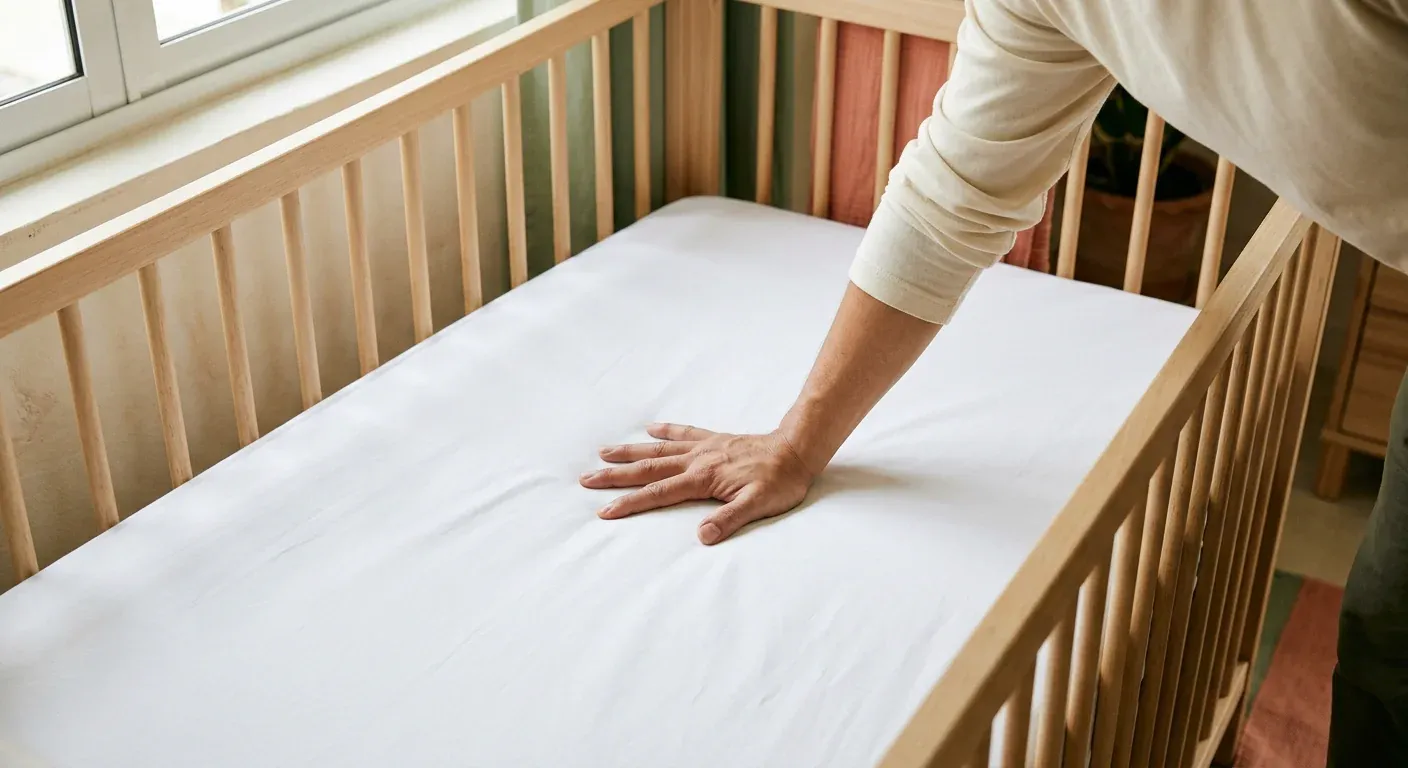
Press the mattress firmly in the center with your hand, then release. NICHD's plain-language test: a safe mattress "returns to its original shape quickly when pressed on" [3]. If your palm leaves an indent that lingers, or if the surface conforms around your hand, it is too soft for an infant.
Press again at the corners. Same standard. The center and the corners should both pass.
How to test fit
With the mattress in the crib, run two fingers around the gap between the mattress edge and the crib frame on every side. More than two finger-widths of gap on any side means the mattress is too small for that crib — a baby can roll into the gap and get trapped. If the mattress doesn't fit snugly, it is the wrong mattress for that frame; do not pad the gap with rolled towels.
Mattress materials — what's OK, what isn't
The firmness test is the gate, not the material. Both innerspring and high-density foam mattresses can pass; soft "comfort foam," memory foam, and pillow-top constructions cannot. Specifically:
- No memory foam for infants under two. Memory foam is designed to conform — exactly the property a safe infant mattress must not have [3].
- No pillow-top. Same reason.
- No mattress topper or additional padding. The mattress that ships with the bassinet or play yard is calibrated to the frame; adding a layer changes the firmness profile and the fit.
- Waterproof cover under the fitted sheet is fine — a thin vinyl or laminated protector adds no loft and helps the mattress last through diaper accidents and spit-up.
- "Organic" or "natural fiber" mattresses are fine if firm. The certification doesn't make them safer, and it doesn't make them unsafe — pass the firmness test and the fit test and the rest is preference.
What about hand-me-down or secondhand mattresses?
The safest mattress is a new one. If you are reusing a mattress across siblings or accepting a hand-me-down, check it carefully:
- Firmness. If it has lost firmness — any visible body indent, any compression at the corners — replace it.
- Cleanliness. No staining, no mold, no smell. A mattress that has been stored in a humid garage in Bangkok for three years is not the right starting point.
- Standards. Confirm the mattress was sold as an infant mattress and meets current standards. Old crib mattresses from before modern firmness rules may not pass the press-and-release test.
If you are uncertain, buy new. This is one of the categories where "used to save money" can shift risk in the wrong direction.
Sheets, sleep sacks, swaddles — the only textiles in the sleep space
The AAP rule is short: fitted sheet only [1]. Nothing else lies on top of or alongside your baby. Warmth comes from clothing layers and a wearable blanket, not from anything loose.
Fitted sheet
Sized to the mattress, snug at every corner, no slack to pull free. Cotton or cotton-blend with a small percentage of elastane is typical. Buy two or three so you can change one at 3 a.m. and put the next on without doing laundry first.
Sleep sack (wearable blanket)
The AAP-approved alternative to a loose blanket. A sleeveless or short-sleeved garment with a zipper that keeps your baby warm without anything loose in the crib. Choose the TOG rating for your room temperature — a thinner 0.5 or 1.0 TOG works in a typical Bangkok bedroom at 24–26°C with AC, while 2.5 TOG is for cool rooms you would rarely keep a baby in.
Do not use a weighted sleep sack or weighted swaddle. The AAP 2022 update is explicit: "don't use weighted swaddle blankets or weighted objects like rice bags inside the swaddle" [1]. The CPSC has the same position. The category exists; it is not safe.
Swaddle
A snug fabric wrap for newborns who sleep better with their startle reflex contained. The two non-negotiable rules:
- Always place a swaddled baby on their back. Never on the side, never on the stomach [1].
- Stop swaddling at two to three months — or as soon as your baby shows any sign of rolling, whichever comes first. A swaddled baby who rolls onto their stomach cannot use their arms to lift their head; this is a suffocation risk. The window closes faster than parents expect.
The do-not-buy list
There are products that are sold, sometimes prominently, that should not be in your sleep space at all. The AAP, the CPSC, and the NICHD agree on these [1] [2] [3]:
- Crib bumpers — padded OR mesh. US federal law (Safe Sleep for Babies Act, 2022) bans them; AAP says do not use any version, including "breathable" mesh liners. The risk is suffocation, entrapment, and strangulation; the benefit (preventing limbs getting stuck between slats) is unsubstantiated for modern 6 cm slat spacing.
- Inclined sleepers. Any surface that puts a baby's head higher than their feet by more than 10° is unsafe for sleep. This category was banned by federal law in 2022 after multiple infant deaths.
- Sleep positioners and wedges. Marketed for reflux, flat head, or sleep position. CPSC and FDA: do not use. They do not reduce reflux and they do create suffocation risk.
- Head-shaping pillows ("donut pillows"). Marketed in Thailand and elsewhere as flat-head prevention. AAP and FDA: do not use. They are unsafe (anything besides a fitted sheet in the sleep space is unsafe) and ineffective (no evidence they prevent or correct plagiocephaly).
- Drop-side cribs. Banned in the US since 2011 because the drop-side hardware can fail and trap a baby. Do not buy new, do not accept secondhand, do not use a hand-me-down even if "everyone's baby slept in it."
- Weighted swaddles and weighted sleep sacks. AAP 2022: explicit do-not-use [1].
- DockATot, Snuggle Me, "loungers." Awake-supervised use only. Not a sleep product.
- Stuffed animals, pillows, comforters, sheepskins, blankets. None of these go in the sleep space until your child is over a year old, and most of them not until much later than that.
If a product description includes the words "reduces SIDS," "prevents flat head," or "for safe sleep" and the product is anything other than a standards-compliant crib, bassinet, mattress, fitted sheet, or sleep sack — treat the claim as marketing, not medicine.
Setting up the nursery — where the crib goes
Buying the right crib is half the work. Where you place it matters just as much [5]:
- Away from windows. Window-blind cords are a strangulation hazard. Use cordless blinds where you can; if you can't, the crib goes on a different wall and the cords get tied up high and out of reach.
- Away from heaters, radiators, AC vents. Hot spots and cold drafts both make temperature regulation harder.
- Away from climbable furniture. Once your baby is old enough to pull to stand, a chair or dresser next to the crib becomes a climb-out platform.
- Mobiles come down by five months or as soon as your baby can reach them — whichever is sooner.
- No cords from baby monitors anywhere within reach. Run them along the wall, not across the crib.
- Smoke-free room. Always.
The most common Thai nursery hazard is a ceiling fan hanging lower than two metres above an adjustable crib at its top setting. Check the clearance from the highest mattress position, not the lowest.
A few words on Thai context
Most of this guide draws on AAP and CPSC sources because that is where the cleanest infant-sleep evidence base sits. A few topics deserve a local note.
Bed-sharing — the harm-reduction conversation
Many Thai families bed-share. Multigenerational sleeping arrangements are common; cribs are sometimes seen as cold or isolating. The AAP position is firm: under twelve months, bed- sharing increases SIDS risk and is not recommended [2]. The recommended compromise is room-sharing without bed-sharing — baby in your room, in a separate sleep surface, ideally a bedside co-sleeper that keeps baby within arm's reach for night feeds.
If your family will bed-share anyway, the harm-reduction layer is worth knowing:
- Firm adult mattress, no waterbed, no couch, no armchair.
- No loose pillows, comforters, or soft bedding near the baby.
- No one in the bed who has smoked, drunk alcohol, or taken sedating medication.
- Baby supine, on the parent side of the bed (not between two adults), away from the wall.
- Breastfed (associated with lower bed-sharing risk).
We share this not as endorsement but because parents who choose to bed-share are better off knowing the risk-reduction layer than being told "don't" and getting nothing else.
Hand-me-downs and the cost-of-safety trade
Thai families pass equipment across siblings, cousins, and neighbours, and that culture is mostly good. For cribs and mattresses, three categories of hand-me-down need to be reconsidered:
- Drop-side cribs. Do not use, even in beautiful condition.
- Cribs with missing hardware or unknown manufacturer. Do not use — you cannot verify slat spacing, you cannot order replacement parts.
- Mattresses that have softened. The press-and-release test is the only check that matters. Indent stays, replace.
A new crib mattress is one of the few infant purchases where "cheap because we got it free" can shift risk in the wrong direction.
The Bangkok heat
The AAP guideline (room temperature "comfortable for a lightly clothed adult") and the NHS guideline (16–20°C) are easier to hit in temperate climates than in Bangkok. A reasonable Thai-bedroom target is 24–26°C with AC, a lightweight sleep sack appropriate to that temperature, no hat indoors after the newborn period, and the back of the neck (not the hands or feet) as your warmth check.
Astrologer and feng shui placement
Some families consult an astrologer or feng shui practitioner for the crib's orientation. There is no clinical objection — your baby sleeps on their back regardless of which wall the crib faces. The clinical objections come back only when the suggested placement creates a hazard: a crib against a window with cords, a crib directly beneath a low ceiling fan, a crib in a path where furniture could fall on it. Where culture meets safety, safety wins; where they do not conflict, follow the practice if it matters to your family.
A pre-purchase checklist
Before you click buy or carry it home from the store, run through:
- ✓ Crib is current and standards-compliant in your country
- ✓ Slat spacing ≤ 6 cm
- ✓ Fixed sides (no drop-side)
- ✓ Mattress fits with ≤ two-finger gap on every side
- ✓ Mattress passes the press-and-release firmness test
- ✓ Waterproof cover and at least two fitted sheets
- ✓ One sleep sack in the right TOG for your room
- ✓ Nothing else for the sleep space (no bumpers, no pillows, no positioners, no head-shaping pillows, no loungers)
- ✓ Crib placement away from windows, cords, heaters, climbable furniture, low ceiling fans
If every line passes, the equipment is in place. The rest is the nightly habit — back to sleep, every sleep, every nap — and the safe-sleep guide covers the habit side.
Summary
A crib and a mattress are a sleep space, and a sleep space is a medical intervention against SIDS. Firm mattress, fitted sheet only, nothing else — the rules are short, and almost every buying decision is one of those rules in different words.
Buy fewer things. Buy the right ones. Skip everything the safe- sleep evidence rules out — bumpers, incline sleepers, head-shaping pillows, weighted swaddles, DockATot-style loungers, drop-side cribs — no matter how nice the catalog photo looks. Place the crib carefully. Replace the mattress before you reuse it across a gap of years. Lay your baby on their back, every sleep.
The equipment is doing its job when you don't think about it.
แหล่งอ้างอิง
- AAP HealthyChildren — A Parent's Guide to Safe Sleep
- AAP — Safe Sleep (2022 Updated Recommendations hub)
- NICHD Safe to Sleep — Safe Sleep Environment
- AAP HealthyChildren — Make Baby's Room Safe (crib slat spacing, cords, mobiles)
- NHS — Reduce the risk of sudden infant death syndrome (SIDS)
- ราชวิทยาลัยกุมารแพทย์แห่งประเทศไทย (Royal College of Pediatricians of Thailand)