
Baby-Proofing Your Home: Room by Room Before Baby Crawls
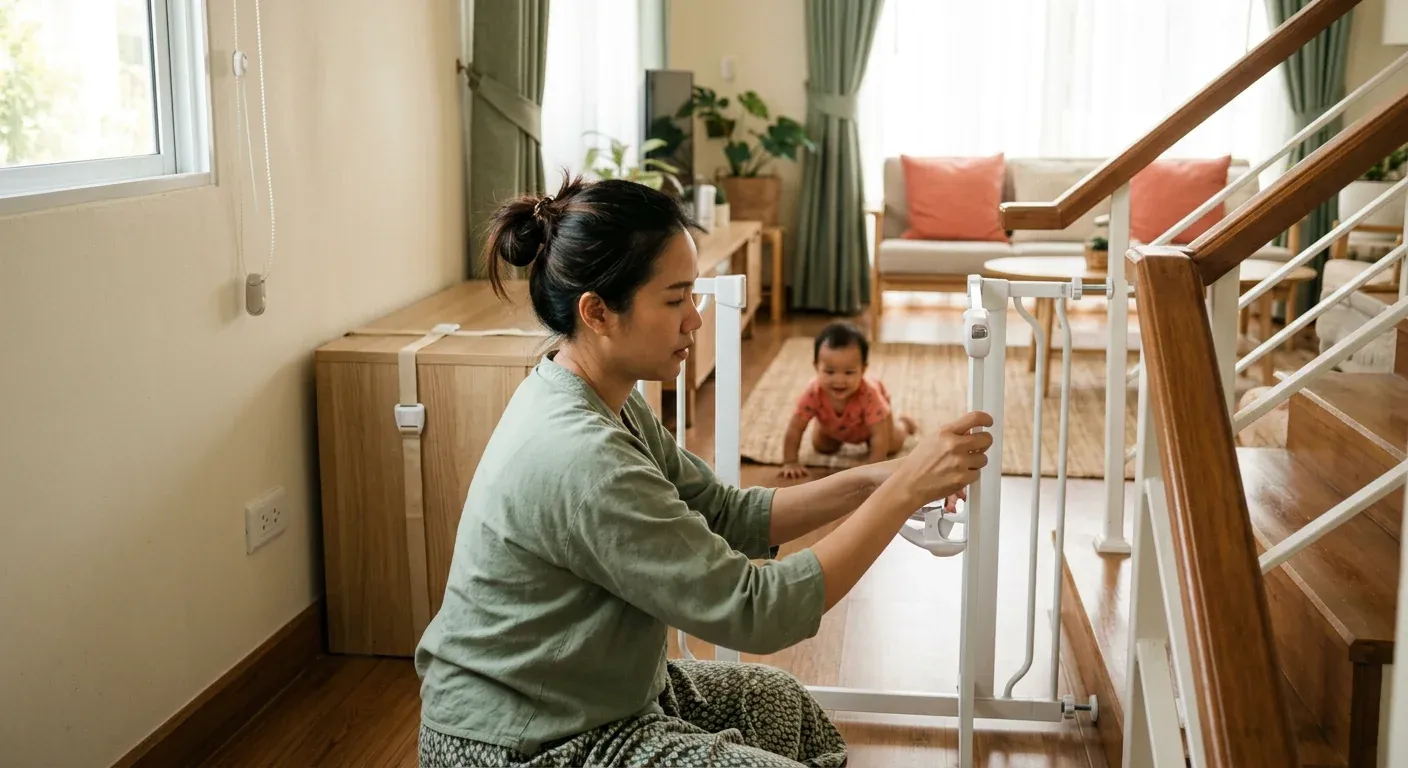
Most childhood accidents are preventable — and best prevented before they happen. Start baby-proofing before baby crawls. Don't wait until they reach something to react.
Baby-proofing (childproofing) means modifying your home environment to reduce hazards before your baby can move independently. Many parents plan to handle it "when the baby starts crawling" — but crawling quickly becomes running, and the window to catch up is short. This guide walks room by room through the most important steps.
When to Start: Earlier Than You Think
The AAP recommends starting "before or as soon as your child begins crawling or walking" [1]. In practice, months 4–5 is the right time to begin, because:
- 0–6 months: Not yet mobile but can grasp objects in reach. Watch for small objects and heavy items at arm level.
- 6–12 months: Crawling, pulling to stand, cruising furniture — peak risk for falls, pulling open drawers, and toppling heavy items.
- 12–24 months: Walking, climbing, exploring everything — risks from falls, ingesting chemicals, and electrical hazards increase significantly.
One key principle to remember: no safety device is completely childproof [4]. Adult supervision is always the most important layer of protection.
Living Room and Hallways
Electrical Outlets and Cords
Install outlet covers on every socket within your baby's reach. Tuck or bundle electrical cords — babies pull dangling cords and can bring heavy appliances down on themselves. Use cord management boxes to keep them tidy and inaccessible.
Furniture and TV Tip-Overs
This is one of the most underestimated hazards. The CPSC warns that "furniture, TVs, and ranges can tip over and crush young children" [4]. A flat-screen TV resting on a cabinet without wall anchoring is a serious risk:
- Secure all tall or top-heavy furniture to walls with anti-tip straps: bookcases, dressers, wardrobes, and TVs.
- If a TV sits on a cabinet, push it back from the edge and anchor it to the wall.
- Dresser drawers pulled out one at a time by a toddler shift the center of gravity — the whole unit can topple. Lock every drawer.
Small Objects and Button Batteries
Keep any object smaller than 3.5 cm (about the size of a toilet-paper tube) away from babies [2]. Button batteries — found in remotes, watches, and some toys — are an especially dangerous hidden hazard: if swallowed, they can cause severe chemical burns to the esophagus within two hours. This is a medical emergency requiring immediate hospital care. Store battery-powered devices in locked places and verify battery compartment covers are secure.
Blind Cords and Drawstrings
Corded window blinds are a serious strangulation risk for young children. The CPSC recommends replacing corded window coverings with cordless alternatives [4]. If you still have corded blinds, tie cords short and hang them high and out of reach every time after use.
Stair Gates
Install baby gates at both the top and bottom of every staircase [4]. Critical point: only wall-mounted (screw-in) gates are safe at the top of stairs — pressure-mounted gates can be pushed out by a determined toddler and should only be used in interior doorways where a fall would not be a risk.
Kitchen
The kitchen contains more hidden hazards than almost any other room [2]:
- Turn pot handles inward — away from the stove edge — so a curious child can't grab and pull boiling liquids.
- Install cabinet locks on all drawers and cabinets containing sharp objects, heavy items, or chemicals.
- Store all cleaning products, bleach, and chemically labelled products in locked cabinets in their original packaging — never decant into unlabelled containers [1].
- Fit stove knob covers to prevent a toddler from turning on gas or electric burners.
- Unplug all small appliances when not in use.
- Keep matches and lighters completely out of reach.
- Be cautious with small decorative magnets on refrigerators — if a child swallows multiple magnets simultaneously they can attract across intestinal walls and cause life-threatening perforations.
Bathroom
Water is a hazard that demands zero complacency. Young infants can drown in just a few inches of water:
- Never leave a child alone in the bath, even for a moment — if you need to leave, take the baby with you [3].
- Set your water heater to no more than 49°C (120°F) to prevent scalding [3].
- Install a toilet lid lock to prevent a curious toddler from falling headfirst or playing in the water.
- Keep all medications — including vitamins, supplements, and traditional medicines — in a locked cabinet that is high and out of reach [3].
- Unplug and store hair dryers, straighteners, and all electrical appliances when not in use. Better yet, use them only in rooms away from water.
Water buckets and basins: Households that store water in open buckets or basins should empty and invert them when not in use. Even a small amount of water is sufficient for an infant to drown.
Bedroom
- Clear the floor and low surfaces of small objects, button batteries, and jewelry.
- Verify that bedroom furniture — especially wardrobes and shelving units — is anchored to the wall.
- Windows: Fit window guards or restrictors that prevent opening more than 10 cm [4]. Never rely on insect screens as fall prevention — they are not load-bearing.
Ceiling fans: In older buildings, ceiling fans are sometimes mounted lower than ideal. Check that fan blades are at least 2.1 metres from the floor and ensure the switch is out of a toddler's reach.
Balconies and Thai-Specific Hazards
Balconies are high-risk areas in condominiums and two-storey homes:
- Check that railing gaps are narrower than 10 cm — wide gaps allow a child to get their head through.
- Do not place chairs, boxes, or anything climbable against the balcony railing.
- Lock balcony doors with a proper lock, not just a latch — older toddlers learn to operate simple latches.
- Monsoon season: Standing water accumulates quickly on balconies during heavy rain. Clear it promptly and supervise any access to the balcony during wet weather.
Motorbike helmets: In Thai households where motorbikes are common, loose helmets left on the floor are attractive to toddlers who reach inside and can get stuck or fall. Store them out of reach.
Medications, Chemicals, and Houseplants
- All medications — prescription, over-the-counter, vitamins, and traditional remedies — in locked, high cabinets [1].
- All cleaning agents, bleach, and product-labelled chemicals in locked storage, in original containers [1].
- Verify that common houseplants are non-toxic. Several popular plants in Thai homes are harmful if ingested or cause mucous-membrane irritation — check each plant and relocate any that are toxic.
Warning Signs — Seek Emergency Care Immediately
If your child shows any of these after potential contact with a hazard [1][3]:
- Swallowed a button battery — even if no symptoms, X-ray is needed immediately.
- Swallowed or contacted any chemical or medication.
- Unusual crying, vomiting, lethargy, or unconsciousness after a fall.
- Fell from a height greater than their own body length.
- Was submerged in water, even briefly.
In Thailand, call 1669 (National Institute for Emergency Medicine, NIEMS) for medical emergencies.
Quick-Reference Checklist
| Room | Before Baby Crawls |
|---|---|
| Living room | Outlet covers · Anti-tip straps on TV and furniture · Store button batteries · Tie blind cords · Screw-mounted stair gate |
| Kitchen | Lock cabinets with chemicals and sharps · Turn pot handles in · Stove knob covers · Unplug appliances |
| Bathroom | Toilet lid lock · Water heater ≤49°C · Lock medicine cabinet · Invert water buckets · Unplug electrics |
| Bedroom | Anchor wardrobe · Window restrictors · Check ceiling fan height |
| Balcony | Railing gap <10 cm · Lock door · Clear standing water |
The most important reminder: every safety device is just one extra layer of protection. Adult presence and supervision cannot be replaced. Revisit your home safety setup at each new stage of your baby's development [5].
แหล่งอ้างอิง
- AAP HealthyChildren — Childproofing Your Home for Poisons
- AAP HealthyChildren — Kitchen Safety: 10 Tips for Families With Young Children
- AAP HealthyChildren — Bathroom Safety
- U.S. Consumer Product Safety Commission (CPSC) — Childproofing Your Home
- AAP HealthyChildren — At Home Safety (portal, room-by-room resources)