
Thai Car Seat Law: The Legal Floor and the AAP Ceiling
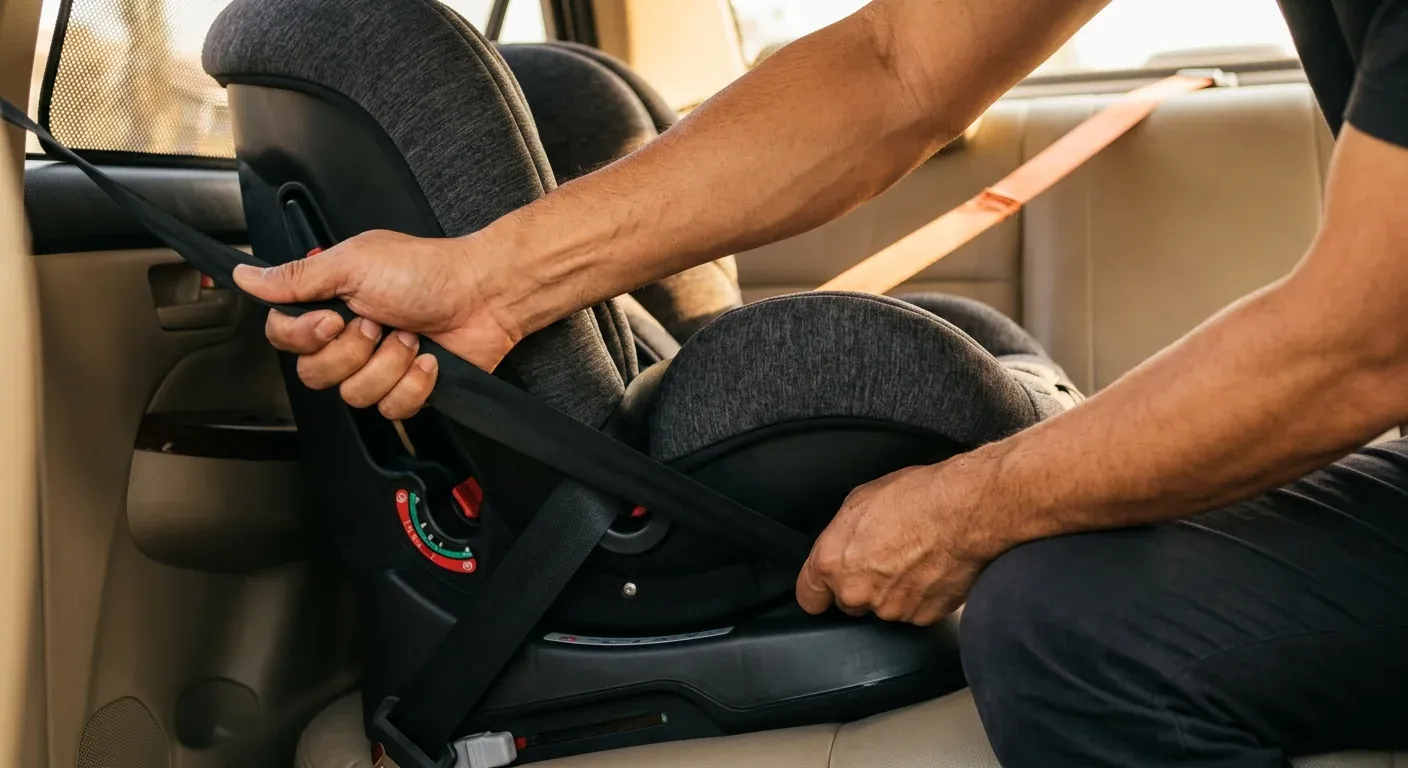
Thai law is the floor of child passenger safety. AAP guidance is the ceiling that actually keeps your child alive. Both belong in the same car.
On 5 September 2022, Thailand began enforcing a law requiring children under 6 to ride in a child restraint system. That law sets the legal minimum — but the American Academy of Pediatrics (AAP) and the US National Highway Traffic Safety Administration (NHTSA) recommend car seat and booster use for far longer, typically through age 8–12 depending on height, with back-seat seating through age 13 [1][2]. The WHO estimates that child restraints can reduce infant deaths in road crashes by up to 71% [4].
This guide separates the two clearly: what Thai law requires you to do, and what AAP recommends on top to actually keep your child safe. Both standards belong in the same vehicle.
What Thai Law Actually Says
The Road Traffic Act (No. 13), B.E. 2565 (พระราชบัญญัติจราจรทางบก ฉบับที่ 13 พ.ศ. 2565) took effect on 5 September 2022. The provisions that matter for parents:
- Children under 6 years old must use a child restraint system (car seat) or another age- and weight-appropriate restraint in private passenger vehicles.
- The maximum fine for non-compliance is 2,000 baht.
- The rule applies to private passenger vehicles. Motorcycles cannot accept a car seat at all, and public transport vehicles fall under separate rules.
For technical questions about which restraints meet Thai regulatory standards, the Department of Land Transport (กรมการขนส่งทางบก, dlt.go.th) is the authority [3].
The law's limit — Thai law sets a hard age threshold of 6 years, but crash physics doesn't care about birthdays. A child who has just turned 6 but is still under 145 cm tall will not fit a vehicle seatbelt correctly. The lap belt will ride up over the abdomen instead of sitting low across the thighs, and the shoulder belt will cut across the neck. In a crash, an abdominal lap belt causes severe internal injuries.
This is why AAP guidance picks up where Thai law stops.
Why AAP Recommends More Than the Law
AAP and NHTSA define child passenger safety as a four-stage progression keyed to physical development, not to age [1]. The guiding principle for every stage: stay in that stage as long as your seat's height and weight limits allow before moving up.
Stage 1: Rear-Facing — From Birth
Infants and young children should ride rear-facing from their first ride home from the hospital until they reach the highest weight or height allowed by the seat's manufacturer [1]. The rear-facing position distributes crash forces across the child's whole back, neck, and head in a frontal collision — protecting the still-developing spine.
In practice, most children stay rear-facing through at least age 2, and often longer. Convertible seats commonly accept rear-facing children up to 18–22 kg.
Critical: Never place a rear-facing seat in the front seat of a vehicle with an active frontal airbag. Even in a low-speed crash, a deploying airbag can strike the seat with enough force to cause serious brain injury or death [1].
Stage 2: Forward-Facing With 5-Point Harness — After Outgrowing Rear-Facing
Once your child outgrows their rear-facing limits, transition to a forward-facing seat with a 5-point harness. AAP recommends keeping children harnessed as long as possible — at least through age 4, and longer if the seat permits [1].
Forward-facing seats must always use the top tether — the strap that anchors the top of the seat to a vehicle anchor point — regardless of whether you installed using ISOFIX or the seatbelt. The top tether substantially reduces forward head movement in a crash.
Stage 3: Booster Seat — After Outgrowing the Harness
A booster seat raises your child enough that the vehicle's adult seatbelt fits correctly — lap belt low across the thighs (not the stomach), shoulder belt across the chest and shoulder (not the neck or face) [1]. Children stay in a booster until they pass the 5-point seatbelt fit test (Stage 4), typically around age 8–12 and approximately 145 cm tall.
Stage 4: Adult Seatbelt — When the Body Fits
Your child is ready for the vehicle's seatbelt alone when all five conditions are true [1]:
- They sit with their back flat against the seat back.
- Their knees bend naturally over the edge of the seat.
- The lap belt sits low across the upper thighs, not the stomach.
- The shoulder belt crosses the chest and shoulder, not the neck or face.
- They can maintain that position for the whole trip.
Until every condition is met, continue using a booster.
Back Seat Until Age 13
AAP and CDC are explicit: every child under 13 should ride in the back seat, regardless of restraint type [1][2]. The front seat is designed around adult-sized occupants, with airbags calibrated for adult bodies and a seatbelt geometry that does not fit children correctly.
Choosing an Approved Seat
Thai law requires that the restraint meet recognized standards. In practice, almost every car seat sold in Thailand carries one of these certifications:
| Standard | Notes | How to spot |
|---|---|---|
| ECE R44/04 | Older European standard, grouped by weight | Circular "E" label with country number |
| ECE R129 (i-Size) | Newer European standard — height-based with stronger side-impact testing | "i-Size" label |
| FMVSS 213 | US federal standard | US-standard sticker (less common in Thailand) |
Before you buy:
- Visible certification label — ECE R44, ECE R129, or FMVSS 213.
- Manufacture date and expiration — most car seats expire 6–10 years from manufacture date. Plastic degrades over time even when the seat is unused [1].
- Buy from an authorised retailer — counterfeit seats exist in the Thai market. Saving 30% on the price is not worth a seat that may have never been crash-tested.
- The most expensive brand is not required for safety — every seat that passes ECE R44 or R129 passes the same crash tests. A budget-tier seat with proper certification protects your child as well as a premium seat with the same certification.
The Thai TIS / มอก. mark does not yet have a car-seat-specific category — rely on international certifications.
Installing Correctly — What the Law Does Not Teach
The law says you must have one. It does not say how to install it. And a wrongly installed seat is little more than decoration.
Pick One Install Method: ISOFIX or Seatbelt — Not Both
Most newer vehicles have ISOFIX lower anchor points (called LATCH in the US — same physical standard) in the rear seat crease, plus a top tether anchor.
AAP and NHTSA state clearly: ISOFIX/LATCH and the seatbelt are equally safe [1]. Choose whichever gives you a firmer, easier install in your specific vehicle/seat combination. Never use both at the same time — combining them can route crash forces in unintended ways.
ISOFIX/LATCH weight limit: lower anchors are typically rated for a combined child + seat weight of about 29 kg (65 lb). Above that limit, switch to seatbelt installation [1].
The 2.5 cm Rule
After installation, grip the seat at the belt path and shake it in every direction. If it moves more than 2.5 cm (about one inch), the install is too loose — tighten the belt path further.
Recline Angle for Infants
Rear-facing infant seats include a recline indicator on the base. Newborns need approximately a 45-degree recline — too upright lets the head flop forward and obstruct the airway in a sleeping baby; too reclined lets the child slide upward. Always use the indicator, not your eye.
Always Use the Top Tether With Forward-Facing
A forward-facing seat without the top tether allows substantial forward head excursion in a frontal crash. Use it every time, no exceptions, whether the seat is installed with ISOFIX or seatbelt [1].
Harnessing Correctly — The Most-Missed Step
Firm installation is only half the job. A poorly harnessed child in a perfectly installed seat is still at risk.
Chest clip position — the chest clip must sit at the child's armpit level, not on the belly or near the throat. Too low and it cannot distribute crash forces; too high and it can injure the throat [1].
The pinch test — after buckling, try to pinch the harness webbing at the collarbone. If you can pinch any slack, the harness is too loose. Tighten until you cannot pinch — but your child can still breathe comfortably [1].
No bulky coats under the harness — winter jackets and puffer layers compress dramatically in a crash, leaving the harness suddenly loose enough for ejection. AAP guidance is to dress your child in thin layers and place coats or blankets over the buckled harness, never under it [1].
Skip the aftermarket accessories — strap covers, head supports, baby-view mirrors, and toys that clip onto the harness have not been crash-tested with that specific seat. They can alter the harness's behavior in a crash. Use only what the seat's manufacturer supplied or specifically approved.
Thai-Specific Situations the Law Does Not Cover Clearly
Taxis and Ride-Share
The law does not explicitly prohibit taxis from carrying small children, but practical realities apply:
- Most metered taxis do not carry car seats — parents need to bring a travel-friendly seat.
- Some ride-share apps offer "with car seat" booking tiers — select before confirming the ride.
- Holding a child on your lap is not an alternative. In a crash, the G-forces involved make it physically impossible to hold onto a child — this is mechanics, not effort.
Grandparent or Relative Vehicles
If your child rides regularly with grandparents or relatives, the safest solution is to keep a dedicated seat installed in that vehicle, not to move yours back and forth. Moving a seat between cars increases the chance of an installation error. A budget booster makes a practical "always there" seat for the grandparents' car.
Songthaew and Public Transport
Many forms of public transport in Thailand have no rear seatbelts, which makes a car seat impossible to install. Minimize using these for very young children when you have alternatives, and pick interior seats away from doors when you cannot.
Rental Cars on Holiday
- Renting a car seat with the vehicle — convenient, but inspection of crash history is difficult.
- Bringing your own — safer; most airlines allow a car seat as free checked baggage when flying with a child (see flying with baby).
The First Ride Home From the Hospital
Most Thai maternity hospitals today inspect your car seat before discharge. Have an infant-appropriate seat (a dedicated infant carrier or a convertible installed rear-facing) ready and practice the installation before delivery week.
Common Thai Parent Questions
"Bangkok traffic is slow — do I really need a car seat?" — Yes. Crashes happen at every speed. A 30 km/h impact has enough force to cause severe injury or death in an unrestrained child.
"I can hold my baby tightly enough" — Physics says you cannot. A 10 kg child in a 50 km/h crash carries the inertial force of more than 300 kg. No adult can hold against that.
"Can I use a hand-me-down from my sibling that has never been in a crash?" — Only if every condition is true: complete known history, no crashes, within the seat's lifespan (not expired), no cracks in the plastic, and not subject to a recall. If you can't answer all five, buy new. Thai institutional sources such as Samitivej Hospital note that correctly used child restraints reduce injury severity by 70–80% — most of that benefit comes from a known-good seat correctly installed [5].
"Enforcement is uneven — why bother?" — Because crash physics does not depend on whether police are checking. Enforcement and actual injury risk are separate things; the law is a reminder, not the cause.
After a Crash — When to Replace the Seat
NHTSA guidance is clear: after a moderate or severe crash, replace the seat every time, because internal damage may not be visible.
A crash is considered "minor" — and the seat can stay in service — only if every condition is true [1]:
- The vehicle could be driven away from the crash.
- The airbags did not deploy.
- The door nearest the car seat was not damaged.
- No occupant of the vehicle was injured.
- The car seat shows no visible damage.
If any one condition fails, replace the seat. Many Thai motor-vehicle insurance policies cover car seat replacement after an accident — check your policy.
Red Flags Requiring Immediate Replacement
- Visible cracks in the plastic shell
- Past the expiration date on the manufacturer's label (typically 6–10 years from manufacture)
- Aftermarket modifications or non-manufacturer parts added
- Unknown history — auction purchase, hand-me-down without provenance
- Subject to a recall by the manufacturer or by Thai authorities
Summary
Thai law requires car seats for children under 6, with fines up to 2,000 baht. That is the legal floor. AAP and NHTSA define a much higher and safer practical ceiling:
- Rear-facing as long as the seat's limits allow
- Forward-facing with harness beyond the rear-facing limit (at least through age 4)
- Booster until the 5-point seatbelt fit test passes (typically 8–12 years, 145 cm)
- Back seat for every child under age 13
How you install the seat and how you tighten the harness matter as much as which seat you buy. Crash physics does not check the seat's price — it checks whether the install is firm and the harness is snug.
Every ride. Every time. The law is the floor; AAP is the goal.
แหล่งอ้างอิง
- AAP HealthyChildren — Car Safety Seats: Information for Families. Four-stage progression: rear-facing to manufacturer's height/weight limit; forward-facing harness at least to age 4; booster until proper seatbelt fit (typically 145 cm / 8–12 years); back seat for all children under 13; LATCH/ISOFIX and seatbelt equally safe — use one not both; LATCH combined weight limit 65 lb; top tether always with forward-facing; chest clip at armpit level; pinch test; no bulky coats under harness; never rear-facing in front seat with active airbag; minor crash 5-condition criteria for keeping a seat.
- CDC — Child Passenger Safety. Four-stage car seat progression (rear-facing, forward-facing with harness, booster, seatbelt); back seat for all children under 13; rear-facing seats must never go in the front seat with an active airbag.
- Department of Land Transport (กรมการขนส่งทางบก) — Road Traffic Act (No. 13), B.E. 2565: in effect from 5 September 2022; children under 6 must use a child restraint system in private passenger vehicles; maximum fine 2,000 baht.
- WHO — Road Traffic Injuries. Child restraint use can reduce infant deaths in road crashes by up to 71%; enforcement of child restraint laws is part of the WHO safe-system approach to road safety.
- Samitivej Hospitals TH (samitivejhospitals.com/th) — Thai institutional reference for child passenger safety vocabulary: correctly used child restraints reduce injury severity by 70–80%; age/weight grouping (infants 0–13 kg rear-facing; toddlers 9–18 kg; older children 18+ kg).