
Baby-Led Weaning (BLW): How It Works, Is It Safe, and Who It's For
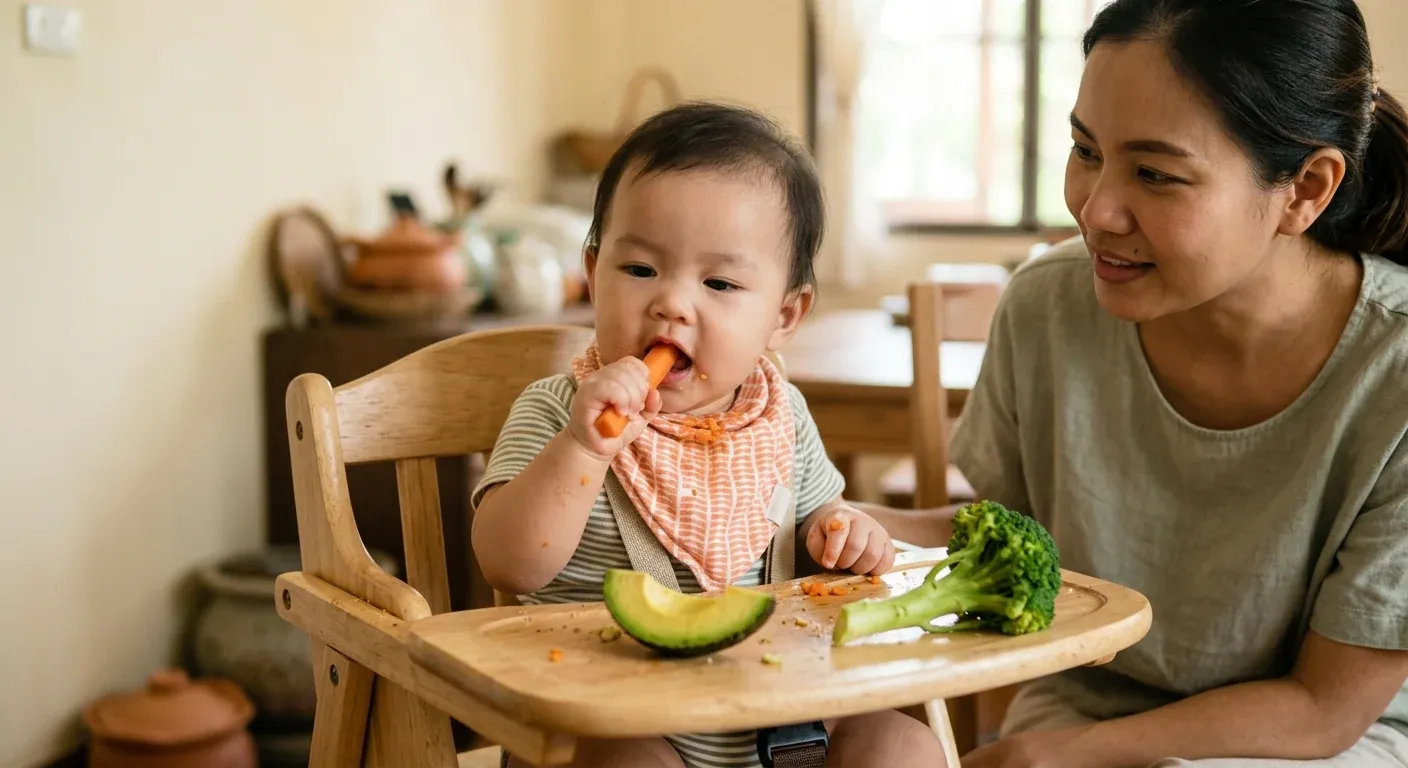
Baby-led weaning is not a parenting philosophy — it is a feeding method. The evidence says it is as safe as spoon-feeding when food shapes are correct. The goal is the same as traditional weaning: iron-rich, varied, allergen-inclusive nutrition. BLW just hands the spoon to the baby.
Baby-led weaning (BLW) is the approach developed by UK midwife and health visitor Gill Rapley in the early 2000s: instead of spoon-feeding puréed food to a baby, you offer soft finger-food pieces from around 6 months and let the baby self-feed entirely from the start. The NHS states that "there is no more risk of choking when a baby feeds themselves than when they're fed with a spoon" [1] — with the essential caveat that food shape and texture must be correct.
This article covers what BLW is, the three readiness signs that must all be present (not age alone), how to prepare food safely, the critical distinction between gagging and choking, iron as the first nutritional priority, allergen introduction, and when combination feeding (some BLW, some purees) is a practical option.
The Three Readiness Signs — All Must Be Present
Age alone is not enough. NHS and AAP guidance [1][2] specifies developmental readiness as the gate, not the calendar. A baby is ready to start any solid foods — including BLW — when all three of these are present simultaneously:
- Sits unsupported with steady head and trunk control. The baby can maintain an upright position in a high chair without slumping. This is essential for safe swallowing — gravity helps keep food moving forward, not back toward the airway.
- Lost the tongue-thrust reflex (extrusion reflex). Young babies automatically push objects out of the mouth with the tongue. When this reflex fades, the baby can move food toward the back of the mouth rather than expelling it. If every piece of food comes straight back out, the reflex is still active — wait.
- Reaches for food and brings objects to the mouth. The baby deliberately grasps food and brings it to the mouth — not incidentally, but intentionally. This is the motor skill that makes self-feeding possible.
Most babies reach all three signs around 6 months. AAP guidance states babies should not start any solids before 4 months, and WHO recommends exclusive breastfeeding for the first 6 months [2][3]. Starting BLW or any solids before readiness signs are present increases risk without benefit.
Safe Food Shapes: The One Rule That Matters Most
BLW is safe when food shapes match what a baby can manage. The single most important rule: finger-shaped sticks, not balls or coin rounds.
The NHS states finger foods should be "cut up into pieces big enough for your baby to hold in their fist with a bit sticking out" [1]. In practice, that means roughly the length and thickness of an adult finger — a shape the baby grips around the outside, not something that can be popped whole into a small mouth.
Safe shapes and textures:
- Soft enough to be squashed easily between thumb and forefinger (test it yourself before offering)
- Stick or finger shape — so the baby grips the outside and gums/bites one end
- Not slippery-round: round, smooth foods are the highest-risk shape because they fit perfectly into a baby's airway
AAP choking-hazard list — avoid these for all babies under age 4 [4]:
- Whole grapes (cut into quarters lengthwise)
- Whole nuts or whole seeds
- Hot-dog rounds or any coin-shaped sliced sausage
- Raw hard vegetables (raw carrot sticks, raw celery)
- Whole cherry tomatoes (halve or quarter them)
- Whole berries (large ones — halve blueberries)
- Chunks of meat or cheese
- Whole olives or stone fruit with stones
- Popcorn
Safe BLW first foods (examples):
- Steamed broccoli or cauliflower florets (soft, easy to grip)
- Steamed carrot sticks (must be soft enough to squash)
- Ripe banana in stick pieces (remove the slippery skin; the flesh is grainy, not slippery)
- Ripe avocado sticks (roll in baby rice cereal to reduce slipperiness)
- Soft-cooked sweet potato sticks or potato wedges
- Scrambled egg pieces (cooked through, soft)
- Minced or ground meat shaped into small patties (not round meatballs)
Gagging Is Not Choking — Know the Difference
This is the single anxiety point that stops most parents from trying BLW. Understanding the physiology removes most of that fear.
Gagging (ขย้อน — normal, do nothing):
- Loud — the baby makes retching, coughing, or sputtering sounds
- The baby is actively breathing and making noise throughout
- The baby is working the food forward in the mouth and will expel or swallow it
- Face may redden; eyes may water
- Action: stay calm, observe, do not intervene. The gag reflex is further forward in infants than in adults — this is protective.
Choking (สำลัก — emergency):
- Silent or near-silent — the baby cannot make sound because the airway is blocked
- No effective breathing — the baby cannot cough, cry, or speak
- Rapidly progressing distress; colour may change to blue or grey
- Action: begin infant choking first aid immediately. Back blows + chest thrusts, not abdominal thrusts for infants under 1 year. Call 1669 (Thailand) or local emergency number.
All parents introducing finger foods — whether through BLW or not — should learn infant choking first aid before starting. See our guide on choking first aid.
Iron First: The Nutritional Priority BLW Must Address
The most important fact about starting solids at 6 months: the reason you are starting is largely iron. Fetal iron stores are depleted by approximately 6 months. Breast milk is low in iron. The WHO recommends that the first complementary foods should be iron-rich [3]; AAP specifies "foods that provide iron and zinc, such as baby food made with meat or iron-fortified cereals" [2].
In a BLW approach, this translates to:
- Offer meat (red meat, chicken, turkey) in strip or patty form early and often — this is the highest-bioavailability iron source
- Offer liver (e.g., chicken liver blended into a soft paste, or baked into sticks) — highest iron density of any food
- Iron-fortified infant oatmeal or cereal thinned to a soft paste, offered on a preloaded spoon or as a finger-food cracker, qualifies as BLW-compatible
- Beans and lentils (soft-cooked, mashed lightly into a spread on soft bread or soft vegetable strips)
Relying on vegetables and fruit alone for the first months of BLW will not meet iron needs. Prioritise iron-rich foods at every meal.
Allergen Introduction: Early and Intentional
The LEAP study (Learning Early About Peanut Allergy, 2015) and the NIAID Guidelines (National Institute of Allergy and Infectious Diseases, 2017) established that early introduction of allergenic foods reduces allergy risk in high-risk infants. AAP guidance confirms: there is no evidence that delaying allergen introduction beyond 4–6 months reduces food allergy risk [2].
BLW-compatible allergen introduction:
- Peanut: thin smooth peanut butter stirred into puréed vegetables, or spread thinly on soft bread. Never whole peanuts (choking hazard) or thick peanut butter chunks.
- Egg: fully cooked scrambled egg pieces, or hard-boiled egg in soft pieces (not slippery-round hard-boiled egg given whole)
- Fish: soft-cooked fish in flakes (remove all bones); salmon, tilapia
- Tree nuts: nut butters (almond, cashew) stirred into food — never whole nuts
- Dairy: full-fat plain yoghurt on a preloaded spoon, or soft cheese in small portions
- Wheat/gluten: soft pieces of well-cooked pasta, or soft bread
The protocol: introduce one new allergen at a time, in a small amount, and wait 2–3 days watching for reaction (hives, vomiting, diarrhoea, swelling, difficulty breathing). If a baby has severe eczema or a known food allergy, consult a paediatrician before introducing peanut or egg. Once a food is tolerated, keep offering it regularly — NHS guidance confirms continued exposure maintains tolerance [1].
Honey is banned for all babies under 1 year regardless of feeding method — risk of infant botulism. No salt. No added sugar. No whole cow's milk as a drink before 1 year (use in cooking and as yoghurt is fine).
Mess, Development, and What BLW Actually Builds
Mess is not a side effect of BLW — it is part of the mechanism. Self-feeding builds several developmental skills simultaneously:
- Pincer grasp: picking up small food pieces with thumb and forefinger, the same fine motor skill needed for writing later
- Oral-motor coordination: moving food around the mouth, controlling bite force, learning texture variation — all skills that support clear speech development
- Hunger-cue self-regulation: the baby stops eating when full. Studies (including the BLISS RCT, New Zealand 2017) found that BLW babies are no more likely to choke than spoon-fed babies when safe food shapes are used, and may have better appetite self-regulation
The mess phase lasts weeks, not forever. A silicone splat mat under the high chair and a long-sleeved bib are the practical solutions.
BLW Is Not All-or-Nothing
NHS explicitly supports a combination approach: "Some parents prefer baby-led weaning to spoon-feeding, while others do a combination of both" [1]. There is nothing in the evidence base that makes a purist BLW approach superior to combination feeding.
Combination feeding is common and practical when:
- The baby is interested in self-feeding but iron intake from finger foods is difficult to monitor
- The family eats foods that are hard to offer as finger foods (curries, soups, dal)
- One parent is comfortable with BLW and another is not
- The baby is at a childcare setting that uses spoon-feeding
Offer soft finger foods at every meal for motor-skill development, while also offering iron-fortified purees or soft mashes via spoon at the same meal if needed. Both methods get to the same nutritional destination.
Summary
Baby-led weaning means the baby self-feeds soft finger foods from around 6 months — no parent-administered purees required. The NHS and AAP both support it as safe when food shapes are right.
The three readiness signs (all required, not age alone): sits unsupported, lost tongue-thrust reflex, reaches for and brings food to mouth.
Safe food shape: finger-stick, soft enough to squash between fingers, not slippery-round. Cut grapes into quarters, halve cherry tomatoes, never offer whole nuts, whole hot-dog rounds, or raw hard vegetables.
Gagging ≠ choking. Gagging is loud and normal. Choking is silent and an emergency. Learn infant choking first aid before you start.
Iron first: offer meat, liver, iron-fortified cereal at every meal. Fruit and vegetable BLW alone will not meet iron needs at 6 months.
Allergens early: introduce one at a time in safe forms (peanut butter stirred in, not whole peanuts). Early introduction reduces allergy risk. Honey banned under 1 year.
Combination feeding is fine. BLW is a method, not a religion.
แหล่งอ้างอิง
- NHS — Your baby's first solid foods. Baby-led weaning definition ('giving your baby only finger foods and letting them feed themselves from the start'); 'no more risk of choking when a baby feeds themselves than when they're fed with a spoon'; three readiness signs (sits steady, eyes-hands-mouth coordination, swallows food); finger-food size (big enough to hold in a fist); avoid hard foods (whole nuts, raw carrot, raw apple); allergens from 6 months one at a time; combination approach acceptable.
- AAP HealthyChildren — Starting Solid Foods. Readiness signs (hold head up, opens mouth for food, can move food from spoon to throat, doubled birth weight); iron-first rule ('foods that provide iron and zinc, such as baby food made with meat or iron-fortified cereals'); choking-hazard list (hot dogs, nuts, whole grapes, popcorn, raw vegetables, peanut butter chunks, fruit chunks); no evidence that delaying allergens reduces allergy risk.
- WHO — Infant and young child feeding. Exclusive breastfeeding for 6 months; complementary foods should start around 6 months; 'gradually increase food consistency and variety'; 2–3 meals/day at 6–8 months; responsive feeding ('feed slowly and patiently, encourage them to eat but do not force them').
- AAP HealthyChildren — Choking Prevention. Choking-hazard foods to avoid or modify: hot dogs, hard candy, nuts, whole grapes, raw vegetables, popcorn, thick peanut butter, marshmallows, meat chunks, cheese pieces. Round firm foods must be completely chopped into tiny pieces. Cut food into pieces no larger than one-half inch. Supervise all mealtimes.
- Samitivej Hospitals TH — Thai patient education portal. Institutional Thai authority anchor for infant-feeding vocabulary used in the TH version of this article.