
Baby Diarrhea: Dehydration Is the Real Danger — ORS and Continued Feeding Are the Answer
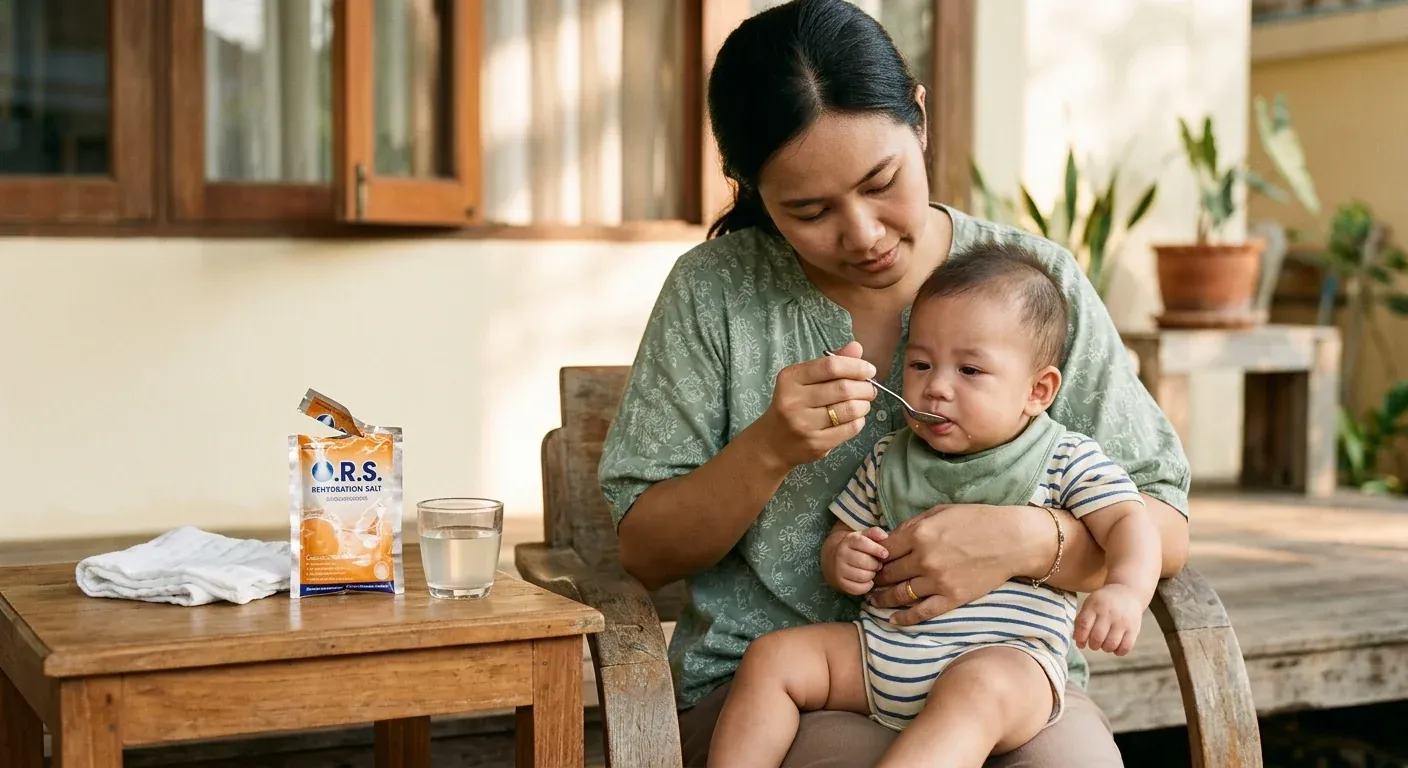
Most baby diarrhea is viral and clears in 5–7 days — what kills isn't the stool, it's dehydration Keep breastfeeding/formula as normal + give oral rehydration salts (ORS) after every loose stool — no fasting, no formula switching Don't give anti-diarrheal medicine to children under 2 (AAP), and don't give fruit juice, fizzy drinks or sports drinks (NHS) — wrong sugar-salt ratios make dehydration worse
Most baby diarrhea is caused by rotavirus or another stomach-bug virus and resolves on its own in 5–7 days [2]. What's dangerous isn't the stool itself — it's dehydration, which can develop within hours in a baby who is also vomiting.
The WHO is unambiguous: oral rehydration salts (ORS) + zinc + continued feeding is the standard of care that has driven global childhood-diarrhea mortality down dramatically [2]. The AAP is equally clear that anti-diarrheal medicines are off-limits in young children — "Over-the-counter antidiarrheal medicines are not recommended for children younger than 2 years" [1].
This guide pulls from WHO [2], AAP [1], NHS [3], CDC [4], and Bumrungrad Hospital [5] — to help parents tell when dehydration has set in, when to go to the ER now, and what's safe vs harmful to give while a baby is sick.
🚨 Read this first — dehydration signs that mean ER
Dehydration in babies develops fast and gets dangerous quickly. Recheck these signs every 2–3 hours:
NHS [3] lists these specific warnings for babies and young children:
- ❌ Dry diaper for 6 hours (older child) or 8 hours (infant)
- ❌ Dry mouth and tongue, no saliva
- ❌ Crying without tears
- ❌ Sunken fontanelle (the soft spot — clearly dipped in babies under 1)
- ❌ Sunken eyes with visible cheekbone hollows
- ❌ Lethargic, hard to rouse, slow to respond
- ❌ Skin tenting — pinch the skin gently on the back of the hand; if it stays raised in a ridge for several seconds, the baby is dehydrated
→ Call 1669 (Thai EMS) or go to the ER immediately if you see two or more of these — IV fluids may be needed.
Go to the ER within 2–4 hours (urgent, not an ambulance call)
AAP [1] lists these immediate red flags:
- Vomiting > 12–24 hours, or vomit that is green, tinged with blood, or like coffee grounds
- Blood in the stool, or black tarry stool
- High fever > 38°C in an infant < 3 months, or > 39°C in an older child
- Severe abdominal pain with the baby crying inconsolably and arching the back
- Fever that doesn't resolve after 24–48 hours
- Refusing all fluids — milk, water, ORS
- Swollen, tight abdomen or rash or jaundice
Don't wait to "see how it looks tomorrow" — in babies, dehydration almost always advances faster than parents expect.
What counts as "diarrhea" in a baby
Babies poop more often than adults — a breastfed baby may have 5–10 stools a day and that's normal. So it's not the count, it's the change from your baby's normal pattern:
| Feature | Normal | Diarrhea |
|---|---|---|
| Texture | Soft to slightly loose | Watery, soaks through diaper |
| Color | Yellow, light brown | May change — bright green, yellow |
| Frequency | Your baby's usual | Clearly increased |
| Volume | Modest | Large every time |
| Smell | Normal | Sour or unusually foul |
Breastfed babies: loose stools are normal — watch for a clear jump in frequency + larger volume + lethargy or refusing feeds.
Formula-fed babies: stools are usually firmer — if every stool is watery and soaks through the diaper, that's diarrhea.
Common causes
Rotavirus — top cause in children under 2
WHO [2] states "rotavirus and E. coli are the most common pathogens" of diarrhea in children under 5.
Classic pattern:
- Fever + vomiting for 1–2 days first
- Followed by watery stools 10–20 times a day
- Often starts at daycare/preschool
- Resolves in 3–8 days [4] — but dehydration can be intense, so aggressive ORS is essential
Preventable by rotavirus vaccine (see Prevention).
Other gastro viruses (norovirus, adenovirus)
Similar to rotavirus but typically milder and shorter — same treatment.
Bacterial (Salmonella, Shigella, E. coli, Campylobacter)
Suspect if you see:
- Mucus or blood in stool
- High fever + severe abdominal pain
- History of raw/leftover food, picnic, contaminated water
→ Go to the doctor — may need stool culture and targeted antibiotics (not all cases).
Too much fruit juice
AAP [1] explicitly identifies "excessive fruit juice" as a cause of chronic diarrhea in young children — the sugars (sorbitol/fructose) draw water into the gut.
Cow's milk allergy / food allergy
Chronic loose stools > 2 weeks + atopic rash + vomiting → talk to your pediatrician about a hypoallergenic formula trial.
Antibiotic-associated
Diarrhea after 2–7 days of antibiotics — usually mild and resolves after stopping the course.
What to do — in this order
1. Oral rehydration salts (ORS) — start immediately
WHO [2]: ORS "is a mixture of clean water, salt and sugar" — replaces lost water and electrolytes in correct proportions.
Use commercially packaged ORS sachets from a pharmacy (mix in cooled boiled water exactly per the label — wrong ratios are dangerous).
Volumes by age (general guidance — always check with your pharmacist):
- Infants < 6 months: continue breastmilk as normal + 50–100 mL ORS after each loose stool
- Children 6 months – 2 years: 100–200 mL ORS after each loose stool
- Children > 2 years: 100–200 mL or more as desired
How to give: slowly, one teaspoon every 1–2 minutes, to prevent vomiting. If the baby vomits, wait 10 minutes and resume even slower.
2. Keep feeding — don't fast
AAP [1] is unambiguous: "Most children with mild diarrhea do not need to change their diet… You can keep giving human (breast) milk, formula, or cow's milk."
- Breastmilk: offer more frequently for shorter sessions — the water + antibodies in breastmilk help recovery. WHO [2] recommends "exclusive breastfeeding for the first 6 months" as the single best prevention.
- Formula: keep the same brand and same concentration — don't dilute, don't switch to lactose-free unless your doctor advises.
- Solids (over 6 months): keep eating normally — rice porridge, banana, carrot, potato, bread, chicken, egg — whatever your baby is used to.
3. The BRAT diet is outdated — don't restrict food
AAP [1]: "The bananas, rice, applesauce, toast (BRAT) diet… is no longer considered useful."
Restricting foods slows recovery and can leave a sick child malnourished — give a variety of normal foods on demand.
4. Zinc — for babies > 6 months (WHO recommendation)
WHO [2]: "Zinc supplements reduce the duration of a diarrhoea episode by 25% and are associated with a 30% reduction in stool volume" — give for 10–14 days.
Available in Thai pharmacies as dispersible tablets — ask your pharmacist for the age-appropriate dose.
5. Probiotics
The evidence in children is weaker than for ORS or zinc — may shorten diarrhea modestly, but not the main treatment. If you choose to use one, do so alongside (not instead of) adequate ORS. Ask your pharmacist.
What NOT to do — these can be more dangerous than the illness
❌ No anti-diarrheal medicines under 2
AAP [1] puts it bluntly: "Over-the-counter antidiarrheal medicines are not recommended for children younger than 2 years. They can also be harmful in older children."
Loperamide (Imodium) stops gut motility — pathogens stay trapped and replicate further. In small children it can also cause severe gut distension and respiratory depression.
❌ No fruit juice, fizzy drinks, sports drinks, or thin broth
NHS [3]: "fruit juice or fizzy drinks – they can make diarrhoea worse".
AAP [1]: "Soft drinks (soda, pop), soups, juices, sports drinks, and boiled milk have the wrong amounts of sugar and salt."
- High sugar → pulls more water into the gut
- Wrong electrolyte ratios → makes dehydration worse
- Plain water alone isn't safe in babies either — too few electrolytes can cause brain swelling (hyponatremia) — use ORS only
❌ No traditional/folk remedies or "stomach tonics"
AAP [1]: "Do not give your child homemade remedies."
Pharmacy "ya tat" (digestive tonics), white/red liquid remedies, or herbal teas aren't treatments — they delay starting ORS, which is.
❌ Don't ask the pharmacy for antibiotics
Most diarrhea is viral — antibiotics don't help and they kill protective gut bacteria, so the diarrhea continues. Antibiotics are only used when a doctor orders them based on a stool culture.
❌ Don't dilute or concentrate formula
Wrong concentrations cause electrolyte imbalances. Always use the standard mix.
Prevention — what to do before they get sick
Rotavirus vaccine — given from 2 months in Thailand
CDC [4] gives the schedule:
- RotaTeq (RV5) — 3 doses: 2, 4, 6 months
- Rotarix (RV1) — 2 doses: 2, 4 months
Critical age limits:
In Thailand: rotavirus vaccine is in the national EPI (free at government clinics and public hospitals) and available at all private clinics. Don't delay — past 15 weeks the vaccine is no longer recommended.
Exclusive breastfeeding for the first 6 months
WHO [2] recommends "exclusive breastfeeding for the first 6 months of life" — reduces both diarrhea and infant mortality.
Hand hygiene — at home and at daycare
- Wash hands every time after a diaper change, before preparing milk or food
- Teach toddlers > 2 to wash hands before eating and after using the toilet
- Wipe toys and surfaces with soap and water — rotavirus is more resistant to alcohol than people assume
Safe water and food
- Use sealed bottled water or boiled-cooled water
- Peel fruit yourself
- Avoid raw, leftover, or street food in young children
How long it should take to resolve
NHS [3] gives typical timelines:
- Vomiting: 1–2 days
- Diarrhea: 5–7 days
If it's not improving after 2 weeks, see a doctor — possibilities include:
- Chronic post-infectious diarrhea
- Cow's-milk or food allergy
- Parasitic infection (Giardia)
- Post-illness gut sensitivity — usually self-resolving in 2–4 weeks
After your baby is better, don't rush them back to daycare — NHS [3] recommends "at least 2 days" after stools have returned to normal, to prevent spreading the virus.
Summary
Baby diarrhea — what's dangerous isn't the stool, it's dehydration, which develops fast in infants.
Do: keep breastmilk/formula as normal + give ORS after every loose stool + age-appropriate food + zinc (over 6 months) + complete the rotavirus vaccine series before 8 months.
Don't: give anti-diarrheals under 2, fruit juice/fizzy drinks/sports drinks, herbal "tonics", antibiotics without a doctor's order, or follow the BRAT diet / fasting.
Go to the ER: dry diaper > 6–8 hours, sunken fontanelle, sunken eyes, crying without tears, lethargy, skin tenting, blood in stool, green vomit, fever in an infant < 3 months.
Most baby diarrhea resolves on its own in 5–7 days — the parent's job is to prevent dehydration along the way.
แหล่งอ้างอิง
- American Academy of Pediatrics — Diarrhea (HealthyChildren.org). No anti-diarrheals under 2; BRAT diet outdated; continue breastfeeding/formula/cow's milk; avoid juice/soup/sports drinks/boiled milk; no homemade remedies.
- World Health Organization — Diarrhoeal disease fact sheet. ORS + zinc 10–14 days as standard care; rotavirus and E. coli most common pathogens; exclusive breastfeeding 6 months + rotavirus vaccine + sanitation as prevention.
- NHS — Diarrhoea and vomiting. Dehydration signs in babies (fewer wet nappies, no tears, dry mouth); continue breastfeeding/formula; avoid fruit juice and fizzy drinks; expected timeline.
- CDC — Rotavirus Vaccine. RV5 (3 doses at 2/4/6 months) and RV1 (2 doses at 2/4 months); first dose before 15 weeks, all doses before 8 months.
- Bumrungrad Hospital — Rotavirus disease (Thai). Source for Thai medical vocabulary used in the original Thai article (ไวรัสโรต้า, ท้องเสีย, ขาดน้ำ, ทารก, เด็กเล็ก).