
Toddler Sleep: Why Your 1–3 Year Old Won't Sleep (and What to Do)
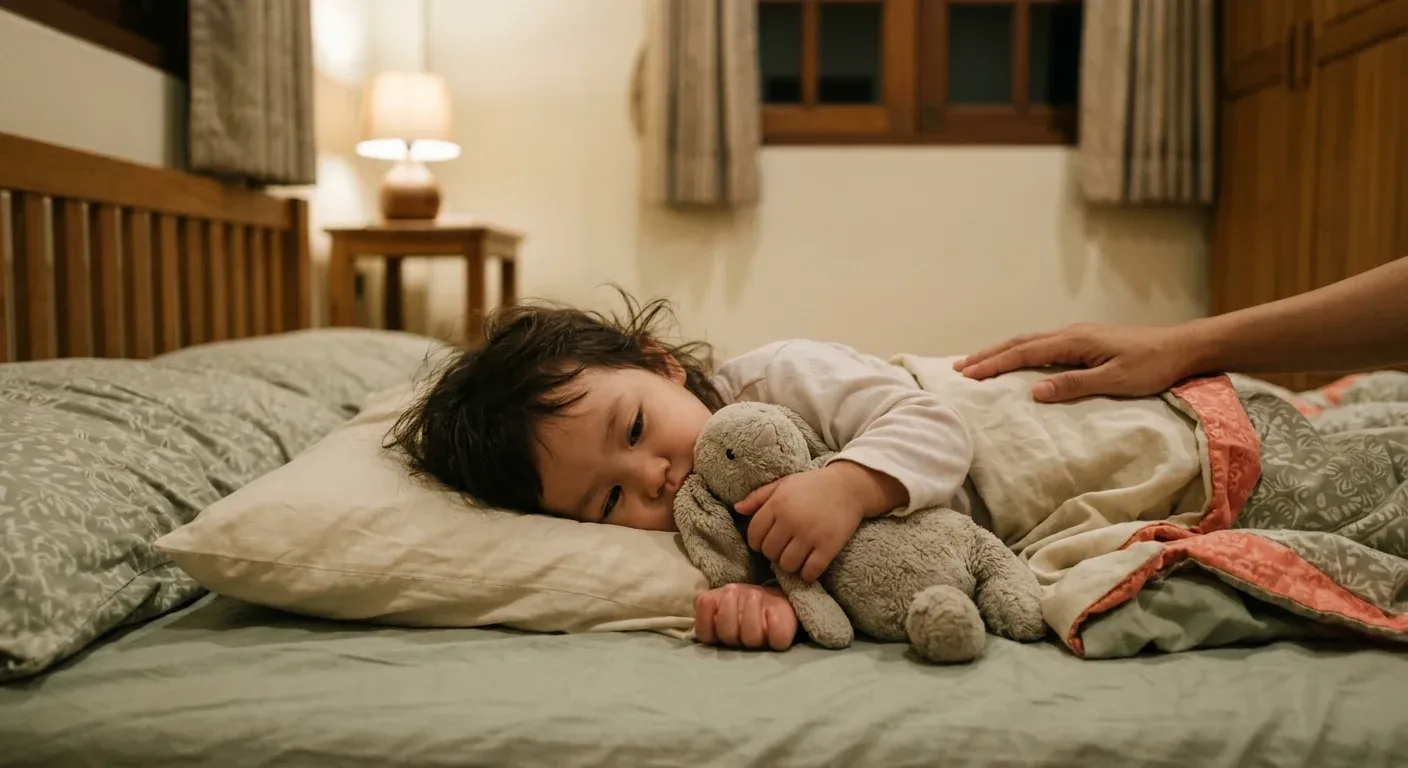
A toddler who won't sleep is not being difficult. They are a developing brain without working brakes, navigating a world that is suddenly very interesting. Your job is not to force sleep — it's to create the conditions where sleep can happen.
Your eighteen-month-old has thrown the blackout curtain to the floor. Your two-year-old is negotiating "just one more" for the fourteenth time. Your three-year-old woke screaming at 11 pm, thrashing and inconsolable, and had no memory of it by morning.
Toddler sleep is one of the most-searched parenting topics — and one of the most misunderstood. This is not infant sleep training. It is a distinct developmental landscape, with its own regressions, its own disruptions, and its own clinical vocabulary. This article draws on WHO [1], NHS [2], and AAP guidance [3] [4] to map that landscape as clearly as possible.
How Much Sleep Does a Toddler Need?
Before troubleshooting, you need a baseline. The WHO [1] guidelines (consistent with the 2016 American Academy of Sleep Medicine consensus) are:
| Age | Total sleep per 24 hours | Typical pattern |
|---|---|---|
| 1–2 years (12–24 mo) | 11–14 hours | 10–12 hr night + 1–3 hr in 1–2 naps |
| 3–5 years (preschool) | 10–13 hours | 10–13 hr night + nap that drops by age 4 |
Key transitions parents miss:
- Most toddlers drop from 2 naps to 1 somewhere between 15–18 months. The weeks around this transition are brutal — too rested for two naps, too tired without them. This is not a sleep problem; it is a developmental shift.
- Most toddlers drop the nap entirely between ages 3–5. The range is wide. A four-year-old who still naps and sleeps 11 hours at night is perfectly normal. So is a three-year-old who has been nap-free for six months.
- The AAP [3] notes that total sleep — including naps — is what matters. Counting only nighttime hours and concluding a toddler is "under-sleeping" is a common error.
One rule that applies at every toddler age: an overtired toddler sleeps worse, not better. Skipping a nap to "make them tired enough for bedtime" reliably backfires. Overtired children fight sleep harder, wake more at night, and rise earlier in the morning.
The Two Big Toddler Sleep Regressions
The 18-Month Regression
This is the most disruptive sleep regression most parents encounter. It coincides with:
- Vocabulary explosion — the language system is working overtime, and this cognitive load disrupts sleep
- Separation anxiety peaking — toddlers newly understand that people leave and might not come back
- Autonomy drive intensifying — "no" and "myself" are now a philosophy of life, including at bedtime
What it looks like: a previously good sleeper now fights sleep at every nap and bedtime, wakes frequently, calls for a parent multiple times a night, and may start refusing the crib entirely.
What helps: everything in the bedtime routine section below applies double here. Consistency and predictability are the antidote to the anxiety driving this regression. Hold the limit on bedtime firmly; acknowledge the separation ("I know you want me to stay — I love you, I'll be here in the morning") and leave.
The 2-Year Regression
Less universal than the 18-month version, but common and often prolonged. Triggers include:
- Language explosion (second phase) — toddlers move from 50-word vocabularies to 200–300-word vocabularies in a matter of months; the cognitive load is enormous
- Nightmare onset — the capacity for vivid, scary dreams develops around 2–3 years, and toddlers at this age cannot easily distinguish dream from reality
- New fears — darkness, monsters under the bed, the shadow on the wall. These are real to a 2-year-old; dismissing them extends the bedtime battle
What helps: validate the fear without reinforcing avoidance ("monsters aren't real, but I understand it feels scary — here's your nightlight"). A small nightlight, a consistent "monster check," or a spray bottle of "monster spray" (water with a sticker) all work as transition objects. The goal is enough reassurance to allow separation, not so much that bedtime becomes a 45-minute production.
Night Terrors vs Nightmares: The Clinical Distinction
This distinction matters because the right response to a nightmare actively worsens a night terror, and vice versa.
Night Terror (Parasomnia — NREM Deep Sleep)
A night terror is not a dream. It is a partial arousal from the deepest stage of non-REM sleep — the child's brain is partly awake and partly asleep at the same time.
- Occurs in the first 1–3 hours after sleep onset (when NREM-3 deep sleep is concentrated)
- Child appears to be awake: eyes open, may scream, sit up, thrash, walk
- Child does not recognise you, cannot be consoled, may push parents away
- Child has no memory of it the next morning
- Episode resolves on its own in 10–30 minutes
- Do not try to wake them — attempting to do so typically escalates the episode
- Do keep them safe (move furniture, prevent them from leaving the room), stay calm, and wait
According to NHS guidance [5], night terrors most commonly occur in children between ages 3 and 8, though onset in toddlerhood is possible. They are more common after sleep deprivation, illness, or significant stress. They run in families.
Sleep-walking, sleep-talking, and confusional arousals are all parasomnias on the same NREM spectrum. Same principle: keep safe, do not wake forcibly, wait.
Nightmare (REM Sleep — Dreaming Sleep)
A nightmare is a distressing dream, occurring during the REM phase.
- Occurs in the second half of the night (when REM cycles are longest)
- Child wakes up fully, is genuinely distressed, and can often describe what scared them
- Child recognises you and can be comforted
- Child has memory of it — may resist going back to sleep
- Typical onset: 2–3 years, as imagination and the capacity for vivid dreaming develop
Response to a nightmare: go to them, hold them, reassure them. "It was a dream — you're safe, I'm here." Let them calm down, offer comfort, then help them back to sleep. A brief check under the bed ("nothing here — all clear") is fine. A 45-minute production of checking every room with all the lights on is not — it signals to the toddler that their fear was warranted.
The key parent error is treating a night terror like a nightmare: rushing in, turning on lights, trying to console a child who cannot process any of this, and escalating the episode. If your child is screaming but doesn't seem to see you — that is a night terror. Step back, keep the room dim, and wait.
Bedtime Routine: The Foundation That Works at Every Age
The bedtime routine works in infancy and it continues to work through toddlerhood. If you have one, protect it. If you do not, now is the best time to build one.
Effective elements, per NHS guidance [2] and AAP recommendations [3]:
- Consistent timing — within a 30-minute window every night. The body clock (circadian rhythm) is a biological system; irregular timing trains it poorly.
- Wind-down period: 30–60 minutes — lower stimulation before bed. No rough play, no screens (AAP recommends screen-free for 1 hour before bed [4]), dim lights.
- A predictable sequence — bath → pyjamas → teeth → 1–2 books → song → lights out → goodbye. The sequence signals to the nervous system that sleep is coming. Toddlers need this signal even more than infants because their regulatory capacity is so much higher and their delay tactics so much more sophisticated.
- A comfort object — a lovey, soft toy, or special blanket that the toddler chooses. This becomes a self-reproducible sleep association — unlike nursing-to-sleep or a parent lying down, a comfort object is always there at 2 am when the sleep cycle ends.
- A genuine goodbye — do not creep out after the toddler falls asleep. Put them down awake, say goodnight, and leave. This is the drowsy-but-awake principle from infant sleep training, now applied to a toddler who understands cause and effect: "When I fall asleep, Mama/Papa is still here" versus "When I fall asleep, Mama/Papa disappears — and I don't know if they'll come back."
The Crib-to-Bed Transition
The crib-to-toddler-bed transition is frequently done too early and for the wrong reasons. Important framing first: moving to a toddler bed does not fix toddler sleep problems. A toddler who woke three times per night in a crib will wake three times per night in a bed — they will just now be able to walk to your room.
When to transition:
- Safety mandate: child is climbing out of the crib. A climbing toddler is a fall risk. This is the non-negotiable trigger.
- Child's head is above the top rail when standing
- New baby needs the crib
When not to transition:
- Just because the toddler asks — if they are under 2.5–3 years and not climbing, there is no benefit
- To "solve" sleep problems — the transition creates new ones (freedom to roam at night) without resolving the underlying issue
- During an already-disruptive regression
Safety when you do transition:
- Low bed or floor mattress — eliminate the fall risk
- Baby-proof the room completely — assume your toddler will explore it at 3 am. Lock or block anything unsafe.
- Gate at top of stairs — non-negotiable
- Nightlight — so they can see where they are if they do wake
What Works: Practical Strategies for 1–3 Year Olds
Constrained choices: "Do you want to wear the blue pyjamas or the red pyjamas?" Autonomy is the central developmental drive of this age. Offer real choices within your acceptable range. "What do you want to wear?" is an invitation to chaos. A binary choice is not a negotiation — it is a gift of control within a structure you set.
The bedtime pass: A physical card (can be a homemade token) that entitles the toddler to one post-bedtime request — one glass of water, one extra hug, one last bathroom trip. After the pass is used, no more. This is one strategy that works for many families: it gives the toddler autonomy and a "way out" of separation anxiety, while creating a hard limit. The pass is a tool, not a reward — using it means bedtime restarts, not that they get a prize.
Brief, boring re-entries: When the toddler calls out, go in briefly, calmly, without turning on the light, without engaging in conversation, check they are safe, say "goodnight, I love you" and leave. The goal is to signal "you are safe and I am here" without signalling "if you call, something interesting will happen."
Acknowledge, don't negotiate: "I know you want me to stay. I love you. I'll see you in the morning." Then leave. Repeating this line every time they call — without variation — removes the incentive to keep calling.
White noise, blackout curtains: Both are helpful for light-sensitive or noise-sensitive toddlers, particularly in Thailand's urban environment. Bangkok heat is also a factor: most pediatric sleep guidance recommends a cool, comfortable bedroom (commonly cited ranges fall around 16–22°C / 60–72°F). Air-conditioning the bedroom for the sleep period is a practical approach for Thai families.
What Doesn't Work
Inconsistent bedtime — the most reliable way to produce sleep difficulties. Even weekend irregularity of 45+ minutes disrupts the circadian clock.
Lengthy bedtime negotiations — every minute of extended engagement after goodnight teaches the toddler that the bedtime is not real. Keep goodnight short.
Lying down with the child every night until they fall asleep — this creates a parental-presence sleep association. The toddler cannot fall back asleep at 2 am without the same condition. If the current arrangement works for your family (everyone sleeps, everyone is rested), it is not a problem. If it is causing suffering, it is worth changing.
Removing the nap prematurely to "make them tired enough" — reliably produces an overtired toddler who is harder to put down, wakes more, and rises earlier.
Large rewards or punishments around sleep — raising the stakes raises anxiety. A toddler who is afraid they "failed" at sleep cannot relax into it.
Melatonin without paediatric guidance — the AAP's position is that good sleep habits come first and melatonin is not a substitute for a bedtime routine; any use should be discussed with your paediatrician [7]. Short-term, supervised use can be appropriate for children with neurodevelopmental differences (autism, ADHD) who have severely disordered sleep. For otherwise healthy toddlers with typical bedtime resistance, melatonin does not address the underlying cause and is not the first step.
The Co-sleeping Conversation for Thai Families
Most Thai toddlers sleep with parents or grandparents — in the same bed or the same room — through age 2–3 or beyond. This is culturally normal and does not require correction.
The AAP's safe-sleep guidance around bed-sharing applies most urgently to infants under 12 months, where the SIDS risk is highest. For toddlers over 12 months, the acute risk profile is different. If your family co-sleeps with a toddler and everyone is sleeping adequately and safely, this is a family choice, not a medical problem.
Two practical considerations for Thai families who co-sleep:
- Consistency across caregivers matters more than method. If a toddler sleeps with parents on some nights and alone on others, the inconsistency is more disruptive than either arrangement. Multi-generational households (grandparents involved in bedtime) benefit from agreeing on a consistent approach and sticking with it.
- If you want to transition away from co-sleeping, do it gradually and on the toddler's terms where possible — move from the same bed to a mattress on the floor in the same room, then to a bed in their own room with the door open. Abrupt overnight separations at 2–3 years typically produce weeks of disrupted sleep before any gain.
Red Flags: When Toddler Sleep Needs Medical Assessment
The following warrant a conversation with your paediatrician [3]:
- Loud snoring every night — possible obstructive sleep apnoea (enlarged tonsils/adenoids are the most common cause in toddlers)
- Mouth breathing during sleep
- Pauses in breathing, gasping, or choking sounds during sleep
- Restless legs or repeated leg-kicking that disturbs sleep
- Extreme daytime sleepiness despite apparently adequate total sleep hours
- Night terrors that continue past age 7–8 or involve physical violence
- Any episode with prolonged loss of consciousness or seizure-like movements — see a doctor same day
- Developmental regression in speech, toilet training, or other acquired skills alongside sleep disruption
Do not wait to raise these concerns at the next scheduled well-child visit if the pattern is persistent.
Summary
Toddler sleep is genuinely hard — biologically, developmentally, and culturally. The tools that make it less hard are not tricks; they are the conditions a developing brain needs to organise its own sleep.
Key principles:
- Know the hours. WHO [1] recommends 11–14 hr/day for 1–2 year olds; 10–13 hr for 3–5 year olds (including naps). Counting only night hours misses the picture.
- Regressions are temporary. The 18-month and 2-year regressions are driven by real developmental shifts; they pass. Consistency shortens them.
- Night terrors and nightmares are different. Night terror = NREM, first third of night, no memory, do not try to wake. Nightmare = REM, second half of night, child wakes fully, can be comforted. [5]
- The bedtime routine is the highest-yield intervention. Same sequence, same time, every night.
- Co-sleeping with toddlers is a family choice. The acute safe-sleep concerns centre on infants under 12 months. Consistency across caregivers matters more than the specific arrangement.
- Dropping the nap too early makes everything worse. Most toddlers need a nap until 3–5 years. Protect it.
- Red flags need a paediatrician. Snoring, mouth breathing, breathing pauses, and extreme daytime sleepiness are not "just how they sleep."
For the foundations of infant sleep training before toddlerhood, see sleep training. For the toddler developmental context driving bedtime resistance and night-waking, see toddler/year-2 and toddler/month-19-21. For the emotional regulation tools that also help at bedtime, see toddler-tantrums.
แหล่งอ้างอิง
- WHO — To grow up healthy, children need to sit less and play more (2019). Sleep duration: 1–2 years 11–14 h/day including naps; 3–4 years 10–13 h/day.
- NHS — Helping your baby to sleep. Sleep hours after first birthday (~12–15 h); 2-year-olds (~12–14 h including naps); bedtime routine: bath, dim lights, story.
- AAP HealthyChildren — Healthy Sleep Habits: How Many Hours Does Your Child Need? Sleep totals include naps; screen-free 1 h before bed; snoring/sleep apnoea named as red flags.
- AAP HealthyChildren — Getting Your Baby to Sleep. Drowsy-but-awake; consistent routine; self-settling from 4 months.
- NHS — Night terrors. Definition, timing (early night, NREM), response (do not wake), difference from nightmares, age range 3–8.
- กรมอนามัย กระทรวงสาธารณสุข — ส่งเสริมสุขภาพแม่และเด็ก
- AAP HealthyChildren — Melatonin and Children's Sleep. Good sleep habits first; melatonin not a substitute for routine; pediatric supervision required; selective use in autism / ADHD.