
Infant & Child CPR: A Step-by-Step Guide for Parents
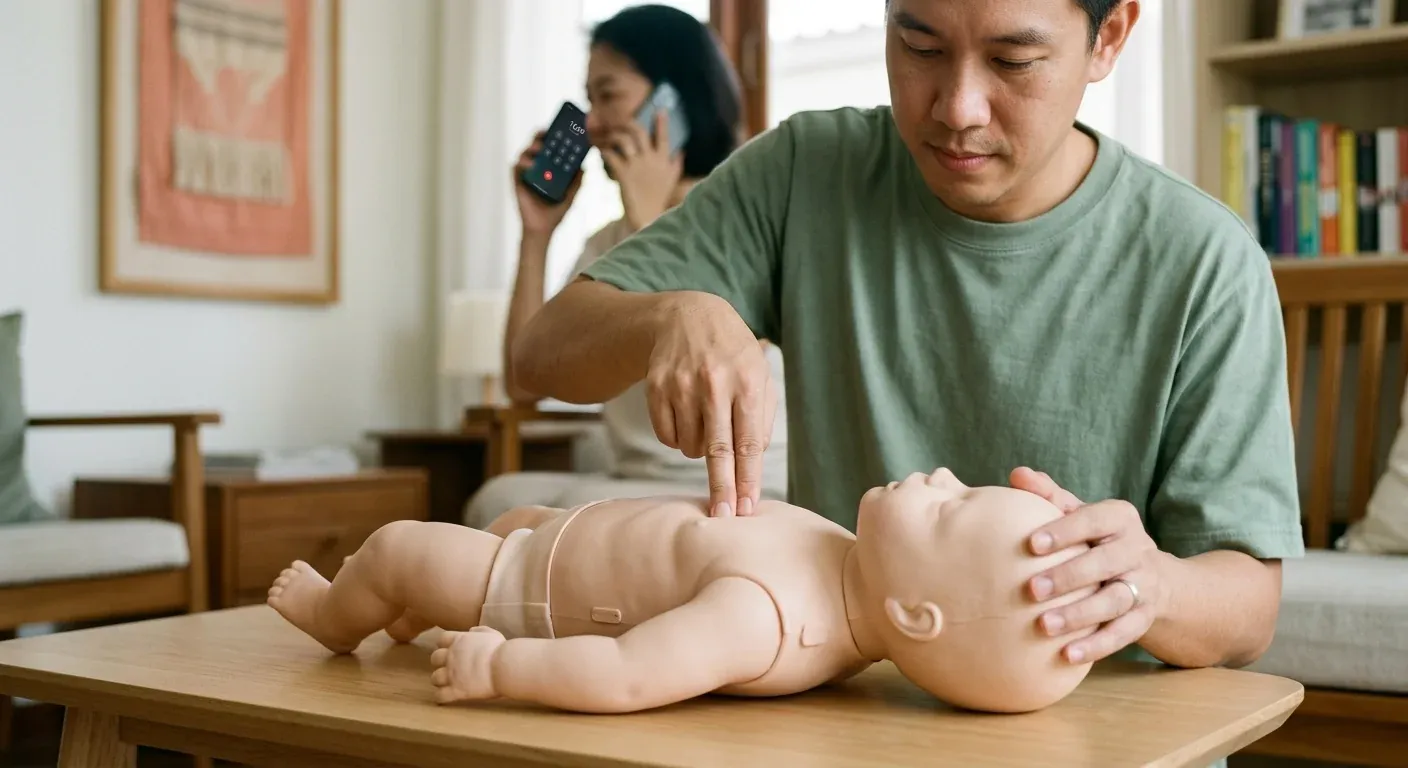
In a cardiac emergency, every second counts — but starting CPR correctly is what saves lives. You do not need to be a medical professional. You need to know four things: call, compress, breathe, and keep going.
Cardiac arrest is rare in infants and young children — but when it happens, it is almost never the "heart attack" kind adults experience. In children, the heart usually stops because breathing has stopped first. This means rescue breaths are not optional in pediatric CPR — they are essential. This guide covers what to do for infants under 1 year and children aged 1 to 8, based on current NHS, American Red Cross, and AHA guidelines [1][2][3].
This guide is not a substitute for hands-on CPR training. Every parent of a young child should take an in-person infant CPR course. This article helps you understand what you are learning — and gives you a reference to revisit.
When to Start CPR
Start CPR immediately if your infant or child is:
- Unresponsive — does not react to your voice or a firm tap (for infants: tap the bottom of the foot; for children: tap the shoulder and call their name)
- Not breathing normally — no chest rise, gasping, or agonal (irregular, slow) breathing
Do not wait to see if they "come around." If they are unresponsive and not breathing, begin CPR and have someone call emergency services simultaneously.
Call 1669 (Thailand EMS) or 911/999 immediately — or shout for someone nearby to call while you start compressions [4].
What CPR does NOT fix
CPR maintains circulation until professional help arrives. It does not restart the heart on its own. An AED (Automated External Defibrillator — the device available in malls, airports, and many public buildings) can restart a heart in certain rhythms. If an AED is nearby, retrieve it — but do not delay CPR to search for one.
Infant CPR: Step-by-Step (Under 1 Year) [1][2]
Step 1 — Check safety and responsiveness
Lay the infant on a firm, flat surface. Flick the bottom of their foot firmly. Shout their name. If no response in 10 seconds:
Step 2 — Call for help
Shout for someone to call 1669 and bring an AED if available. If you are alone, call first (or put the phone on speaker), then begin CPR.
Step 3 — Give 5 initial rescue breaths
This is the most important difference from adult CPR.
- Tilt the head back gently — only slightly. An infant's airway is small; too much tilt folds it shut. Lift the chin with one finger.
- Cover both the mouth and nose of the infant with your mouth (an infant's face is small enough for this).
- Breathe in gently — use only the air in your cheeks, not a full breath from your lungs. Watch for the chest to rise.
- Let the chest fall, then give the next breath.
- Give 5 initial rescue breaths. If the chest does not rise after repositioning the head, check the mouth for an obvious obstruction.
Step 4 — Start chest compressions
Place 2 fingers (or preferably both thumbs side-by-side with your hands encircling the chest if you are alone) on the centre of the chest, just below the nipple line.
- Depth: Push down 4 cm (about 1.5 inches) — approximately one-third of the chest depth.
- Rate: 100–120 compressions per minute (the tempo of the song "Stayin' Alive").
- Recoil: Let the chest fully spring back between compressions. Do not lean on the chest.
- Give 30 compressions.
Step 5 — 2 rescue breaths
After 30 compressions, give 2 rescue breaths (as in Step 3, gentle, 1 second each, watching for chest rise).
Step 6 — Continue: 30 compressions + 2 breaths
Repeat the cycle of 30 compressions and 2 rescue breaths without stopping. Do not stop to check for a pulse — only stop if:
- The infant shows clear signs of life (movement, normal breathing)
- A trained responder or EMS takes over
- An AED is ready to use
- You are physically unable to continue
Step 7 — AED use for infants
If an AED arrives, turn it on and follow its voice prompts. Use paediatric pads if available. If only adult pads are present, use them — one on the centre of the chest, one on the back. Do not delay shocking if the AED advises it.
Child CPR: Step-by-Step (Ages 1–8) [1][2]
The sequence is the same. Key differences:
Step 1–2 — Check responsiveness and call for help
Tap the shoulder and call the child's name. No response in 10 seconds → call 1669 and start CPR.
Step 3 — 5 initial rescue breaths
- Tilt the head back slightly more than for an infant (airway is bigger).
- Pinch the nose closed, seal your mouth over the child's mouth.
- Give a breath lasting 1 second, watching for chest rise.
- Give 5 initial rescue breaths.
Step 4 — Chest compressions
Place the heel of one hand (or two hands for a larger child) on the lower half of the breastbone, centre of the chest. Do not press on the ribs.
- Depth: Push down 5 cm (about 2 inches) — approximately one-third of chest depth.
- Rate: 100–120 compressions per minute.
- Let the chest recoil fully between compressions.
- Give 30 compressions.
Step 5–6 — 2 rescue breaths, then continue
Give 2 rescue breaths (1 second each), then resume compressions. Continue the 30:2 cycle until signs of life appear, EMS arrives, or an AED is ready.
Step 7 — AED use for children
Children aged 1–8: use paediatric pads if available. If only adult pads are present, place one on the front of the chest and one on the back. Follow the AED's voice prompts.
When to Call 1669 (and What to Say)
Call 1669 (Thailand's national EMS) the moment you find an unresponsive, non-breathing child [4]. If you are alone:
- Call first, then begin CPR — the dispatcher can guide you through the steps while help is on the way.
- If there are two adults: one calls, one starts CPR immediately.
What to tell the dispatcher:
- "My child / baby is not breathing and not responding."
- Your address (be specific — building, floor, unit).
- The child's approximate age.
- Stay on the line — the dispatcher will guide you.
If outside Thailand: 911 (USA), 999 (UK), 112 (EU), or your local emergency number.
Common Mistakes to Avoid
Even people who have taken CPR training can freeze or misremember in a real emergency. The most common errors [1][2]:
| Mistake | Why it matters | Correct approach |
|---|---|---|
| Skipping rescue breaths | In children, cardiac arrest is usually caused by breathing failure — breaths are essential | Always give 5 initial rescue breaths before starting compressions |
| Too-gentle compressions | Inadequate depth doesn't circulate blood | Push firmly: 4 cm (infant), 5 cm (child). It should feel like effort |
| Tilting the head too far back (infant) | Folds the airway shut | Gentle tilt only — just enough to align the airway |
| Stopping to check for pulse | Delays circulation; laypersons cannot reliably find a pulse on a distressed infant | Only stop for AED use or obvious signs of life |
| Giving too-large rescue breaths | Pushes air into the stomach, not the lungs, risking vomiting | Gentle puff only — just enough to see the chest rise |
| Waiting to call EMS | Every minute without defibrillation or professional care reduces survival | Call 1669 the moment you find an unresponsive, non-breathing child |
Prevention and Preparedness
CPR is a last resort. Most infant cardiac emergencies are preventable [1][4]:
- Safe sleep position: Always place babies on their backs to sleep (reduces SIDS risk). See our Safe Sleep guide.
- Choking prevention: Avoid small objects and foods (whole grapes, nuts, popcorn) within reach of infants. Know the difference between choking and cardiac arrest — they require different responses. See our Choking First Aid guide.
- Take a hands-on CPR course. Reading this guide is a start. A two-hour in-person infant CPR class with a mannequin is what actually builds muscle memory. In Thailand, the Thai Red Cross, major hospitals (Bumrungrad, Samitivej, Bangkok Hospital), and NIEMS (สพฉ.) offer regular public CPR courses.
- Check your home for AEDs. Know where the nearest AED is located in your building, shopping centre, and regular commute routes.
Summary
| Age | First step | Compressions | Rescue breaths | Ratio |
|---|---|---|---|---|
| Infant (<1 year) | 5 rescue breaths | 2 fingers or 2-thumb encircle, 4 cm deep, 100–120/min | Cover mouth AND nose | 30:2 |
| Child (1–8 years) | 5 rescue breaths | Heel of 1 hand, 5 cm deep, 100–120/min | Pinch nose, seal mouth | 30:2 |
Remember — CAB for children:
- Call 1669 (or have someone else call while you begin)
- Airway — 5 initial rescue breaths first (not optional for children)
- Breathing + compressions — 30:2 until help arrives
Do not wait for someone else to act. Start CPR. Keep going.