
Car Seat Safety: Every Ride, Every Time
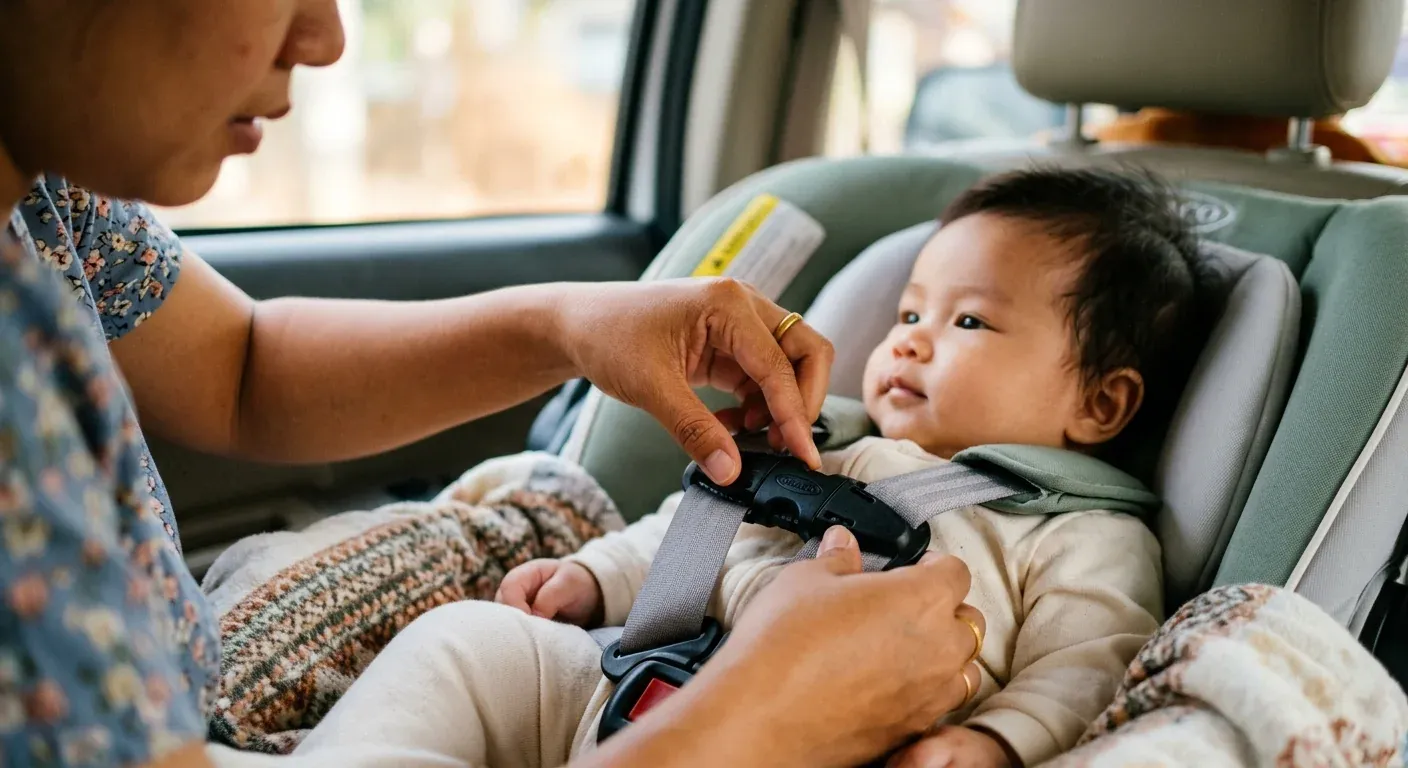
A correctly fitted car seat is the single most effective thing you can do for your child's safety in a vehicle. Every ride. Every time.
The WHO estimates that child restraints can reduce infant deaths in road crashes by up to 71% [3]. Yet the most common cause of death and serious injury for young children in road traffic is not the wrong car seat — it is no car seat, or a car seat used incorrectly. This guide covers the principles that apply every time you buckle your child in.
What Thai Law Requires (Since September 2022)
Thailand amended the Road Traffic Act (พ.ร.บ.จราจรทางบก ฉบับที่ 13 พ.ศ. 2565, Section 123) with effect from 5 September 2022 [4]. The law requires:
- Children under 6 years old must use a child restraint system (car seat) in any motor vehicle.
- The maximum fine for non-compliance is 2,000 baht.
The law applies to all private vehicles. Enforcement frequency varies by area and period; the legal obligation is continuous regardless of enforcement activity.
If you are unsure whether your vehicle's existing child restraint meets Thai standards, the Department of Land Transport (กรมการขนส่งทางบก, dlt.go.th) is the authority for regulatory questions.
Choosing a Seat Type by Age and Weight
Car seats fall into four stages. The key principle: spend as long as possible in each stage before moving to the next — moving up early reduces protection.
Stage 1: Rear-Facing Infant Seat (Birth Onward)
Rear-facing is the safest position for young children. The AAP recommends keeping children rear-facing as long as possible, until they reach the highest weight or height allowed by their seat's manufacturer [1]. NHTSA explains why: a rear-facing seat "cradles and moves with your child to reduce the stress to the child's fragile neck and spinal cord" in a crash [2].
- Infant-only seats accommodate newborns up to roughly 13–15 kg.
- Convertible seats can be used rear-facing from birth, then turned forward-facing later — they offer higher weight limits and are the most cost-effective long-term option.
Typical rear-facing use: birth through at least age 2, and longer if the seat's limits allow.
Stage 2: Forward-Facing with 5-Point Harness (After Outgrowing Rear-Facing)
Once a child has outgrown the maximum weight or height of their rear-facing seat, they move to forward-facing with a full harness. Use the harness as long as the seat allows — at least to age 4, and ideally longer [1].
Forward-facing seats always require a top tether (the strap that anchors to the vehicle's rear shelf or floor) in addition to the lower anchors or seatbelt. The top tether significantly reduces forward head movement in a crash.
Stage 3: Booster Seat (When Harness Is Outgrown)
A booster seat raises the child so that the vehicle's own seatbelt fits correctly — the lap belt low across the upper thighs (not the stomach), and the shoulder belt crossing the chest and shoulder (not the neck or face) [2].
Booster use typically continues until the child passes the seatbelt fit test (see Stage 4 below). This is usually around age 8–12 and height approximately 145 cm.
Stage 4: Vehicle Seatbelt Alone
A child is ready for the vehicle's seatbelt alone when all five of the following are true:
- They sit with their back flat against the seat back.
- Their knees bend naturally at the seat edge.
- The lap belt lies flat across the upper thighs.
- The shoulder belt crosses the chest — not the neck or face.
- They can stay in that position for the whole journey.
Until all five apply, continue using a booster. NHTSA recommends keeping children in the back seat through age 12 [2].
Installing the Seat Correctly
A correctly chosen seat that is installed loosely provides much less protection than one installed firmly. The two-finger rule: at the belt path, the seat should not move more than 2.5 cm (about one inch) in any direction.
LATCH / ISOFIX vs. Seatbelt
Most vehicles sold in recent years have anchor points for a standardised attachment system — called LATCH in the United States or ISOFIX under the ISO/ECE standard used in Thailand and Europe. Both names describe the same principle: rigid lower anchors in the seat crease plus a top tether anchor.
The AAP and NHTSA are clear: the seatbelt and LATCH/ISOFIX systems are equally safe [1][2]. Use whichever gives a firmer, easier installation in your specific vehicle and seat combination — not both simultaneously (dual installation can concentrate crash forces on the wrong path).
Top Tether
The top tether is the strap that runs from the top of a forward-facing seat to an anchor point behind or below it. Always use the top tether with a forward-facing seat, whether you installed with lower anchors or the seatbelt [1]. The top tether reduces forward head movement by up to 4–6 inches in a frontal crash.
Recline Angle for Newborns and Young Infants
Rear-facing infant seats have a recline indicator. Use it. Newborns need a recline of roughly 45° — sitting too upright allows the head to flop forward and can obstruct the airway in a sleeping baby. As the child grows and develops head control, the recline angle can be gradually reduced according to the seat's guide.
Avoiding Active Airbags
Never place a rear-facing seat in the front passenger seat of a vehicle with an active frontal airbag. Even in a low-speed crash, airbag deployment can strike the car seat and cause serious brain injury or death [1]. Rear-facing seats belong in the back seat.
Harnessing Your Child Correctly
Correct installation of the seat is only half the equation. The harness must also be fitted correctly every time.
Chest Clip Position
The chest clip (the flat buckle that clips the two shoulder straps together) must be positioned at armpit level — level with the child's armpits, not at the belly or collarbone [1]. At belly level it provides no crash protection to the upper body; at the throat it can injure the child.
Harness Snugness — The Pinch Test
After buckling, run a finger along the harness straps at the collarbone. You should not be able to pinch any slack between your fingers [1]. If you can, tighten the harness. A "snug but comfortable" check: there should be no loose fabric folds, but the child should be able to breathe normally.
No Bulky Coats Under the Harness
Winter coats, thick puffer jackets, or padded snowsuits worn under the harness compress dramatically in a crash — leaving the harness suddenly far too loose to restrain the child. The AAP's guidance is to dress the child in thin layers and place coats or blankets over the harness, not under it, once buckled [1]. A fleece layer directly on the child is fine; a puffer jacket is not.
Aftermarket Pads and Strap Covers
Car seats are crash-tested as supplied. Adding aftermarket harness pads, strap covers, or head supports that did not come with the seat can alter the harness geometry and may not perform safely in a crash. Use only accessories supplied by or approved by the seat's manufacturer.
Common Mistakes to Avoid
| Mistake | Why it matters | What to do instead |
|---|---|---|
| Switching to forward-facing too early | Rear-facing distributes crash forces across the whole back, neck, and head. Moving forward too early loses this protection. | Stay rear-facing until the seat's height or weight limit is reached. |
| Loose harness | A harness that passes the pinch test provides restraint; a loose harness does not. | Tighten until you cannot pinch slack at the collarbone. |
| Bulky coat under the harness | Padding compresses in a crash, leaving the harness suddenly loose. | Thin layers under, coat over the buckled harness. |
| Skipping the top tether | The top tether cuts forward head travel significantly. | Always clip the top tether to the vehicle anchor when forward-facing. |
| Secondhand seat with unknown history | A seat that has been in a moderate or serious crash may have invisible structural damage. | Only use a secondhand seat if you know its full history — no crashes, not expired. |
| Using an expired seat | Plastic degrades over time; most seats have a 6–10 year lifespan. | Check the manufacture date on the seat's label and the manufacturer's expiration guidance [1]. |
| Aftermarket accessories | Untested add-ons can change how the harness behaves in a crash. | Use only manufacturer-supplied or manufacturer-approved accessories. |
When to Upgrade
Move to the next stage only when your child has outgrown the current seat — not when you think they look too big, and not at a fixed birthday. The signals to move:
- Rear-facing to forward-facing: head is within 2.5 cm of the top of the shell, or weight has reached the seat's rear-facing limit.
- Forward-facing harness to booster: shoulders are above the highest harness slot, or weight exceeds the seat's harness limit.
- Booster to seatbelt: all five seatbelt-fit criteria are met (see Stage 4 above).
There is no minimum age to move up — only minimum physical milestones. If your child is 4 years old and still within the rear-facing limits, keep them rear-facing.
Summary
Car seat protection follows a straightforward sequence: rear-facing as long as possible → forward-facing harness as long as possible → booster until the seatbelt fits correctly. At every stage, the seat must be installed firmly and the harness snugged to the pinch-test standard.
The most common protection failures are not the wrong seat — they are the right seat used loosely, with a bulky coat compressing the harness, or a child moved forward too early. A correct installation and a correct harness check before every journey is what "every ride, every time" means.
For questions about Thai legal compliance, contact กรมการขนส่งทางบก (dlt.go.th).
แหล่งอ้างอิง
- AAP HealthyChildren — Car Safety Seats: Information for Families. Rear-facing as long as possible (highest weight/height limit); chest clip at armpit level; pinch test (no slack); no bulky coat under harness; seatbelt and LATCH equally safe (not both); top tether always with forward-facing; avoid secondhand seats of unknown history; check expiration date on label; never rear-facing in front seat with active airbag.
- NHTSA — Car Seats and Booster Seats. Rear-facing cradles and moves with child to reduce stress on neck/spinal cord; forward-facing harness + tether; booster raises child for correct belt fit; lower anchors OR seatbelt — never both; always use tether with forward-facing; keep children in back seat through age 12; replace after moderate-to-major crash.
- WHO — Road Traffic Injuries. Child restraints can reduce infant deaths in road crashes by up to 71%; child restraint use is part of the WHO safe-system approach to road safety.
- กรมการขนส่งทางบก (Department of Land Transport) — พ.ร.บ.จราจรทางบก ฉบับที่ 13 พ.ศ. 2565 Section 123: children under 6 must use a child restraint system; effective 5 September 2022; maximum fine 2,000 baht.
- Samitivej Hospitals TH (samitivejhospitals.com/th) — Thai institutional authority for child passenger safety vocabulary (คาร์ซีท, ISOFIX, บูสเตอร์ซีท). Notes 70–80% reduction in crash severity with correct restraint use.