
Breast Milk Storage: The CDC Hours-Days-Months Rule — and Everything Else That Matters
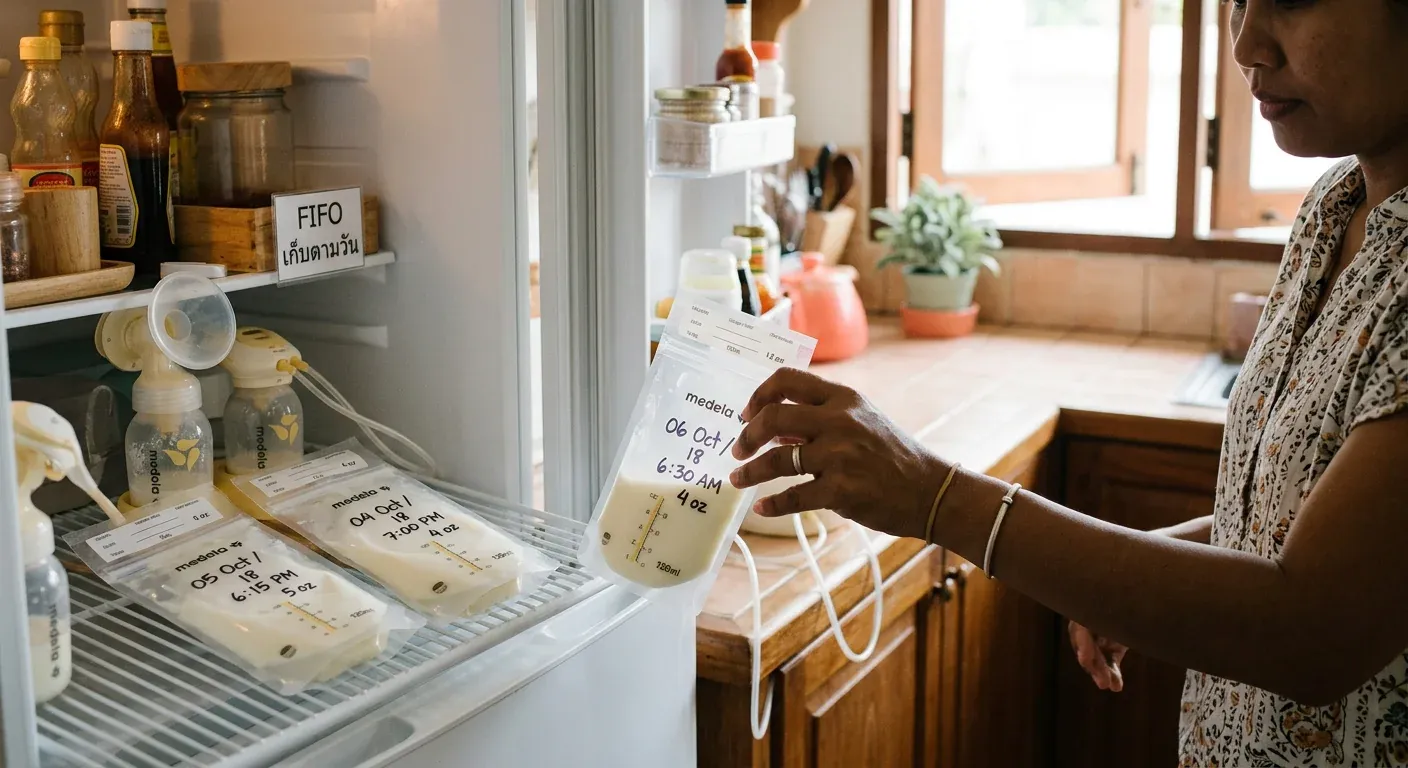
Breast milk is liquid gold — the right storage turns a pumping session into nourishment that lasts for months The CDC's Hours-Days-Months rule is the clearest framework a pumping parent can own: 4 hours at room temperature, 4 days in the fridge, 6 months in the freezer — with a few extra details that protect both safety and nutritional quality
Pumping parents carry a constant low-level worry: is the milk I worked hard to express still safe? The good news is that the CDC and the American Academy of Pediatrics (AAP) give clear, evidence-based storage guidelines that answer almost every question [1][2]. The NHS adds some nuance on refrigerator times, and the WHO anchors the whole enterprise in why breast milk storage matters — it is the delivery mechanism for six months of recommended exclusive breastfeeding [3][4].
This guide walks through every storage scenario a pumping parent encounters, in the order you are most likely to encounter them.
The Core Rule: Hours-Days-Months
The CDC's storage framework [1] is built around one easy-to-memorise sequence:
| Location | Temperature | Best use by | Acceptable upper limit |
|---|---|---|---|
| Room temperature | ≤ 77°F / 25°C | 4 hours | 6–8 hours (very cleanly expressed milk only) |
| Refrigerator | ≤ 40°F / 4°C | 4 days | 5–8 days (NHS: up to 8 days at ≤4°C) [3] |
| Freezer (standard) | 0°F / −18°C | 6 months | Up to 12 months (quality declines after 6 months) |
| Previously frozen, thawed in fridge | — | 24 hours | Do not refreeze |
| Leftover from a feeding (baby drank from bottle) | — | 2 hours | Discard after 2 hours |
The CDC is explicit [1]: freshly expressed milk can stay at room temperature (77°F or colder) for up to 4 hours. In the refrigerator, up to 4 days is best; "in the freezer for about 6 months is best; up to 12 months is acceptable." The NHS guidelines specify up to 8 days in a refrigerator kept consistently at or below 4°C [3] — a small practical extension, but only if your fridge is reliably cold.
The AAP's HealthyChildren guidance specifies freezer storage at 0°F/−18°C for up to 9 months in a standard freezer (with a separate door), and up to 12 months in a dedicated deep freezer (−4°F/−20°C) [2]. "Best" means not just safety, but maintained nutritional and immune quality — fat content, vitamin levels, and immunoglobulins degrade over time even in a freezer.
Choosing the Right Container
The CDC specifies: use breast milk storage bags or clean, food-grade containers made of glass or hard plastic with tight-fitting lids [1]. Never use disposable bottle liners or regular plastic bags not designed for breast milk storage — they can tear, leak, and may not be food-safe.
Practical checklist:
- BPA-free hard plastic or glass containers with a secure lid
- Dedicated breast milk storage bags (thicker than standard zip bags, pre-sterilised)
- Store in 2–4 ounce (60–120 ml) portions to minimise waste — a baby who takes two ounces per feed shouldn't be thawing six [2]
- Label every container with the date (and time, if storing multiple sessions per day) expressed — the CDC says clearly: "Clearly label breast milk with the date it was expressed" [1]
- Store at the back of the refrigerator or freezer, not the door — door temperatures fluctuate with every opening [1]
Thawing Frozen Breast Milk Safely
The CDC gives three safe thawing methods [1]:
- Overnight in the refrigerator — slowest, gentlest, best for quality. Plan ahead by 12–24 hours.
- Warm running water — hold the sealed container under cool water, gradually warming it. Safe and faster than fridge.
- Container in warm water — place the sealed container in a bowl of warm (not boiling) water. Same principle as warm running water.
Never microwave breast milk. The CDC is unambiguous [1]; the NHS explains why: "This can cause hot spots, which can burn your baby's mouth" [3]. Microwaves heat unevenly — the centre of a bottle can be scalding even when the outside feels warm. Additionally, high heat degrades some of the immunoglobulins that make breast milk so valuable.
Once thawed, use within 24 hours [1]. Never refreeze previously frozen breast milk — this raises bacterial risk and further degrades nutritional quality.
Warming Refrigerated Milk
Breast milk does not need to be warm — many babies accept cool or room-temperature milk happily. If you want to warm it:
- Place the sealed container in warm water for a few minutes, or
- Use a bottle warmer set to a gentle cycle
The goal is body temperature or slightly below — comfortable on your wrist (roughly 37°C or below). If the bottle feels hot to the touch, it is too hot. Shake the bottle — then check the temperature again.
Never heat on the stovetop or in boiling water; vigorous heat destroys immunoglobulins just as microwaving does.
Leftover Milk After a Feeding
Once your baby drinks from a bottle of breast milk, bacteria from their saliva enter the milk. The CDC guideline: use leftover milk within 2 hours, then discard [1]. The NHS sets a tighter 1-hour limit for milk once a baby has begun feeding from the bottle [3]. Do not refrigerate and reuse milk that a baby has already drunk from.
This is the one rule that catches many parents off guard — it means if you prepared a 4-ounce bottle and your baby only drank 2, you cannot save the rest for the next feed. Smaller initial portions reduce how often this happens.
Separation and the Cream Layer — Normal, Not Spoiled
Stored breast milk separates: the fat (cream) rises to the top, leaving a more watery layer below. This is completely normal — breast milk is not homogenised. Gently swirl the container to re-mix. Do not shake vigorously; La Leche League International notes that aggressive shaking can degrade some milk proteins, though the clinical significance is modest compared to the disruption of avoiding it altogether.
The separated appearance is not a sign of spoilage. Spoilage is detected by smell and taste — fresh breast milk has a mild, slightly sweet scent. Spoiled milk smells distinctly sour or rancid.
High-Lipase Milk: Soapy Smell After Refrigeration
Some mothers have naturally high levels of lipase — an enzyme that begins breaking down fat in milk, producing a soapy or metallic smell within hours of refrigeration. This is safe for babies, but some infants refuse it due to the altered taste.
If your refrigerated or thawed milk smells soapy and your baby is refusing it:
- Scald fresh milk before storing: heat it briefly to 82°C (just before a full boil), then cool rapidly and refrigerate or freeze. Scalding deactivates lipase. Do not boil — this destroys more of the milk's beneficial components.
- Scalded milk does not smell soapy after storage, but it has lower immunoglobulin activity than non-scalded milk — a trade-off worth discussing with your lactation consultant.
High-lipase milk does not mean something is wrong with you or your milk. It is a common variant.
Combining Milk from Different Sessions
You can combine fresh and previously cooled milk — but cool fresh milk in the refrigerator first before adding it to already-chilled milk [1]. Never add warm fresh milk directly to cold stored milk or to frozen milk. The temperature difference creates a food-safety risk and can partially thaw frozen milk.
The CDC's principle: use a "first in, first out" rotation — older milk first, so nothing sits indefinitely at the back of the freezer.
🚨 When to Discard Milk — No Second-Guessing
Discard breast milk when:
- It smells sour or rancid (not just soapy — see lipase note above)
- It has been at room temperature longer than 4 hours (or 6–8 hours for very cleanly expressed milk) [1]
- It has been in the refrigerator longer than 4 days (CDC) / 8 days (NHS upper limit under ideal conditions) [1][3]
- It was thawed and has been in the refrigerator longer than 24 hours [1]
- It is the leftover from a bottle your baby drank from, and more than 2 hours have passed [1]
- It was already frozen, thawed, and then partially refrozen — discard the whole portion
When in doubt, discard. The rule is not about wasting milk; it is about not giving a sick baby something to make them sicker.
Summary
The CDC's Hours-Days-Months rule covers 90% of pumping parents' questions: 4 hours at room temperature, 4 days in the refrigerator, 6 months (best) to 12 months (acceptable) in the freezer.
Key safety rules:
- Never microwave — hot spots burn and destroy immunoglobulins
- Never refreeze thawed milk
- Discard leftover milk 2 hours after a baby has drunk from the bottle
- Label every container with date (and time)
- Cool fresh milk before combining with refrigerated milk
Normal, not alarming: cream separation (swirl gently, don't shake), soapy smell from high-lipase milk (safe, but scald before storage if baby refuses).
Ask your lactation consultant if your baby consistently refuses stored milk, if you are managing an oversupply or undersupply alongside a return to work, or if you are unsure which container type is right for your situation.
แหล่งอ้างอิง
- CDC — Breast Milk Preparation and Storage: Handling Breastmilk. The primary US authority storage table: room temperature up to 4 hours (≤77°F/25°C); refrigerator up to 4 days; freezer 6 months best / 12 months acceptable; thaw in fridge or warm water; NEVER microwave; leftover after feeding discard within 2 hours; label with date; store at back of fridge/freezer, not door; BPA-free containers or storage bags.
- American Academy of Pediatrics — Storing and Preparing Expressed Breast Milk (HealthyChildren.org). Room temperature up to 4 hours best (6–8 hours very clean milk); refrigerator up to 4 days; freezer up to 9 months (standard at 0°F) / 12 months (deep freezer at −4°F); thaw within 24 hours; microwave unsafe (scalding risk); small 2–4 oz portions; label with date.
- NHS — Expressing and storing breast milk. Refrigerator up to 8 days at ≤4°C; freezer up to 6 months at −18°C; microwave creates hot spots that burn baby's mouth; after baby drinks from bottle use within 1 hour; gently shake separated milk; sterilised containers or breast milk storage bags.
- WHO — Infant and young child feeding fact sheet. Recommends exclusive breastfeeding for the first 6 months of life; continued breastfeeding up to 2 years or beyond. Foundational authority establishing why expressed breast milk storage matters — it is the delivery mechanism for recommended exclusive breastfeeding when direct nursing is not possible.
- กรมอนามัย กระทรวงสาธารณสุข (Thai Department of Health) — Maternal and child health authority. Thai government institutional anchor for นมแม่ breastfeeding vocabulary and recommendations aligned with WHO/AAP international guidance.
- โรงพยาบาลสมิติเวช — Samitivej Hospitals TH. Thai institutional authority anchor for medical vocabulary used in the Thai version of this article (นมแม่บีบเก็บ, เครื่องปั๊มนม, ถุงเก็บนมแม่, เก็บนมแม่).