
Bottles and Pacifiers: A Parent's Buying Guide
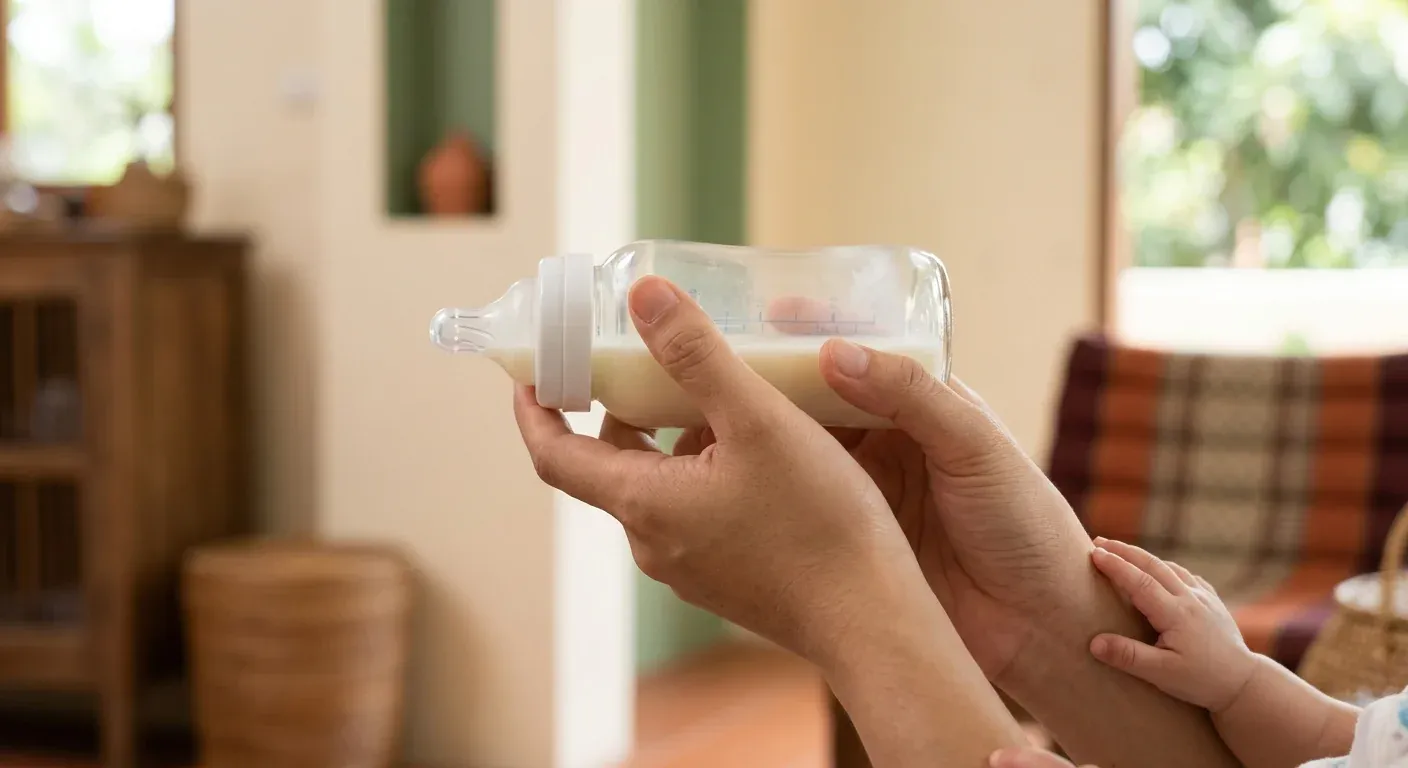
The bottle holds the milk. The pacifier holds the moment. Neither replaces you — both make the hard parts easier.
Choosing a bottle or pacifier can feel overwhelming when every shelf in the pharmacy has twelve options and the internet has twelve conflicting opinions. This guide cuts through the noise with material-safety facts, AAP guidance, and practical notes for Thai families — without brand rankings or price comparisons.
Both bottle and pacifier choice are low-stakes decisions that are routinely over-complicated by marketing. Knowing what actually matters — nipple flow rate, material safety, pacifier timing, and weaning age — is enough to make a confident pick for your baby.
Bottles: what the choice really comes down to
Shape: standard vs wide-neck
Standard narrow-neck bottles have a smaller opening at the top. They tend to be lower cost and widely available. No clinical disadvantage if the baby feeds well from them.
Wide-neck bottles have a broader base at the nipple area, which some families find easier for washing and for fitting orthodontic nipples. For combination-fed babies (breast and bottle), some lactation consultants suggest wide-neck bottles may feel less foreign against the breast — though the evidence on "nipple confusion" in combination-feeding is mixed, and flow rate matters more than shape. See the section on nipple flow rate below.
Material: plastic, glass, silicone, stainless steel
Plastic (BPA-free): The most common choice. Since 2012, the FDA prohibited the use of BPA (bisphenol A) in infant formula packaging and baby bottles after manufacturers removed it from the market [1]. Any bottle sold today in a legitimate pharmacy or retailer carries this standard. Look for the BPA-free label and prefer plastics marked with recycle codes 1, 2, 4, or 5 — avoid codes 3, 6, or 7 unless explicitly BPA-free. Replace when scratched or cracked; deep scratches harbour bacteria and may indicate chemical degradation.
Glass: No chemical leaching, lasts indefinitely (apart from breakage), dishwasher-safe. The trade-off is weight and breakability — a dropped glass bottle mid-feed is a real risk. Some families use glass at home for newborns (when the parent always holds the bottle) and switch to plastic for travel or when older siblings are around. No material-safety advantage over verified BPA-free plastic for intact bottles.
Silicone: Flexible, BPA-free, soft to the touch, dishwasher-safe. Somewhat heavier than plastic, higher cost. Heat degrades silicone faster in tropical climates — inspect more frequently in Thailand's year-round warmth, and replace earlier if the nipple softens, clouds, or distorts.
Stainless steel: Durable, no chemical leach, and very long-lasting. Not microwave- or dishwasher-nipple-safe (the nipple is still silicone or rubber). A niche choice; no medical advantage over the above options.
Anti-colic (vented) systems
Many bottles marketed as "anti-colic" feature valves, vents, or angled tubes that aim to reduce air swallowed during feeding. Evidence that they reduce colic is mixed — colic has multiple causes, and air swallowing is only one. They don't harm, and some families find them helpful. The added components mean more parts to sterilise and replace. If you try one and it doesn't help, a standard bottle works equally well.
Starter set size
For newborns, small 60–90 ml bottles are sufficient — feeds are small and frequent. By one to two months, 120–150 ml capacity is more practical. You don't need to buy the full 240 ml set upfront; a few small bottles in the first weeks are enough.
Nipple flow rate: the decision that matters most
Flow rate — how fast milk passes through the nipple — matters more than bottle brand, shape, or material. Getting this right prevents overfeeding, reduces frustration, and is especially important for combination-fed babies.
General staging guide (follow baby's cues, not age alone):
| Stage | Common label | Approximate age range |
|---|---|---|
| Newborn / Stage 0 | Slow / preemie | 0–4 weeks |
| Stage 1 | Slow | 0–3 months |
| Stage 2 | Medium | 3–6 months |
| Stage 3 | Fast | 6–9 months |
| Stage 4 / variable | Fast / Y-cut | 9 months+ |
These are starting points. Every baby feeds differently. The right signal to move up a flow rate is not age — it is feeding behaviour:
Signs the flow is too slow: baby tires before emptying the bottle, sucking hard with visible effort, pulling off and crying mid-feed, feeding takes more than 30–40 minutes.
Signs the flow is too fast: gulping, coughing, choking, pulling off frequently, lots of milk spilling from the mouth, arching back.
For combination-fed infants (breast and bottle), lactation guidance generally favours a slow-flow nipple — จุกนมขนาดช่องเล็ก. A fast-flowing bottle requires less effort than the breast, and some babies begin to prefer the bottle's easier flow, which can interfere with breastfeeding. This is sometimes called "nipple confusion," though "flow preference" is more precise: the baby isn't confused about what a nipple is — they simply prefer the easier flow. Slow-flow nipples keep the effort level comparable.
Nipple material: Silicone nipples are firmer, last longer, and are less allergenic than latex (rubber). Latex is softer and may be preferred by some babies, but carries a small allergy risk. If your baby has latex allergies in the family, use silicone.
When to replace: Replace nipples every 2–3 months or sooner if you see clouding, thinning, tears, or stickiness. Damaged nipples may leak bacteria or harbour mould. Nipples are not shared between children — degradation is cumulative and invisible.
Bottle care and sterilisation
Sterilising: NHS recommends sterilising all bottle-feeding equipment until the baby is at least 12 months old [2]. Methods:
- Boiling: submerge bottles and nipples in water for at least 10 minutes. Teats degrade faster with this method — inspect regularly.
- Steam steriliser (electric or microwave): follow manufacturer instructions.
- Cold-water sterilising solution: submerge for at least 30 minutes; change solution every 24 hours.
Between sterilise sessions: wash with hot soapy water immediately after each feed, using a bottle brush for the inside of the bottle and a small nipple brush for the nipple. Rinse thoroughly.
In Thailand: Boiled or filtered water adds an extra safety margin for rinsing and sterilisation. Tap water in Thai municipalities meets safety standards, but boiling is the conventional practice and NHS endorses it as the high-hygiene standard.
Replacing bottles: When bottles crack or develop deep scratches, replace them — scratches harbour bacteria and may indicate structural degradation. Don't pass used bottles (or nipples) to subsequent children or between households; wear and invisible microfractures in plastic accumulate over a bottle's life.
Warming: Warm under running hot water or in a bowl of warm water. Never microwave — it creates uneven hot spots. Always test on the inside of your wrist before feeding.
Pacifiers: what AAP actually says
The SIDS case for pacifiers
The AAP recommends offering a pacifier at nap time and bedtime because it helps reduce the risk of SIDS (Sudden Infant Death Syndrome), even if the pacifier falls out after the baby is asleep [3]. This is one of the stronger, more consistent findings in infant sleep safety research.
For breastfed infants, the AAP advises waiting until breastfeeding is well established before introducing a pacifier — meaning adequate milk supply, comfortable feeding, a good latch, and appropriate weight gain [3]. For most breastfed babies, this point is reached around 3–4 weeks. Formula-fed infants can use pacifiers from birth.
Pacifiers are optional. Some babies reject them outright, which is perfectly fine. If your baby doesn't take to it, there is no benefit to forcing it.
Types and shapes
One-piece silicone: The safest construction — no detachable parts that could separate and become a choking hazard. Silicone is durable, non-allergenic, and easy to sterilise. This is the type most commonly recommended.
Orthodontic (flattened / teardrop) vs round: Orthodontic pacifiers are shaped to reduce pressure on the developing palate and tooth alignment. Round (cherry-shaped) nipples are the traditional form. AAP notes that either shape is acceptable when pacifier use is appropriate and weaning happens at the right age [4]. The clinical benefit of orthodontic shape is modest — the more important variable is weaning before prolonged use can affect dental development.
Multi-piece pacifiers: A ring, shield, and nipple assembled together. Verify that the shield is a single rigid piece with ventilation holes — never improvise a cord or ribbon attachment.
Size:
- Newborn / 0–6 months: smaller shield, smaller nipple — essential for a correct fit.
- 6–18 months: standard size.
- 18 months+: larger, toddler-size.
Using the right size ensures the shield sits flat against the face and cannot be drawn into the mouth.
Pacifier safety rules (the don't-list)
These rules directly reduce risk [3]:
- Never attach a pacifier to a cord, ribbon, or clip during sleep. Strangulation risk. Daytime clips that keep a dropped pacifier off the floor are fine — remove before nap or bedtime.
- Never dip in honey, sugar, or any sweetened substance. Honey before age 1 carries a serious risk of infant botulism. Sweetening a pacifier also initiates early sugar exposure and dental caries.
- Sterilise before first use and regularly in the first 6 months. Boil for 5 minutes.
- Inspect and replace every 4–6 weeks. Silicone weakens and may develop invisible micro-tears over time. If you see clouding, stickiness, or deformation — replace immediately.
- Discard if cracked or damaged.
- One-piece preferred — multi-piece pacifiers must be inspected frequently to confirm no separation.
Weaning: when and how
Prolonged pacifier use past age 2 is associated with dental misalignment and, in some cases, effects on speech development [3] [4]. The guidance:
- AAP / most US pediatric guidance: wean from pacifier by age 3–4.
- AAFP and general dental guidance: consider weaning by age 2–3, before the permanent effects on tooth alignment compound.
In practice: begin reducing pacifier use around 18–24 months by limiting it to sleep times only, then to the most emotionally difficult moments, then phasing out. Replacing the pacifier with a transitional comfort object (a small soft toy the child chooses) helps many toddlers.
If your child uses the pacifier beyond age 2, mention it at the next well-child visit. Your pediatrician can assess the dental situation and help you make a weaning plan.
Pacifier, bottle, and sleep — the safe-sleep intersection
Per AAP 2022 safe-sleep recommendations [3]:
- A pacifier without any cord or attachment is safe in the sleep space.
- A bottle is not. Leaving a bottle in the crib — even without a nipple — is associated with early childhood caries (ฟันผุในเด็กเล็ก) because milk pools against the teeth as the child falls asleep.
- By 12–18 months, AAP recommends transitioning away from the nighttime bottle (see Transition to Whole Milk).
- For full safe-sleep environment guidance, see Safe Sleep.
Thai market and family context
Brand availability
Most major international bottle and pacifier brands — including Pigeon, Avent, Tommee Tippee, Dr. Brown's, NUK, MAM, Comotomo, BIBS, FRIGG, and Mushie — are available in Thailand through pharmacies, department stores, and online retailers. Regional brands sold at Thai pharmacies meet the same basic material-safety standards (BPA-free). No single brand is universally "best" — the best bottle is the one your baby feeds from comfortably.
Tropical climate considerations
Thailand's year-round heat accelerates the degradation of silicone and latex. Check nipples and pacifiers for changes in texture, cloudiness, or softening more frequently than the standard 4–6 week replacement cycle. If you live in a house without reliable air-conditioning or the feeding equipment is stored in a warm space, inspect weekly.
Multi-generational households and multiple caregivers
In Thai households where grandparents or other caregivers bottle-feed when the mother is working, standardising on one bottle system across locations reduces confusion and ensures consistent technique. When multiple adults feed the same baby:
- Keep one set of labelled bottles at each location.
- Train all caregivers on the same flow rate and paced-feeding technique.
- Do not mix nipple stages across caregivers without checking with each other first — a baby accustomed to Stage 1 at home who is given Stage 3 at grandparents' will overfeed.
For information about paced feeding (การป้อนนมแบบ paced feeding) and how to hold the bottle, see Formula Feeding.
Hand-me-downs
Bottles and nipples should not be reused across children. Degradation in plastic bottles accumulates invisibly; nipples develop micro-tears that are not visible but allow bacteria. If a relative offers older baby bottles, politely decline and buy new. This is one area where new-over-second-hand is a genuine safety distinction, not marketing pressure.
Breastfeeding and bottle feeding: both are valid
Breastfeeding is the foundation of infant feeding per WHO and AAP guidance. This article doesn't push bottles over breastfeeding, or breastfeeding over bottles. Many Thai families combine both — mother breastfeeds directly, bottle-feeds expressed milk when working, and uses formula when needed. The bottle is a tool, not a statement about how you feed.
Summary
For bottles:
- Any BPA-free bottle from a legitimate retailer meets the basic safety bar.
- Match nipple flow rate to the baby's current feeding ability — not to age labels alone.
- Replace nipples every 2–3 months or when damaged; replace bottles when cracked or scratched.
- Sterilise until 12 months; wash with hot soapy water between sterilise sessions.
- Slow-flow nipples are recommended for combination-fed babies to maintain breastfeeding comfort.
For pacifiers:
- Offer at nap and bedtime from 3–4 weeks (breastfed) or birth (formula-fed) — AAP says this reduces SIDS risk.
- Choose one-piece silicone; orthodontic or round shape are both acceptable.
- Never attach to a cord during sleep.
- Never dip in honey or sweetener.
- Wean by age 2–3; mention pacifier use at every well-child visit after 18 months.
Both:
- Inspect and replace more frequently in tropical climates.
- Don't share across children or households.
- More expensive does not mean better.
แหล่งอ้างอิง
- FDA — BPA in Food Contact Applications: FDA's current perspective on BPA in food packaging and baby products, including the 2012 rule prohibiting BPA in infant formula packaging and sippy cups
- NHS — Sterilising baby bottles: when and how to sterilise, until at least 12 months, boiling, steam, cold-water methods
- AAP HealthyChildren — A Parent's Guide to Safe Sleep: pacifier at nap/bedtime reduces SIDS risk; introduction after breastfeeding established; no cord during sleep
- AAP HealthyChildren — Pacifier Use in Infants (dental, speech, weaning age, orthodontic vs round shape — URL inaccessible to gate; institutional authority)