
Baby Bedtime Routine: The Simple 4-Step Sequence That Helps Babies Sleep
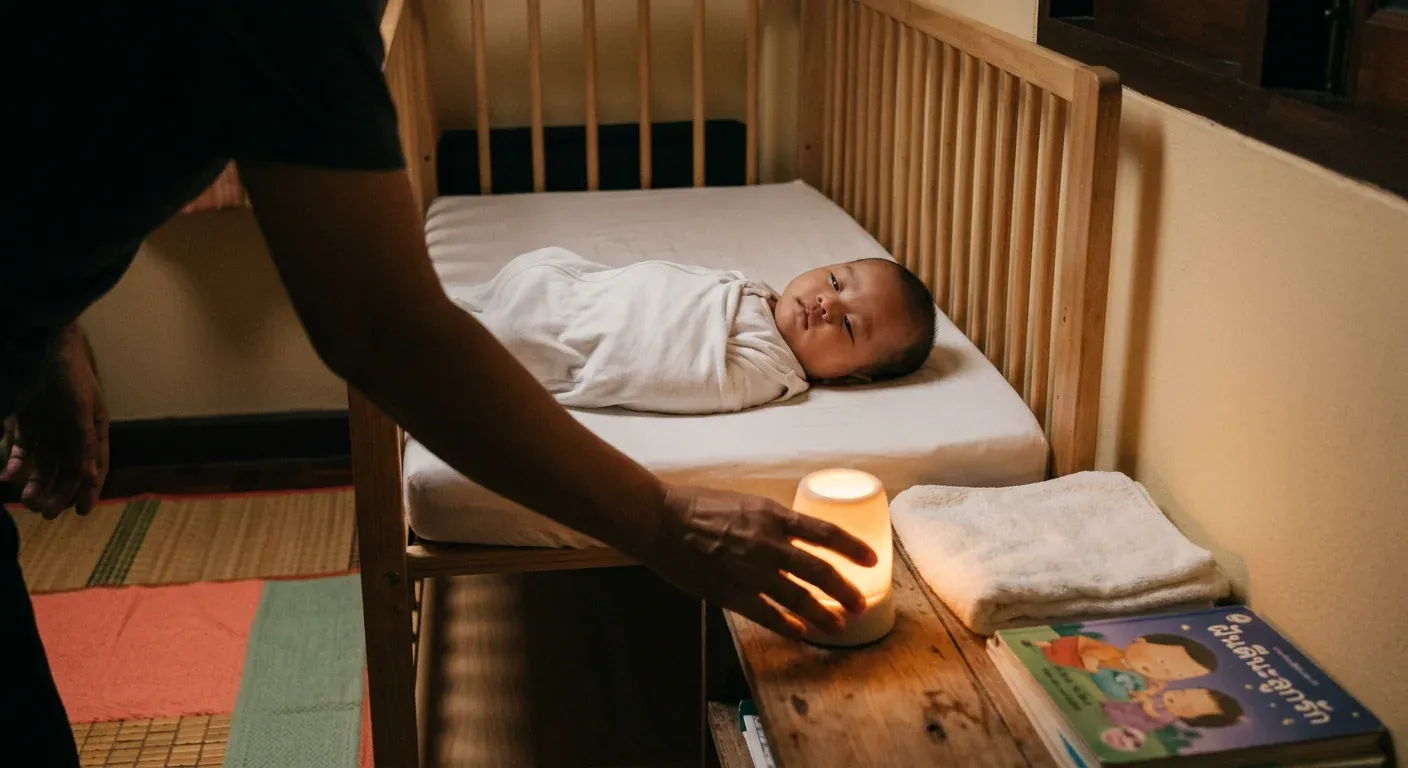
Bath → Book → Feed → Crib The same sequence every night is the most powerful sleep signal you can give your baby's developing brain.
A consistent bedtime routine is more than a comforting habit — it trains a baby's nervous system to recognize the sequence and begin winding down for sleep. Both the AAP [1] and NHS [2] identify a predictable pre-sleep routine as one of the most effective strategies for helping infants sleep longer and more easily.
How Much Sleep Does a Baby Need?
Sleep needs change significantly across the first year, according to WHO [3] and NHS [2] guidelines:
| Age | Total daily sleep (including naps) | Pattern |
|---|---|---|
| Newborn – 3 months | 14–17 hours | Spread across 24 hours; no day/night distinction yet |
| 4 – 6 months | 12–16 hours | Longer night stretches emerge; 2–3 naps per day |
| 6 – 12 months | 12–16 hours | 10–12 hours overnight; 2 naps per day |
These are averages. A baby who is alert, content, and growing well is getting enough sleep, even if the numbers don't match exactly.
Newborns (0–3 Months): Building the Foundation
Young infants have no internal day/night clock yet [1] — their brains cannot distinguish morning from midnight. A rigid schedule is not realistic in this phase, but three things help lay the groundwork:
- Use light to teach day vs. night. Daytime: bright light, activity, talking. Nighttime: dim light, quiet, minimal interaction during feeds.
- Start a short pre-sleep sequence. Even 5–10 minutes of warm bath, a change into sleep clothes, and a quiet feed in dim light begins to form an association between these activities and sleep.
- Put down drowsy but awake. The AAP advises: "Put babies to bed when they are drowsy. Do not wait until babies are asleep." [1] This gives a baby the chance to practice falling asleep independently — a skill they will need every time they surface between sleep cycles.
Never place a baby on their tummy hoping for longer sleep. The safe sleep ABCs apply for all 12 months [4].
The 4-Step Bedtime Routine (AAP and NHS Guidance)
NHS [2] recommends a predictable sequence done in the same order every night:
Step 1: Warm Bath
Warm water relaxes muscles and signals the body to prepare for sleep. It doesn't need to be long — 5 to 10 minutes is enough. On nights when you skip a full bath, a warm washcloth wipe-down serves the same cue function.
Step 2: Change into Sleep Clothes
A sleep sack or wearable blanket worn every night becomes a physical cue associated with sleep. Sleep sacks are safer than loose blankets in the crib because they cannot shift over a baby's face.
Step 3: Last Feed (Before the Crib, Not in It)
Feed in a quiet, dim room so the baby is full and calm before sleep. The key is to finish the feed before placing the baby down — not nurse or bottle-feed until asleep, then transfer. A baby who learns to fall asleep while feeding will wake at 2 a.m. expecting to feed again. A baby who falls asleep independently will often settle back on their own between sleep cycles [1].
Step 4: Book or Lullaby, Then Down in the Crib
Even very young infants are soothed by a familiar voice and rhythm. Read a short book or sing softly — then place the baby in the crib drowsy but awake. This is the most important step: the baby who falls asleep in your arms and wakes in the crib will look for your arms again at every sleep-cycle junction. The baby who learns to fall asleep in the crib develops the skill to reconnect sleep cycles without calling for you.
Sleep Environment
The environment reinforces the routine:
Light: Dim the room 20–30 minutes before bedtime begins. Bright light signals to the brain that it is still daytime. Blackout curtains are especially helpful during Thailand's long daylight seasons, and for daytime naps.
Temperature: NHS [2] recommends a comfortably cool room. Check a baby's temperature at the back of the neck or chest — hands and feet normally run cooler than the body. Signs of overheating: sweating, flushed skin, hot chest. If overheating, remove a layer.
White noise: Consistent sound from a dedicated white noise machine (not a phone that may stop or alert) helps mask household noise that can rouse a baby during light sleep phases. This is particularly effective during the first few months and around the 4-month developmental shift.
Inside the crib: Per safe sleep ABCs, no pillows, loose blankets, stuffed animals, positioners, or wedges [4][5]. A sleep sack replaces a blanket safely.
Sample Schedules by Age
These are guides, not rules. Every baby has their own rhythm:
0–3 Months: No Fixed Schedule Yet
- Wake/sleep every 2–3 hours around the clock
- Goal: Separate day and night; establish a short pre-sleep sequence
- Tired cues: Yawning, eye-rubbing, glazed gaze, pulling at ears
3–6 Months: Laying the Schedule Foundation
- Bedtime: Around 7:00–8:00 p.m. (young infants tire early)
- Naps: 3–4 per day, totalling 4–6 hours
- Pre-sleep routine: 20–30 minutes before the night sleep
6–12 Months: More Consistent Rhythms
- Bedtime: Often 6:30–7:30 p.m. — earlier than many parents expect
- Naps: 2 per day (morning and afternoon), totalling 2–4 hours
- Pre-sleep routine: 20–30 minutes, consistent every night
Why early bedtimes help: A baby kept awake past their natural sleep window becomes overtired — cortisol spikes, and settling becomes harder, not easier. Watch for tired signs and start the routine promptly, before crying begins.
Safe Sleep Is Non-Negotiable
Whatever bedtime routine you use, the AAP safe sleep rules apply without exception [4][5]:
- A (Alone): Baby sleeps on their own sleep surface — not in the parental bed
- B (Back): Back to sleep, every time, for every sleep, until the baby rolls independently
- C (Crib): Firm, flat sleep surface; tight-fitted sheet; nothing else in the sleep space
Room-sharing (not bed-sharing) with parents for at least the first 6 months reduces SIDS risk by up to 50% [4]. A bedside bassinet lets you stay close for nighttime feeds while keeping the baby on their own safe surface.
Pacifier: The AAP recommends offering a pacifier at sleep time — evidence shows it reduces SIDS risk. If it falls out during sleep, there is no need to reinsert it. For breastfed babies, wait until breastfeeding is well established (around 3–4 weeks) before introducing a pacifier.
For the full guide on creating a safe sleep environment, see Baby Safe Sleep.
When the Routine Isn't Working
Before changing the routine, check these common causes:
- Has it been at least 2 weeks? Babies need repetition to form new associations. Results typically take 7–14 nights, not 1 or 2.
- Is this a developmental sleep regression? Especially around 4 months, when the brain reorganises its sleep architecture. See 4-Month Sleep Regression.
- Is the baby tired enough? If the routine starts when the baby is still alert and energetic, settling will be a battle. Shift the start time closer to when the baby naturally shows tired cues.
What not to do:
- Melatonin or sleep aids — not appropriate for infants; no safety data in this age group
- Starting solids early to extend sleep — no evidence this works; increases choking and allergy risk
- Placing baby on their tummy or side hoping for longer sleep — significantly increases SIDS risk
For structured sleep training approaches (after 4 months), see Sleep Training.
Summary
A good bedtime routine does not need to be complicated. It needs to be consistent:
- Warm bath — body relaxation cue
- Into a sleep sack — physical sleep cue
- Last feed in a dim, quiet room — fullness and calm before sleep
- Short book or lullaby — familiar auditory wind-down
- Down in the crib drowsy but awake — practicing independent sleep
The constants, every night:
- Safe sleep ABCs: Alone, Back, Crib
- Room-sharing (separate surface) for at least the first 6 months
- Consistency — results typically appear after 7–14 nights
แหล่งอ้างอิง
- AAP HealthyChildren — Getting Your Baby to Sleep. "Put babies to bed when they are drowsy. Do not wait until babies are asleep."; "Babies need time to put themselves back to sleep, and they need to learn how to fall back asleep on their own."
- NHS — Helping your baby to sleep. Bedtime routine sequence (bath, dim lights, lullaby, story); sleep duration: newborn ~18h, 6-12mo ~15h.
- World Health Organization — To grow up healthy, children need to sit less and play more (2019). Sleep duration: 0–3 months 14–17h; 4–11 months 12–16h including naps; 1–2 years 11–14h with regular wake times.
- AAP HealthyChildren — A Parent's Guide to Safe Sleep. Back-to-sleep always; firm flat surface; room-sharing reduces SIDS risk by up to 50%.
- American Academy of Pediatrics — Safe Sleep
- Department of Health, Ministry of Public Health Thailand — Maternal and Child Health