
Sun Protection for Babies: Shade Before 6 Months, Sunscreen After
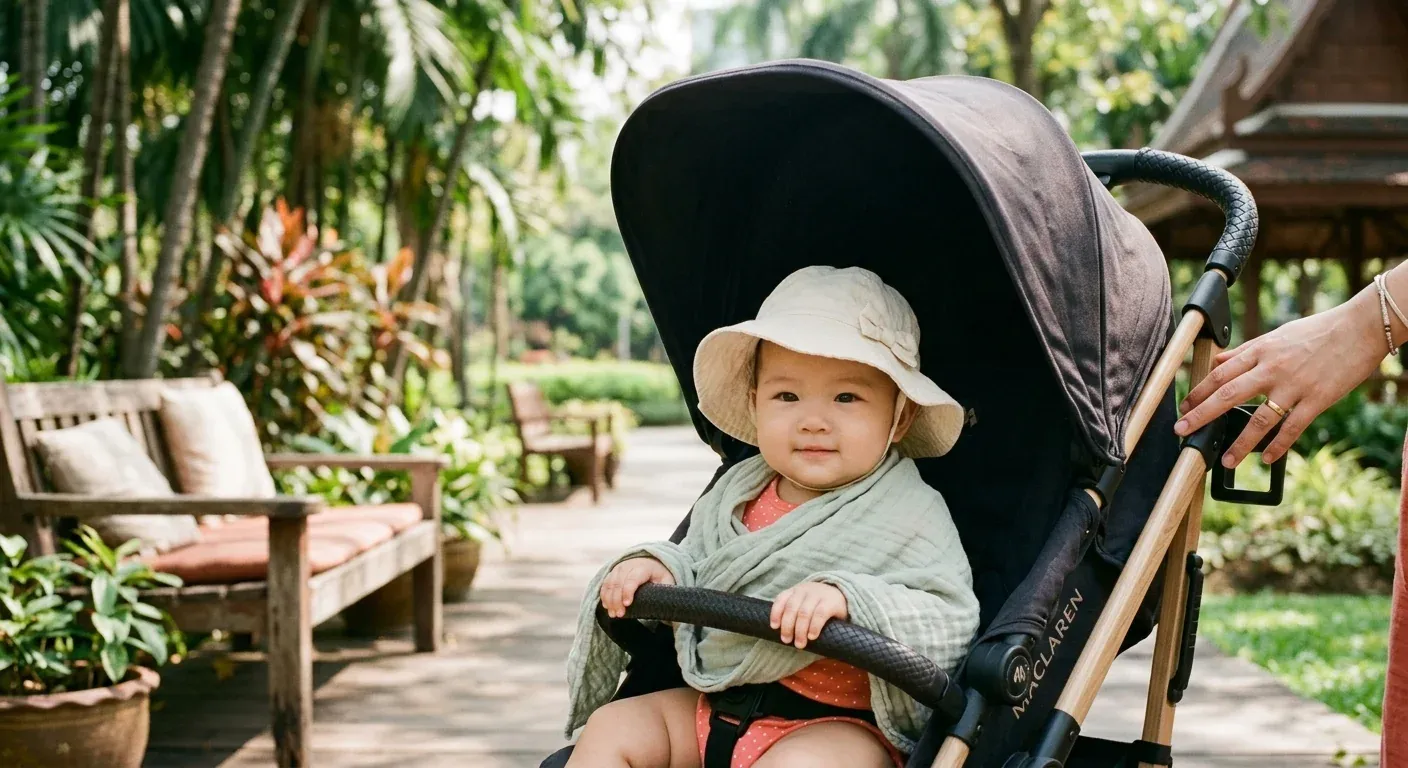
Shade, fabric, hat — the three sun-protection layers that work from day one. Sunscreen comes later, as an addition — never as a replacement.
Thailand's sun is among the most intense on Earth. UV index regularly hits 11+ during the March–May hot season — strong enough to burn baby skin in minutes of direct exposure.
But the answer to "when can I start sunscreen on my baby?" isn't a single number. AAP [1] and FDA [2] draw a clear line at 6 months.
Under 6 months: shade, fabric, hat — not sunscreen
This is the rule a lot of parents don't know. AAP [1] is explicit:
"Keep babies younger than 6 months out of direct sunlight."
Translated: babies under 6 months should not be in direct sun as the primary plan. The reason isn't whether sunscreen is "allowed" — it's that infant skin is thinner and absorbs ingredients more readily than older skin.
Instead of relying on sunscreen, use three layers of protection:
Layer 1 — Shade
AAP [1] recommends "shade under a tree, an umbrella, or the stroller canopy."
- Under the canopy of a large tree (note — leaves still let through ~50% of UV)
- A personal sun umbrella
- A stroller hood that closes properly
Layer 2 — Fabric
- Long-sleeved shirts and pants in lightweight cotton
- AAP [1]: "cool, comfortable clothing that covers the body"
- Plain cotton offers about UPF 5–10; UPF 50+ rated fabric is better
Layer 3 — Hat
- Wide-brimmed, covers the neck and ears
- Avoid loosely-woven hats that let light through
Sunscreen only when absolutely necessary
FDA [2] advises against sunscreen as the primary protection for babies under 6 months — but if you genuinely cannot avoid sun (no shade, no choice), apply a small amount on tiny areas like the back of the hands, neck, and face. Use a zinc oxide formula, not chemical filters.
After 6 months: add sunscreen as Layer 4
For babies 6 months and older, AAP [1] gives clear guidance:
"broad-spectrum sunscreen with a sun protection factor (SPF) of at least 15 (up to SPF 50)"
How to choose
- Broad-spectrum — protects against both UVA and UVB (read the label)
- SPF 15–50 — sufficient; you don't need to chase 100+
- Zinc oxide or titanium dioxide as the active ingredient. AAP [1] calls these "physical sunscreens" — they reflect light rather than absorbing into skin like chemical filters
- No fragrance, no parabens
Avoid
- Combination sunscreen + insect repellent products. AAP [3] is specific: don't use combos because sunscreen needs frequent reapplication, but repellent shouldn't be reapplied that often
- Spray sunscreens — your child can inhale them, and coverage is uneven
How to apply
- Apply 15–30 minutes before sun exposure to let it set
- AAP [1]: "Reapply sunscreen every 2 hours"
- Reapply after swimming, sweating, or towel-drying
- Avoid the eye area and lips
- Use enough — adults need a coin-sized dollop; a baby uses about half that
Sunburn in babies: spotting and treating
If your baby's skin looks red and feels hot after sun:
- Move to shade immediately
- Apply cool compresses (cloth in cool water — not ice)
- Offer extra fluids — a sunburn dehydrates
- If you see blisters or fever — see a doctor today
A baby under 6 months with any sunburn should be seen by a doctor today, no matter how minor it looks.
Avoid the peak-UV window
Thailand's UV index peaks 10 a.m. – 4 p.m. in hot-season months.
If you must be out in this window:
- Use the three-layer protection (shade + fabric + hat)
- Sunscreen for 6+ months as a fourth layer
- Minimise unshaded time
Better still — go out 7–9 a.m. or after 4:30 p.m.
Common questions
"Should I apply sunscreen daily, even indoors?"
If your baby is mostly indoors, no. UV doesn't pass through walls or modern glass. Apply before going out.
"Can I use my own sunscreen on my baby?"
Not recommended. Baby formulations have less alcohol and less fragrance. Infant skin is thinner and absorbs more.
"What about Vitamin D, if we avoid the sun?"
The Royal Thai College of Pediatricians [5] recommends considering a vitamin D supplement for exclusively breastfed babies — ask your paediatrician. Don't use "sun for vitamin D" as a reason to expose infant skin.
Summary
- Under 6 months: shade + fabric + hat, not sunscreen
- 6 months and up: add broad-spectrum SPF 15–50
- Physical sunscreens (zinc oxide / titanium dioxide) are best for baby skin
- Reapply every 2 hours and after water or sweat
- Avoid 10 a.m. – 4 p.m. in hot season
- Sunburn in a baby = same-day doctor visit
Thailand's sun is harsh — but the rule is simple: little babies stay shaded, older babies add cream.