
Baby at 9 Months: Crawling, Pulling to Stand, and Separation Anxiety
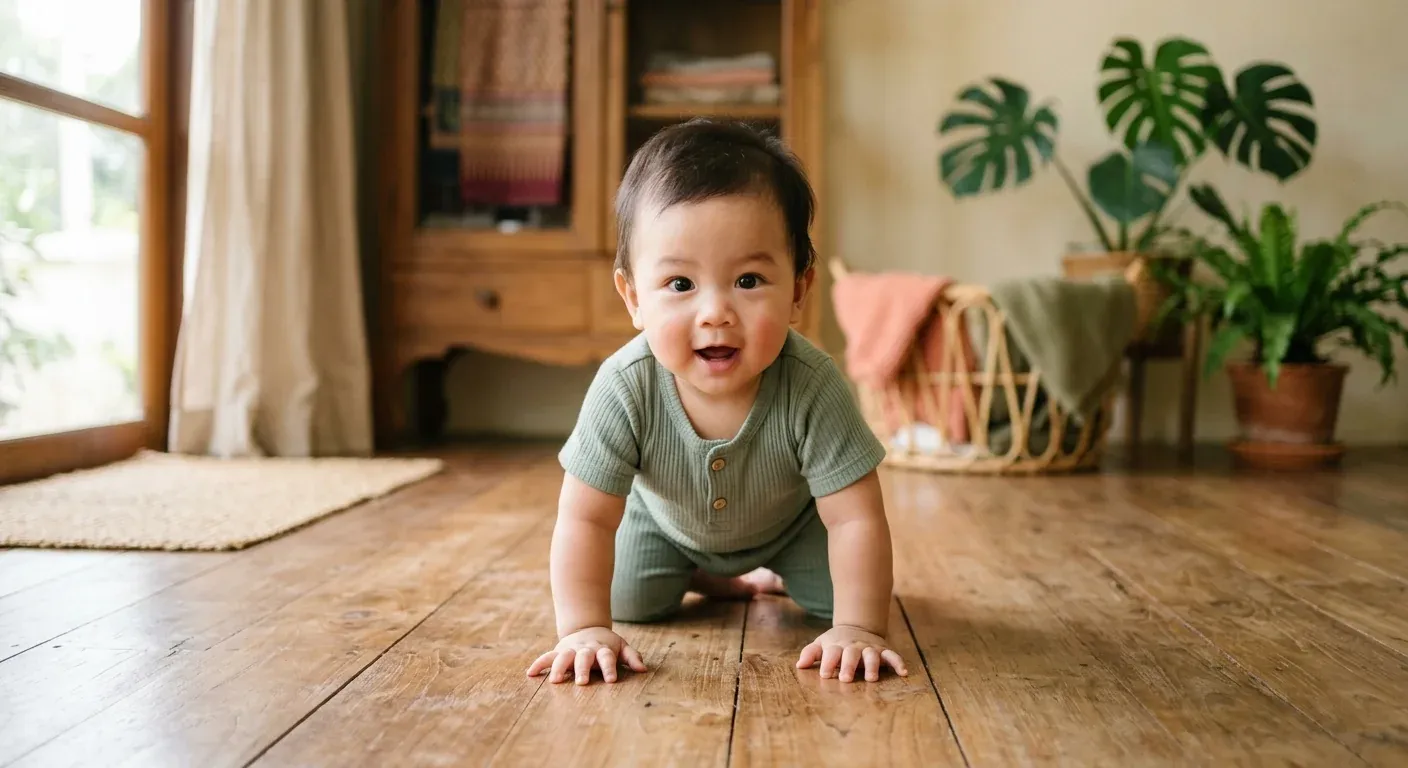
They've gone mobile — and now they need you more than ever. 9 months: brave enough to crawl across the room, but falls apart the moment you step out of sight. Both things make perfect sense.
By month 9, your baby has transformed from a passenger into an explorer. They crawl, they pull themselves up on the furniture, they point at things and look back at you with an expression that says did you see that? And yet — the moment you disappear, the world ends.
This article draws on guidance from AAP [1], WHO [2], and NHS [3] to cover motor development, separation anxiety, language, and feeding at this busy stage.
Motor development: crawling, pulling to stand, and more
Crawling
Most 9-month-olds are crawling — though the exact style varies and that is perfectly fine:
- Classic crawl — hands and knees, moving forward
- Reverse crawl — some babies go backwards before they go forwards
- Army crawl — on the belly, pulling with the arms
- Bum shuffle or rolling — some babies skip crawling entirely and go straight to cruising
According to AAP [1], the method matters less than the movement — exploration is what counts.
Pulling to stand (cruising)
- Your baby grabs onto furniture to haul themselves upright
- Can stand for a few seconds with minimal support
- Some babies begin cruising — stepping sideways along furniture — though many wobble a lot at first
Separation anxiety: a healthy sign, not a phase to fix
Why it happens
Around 9 months, your baby has developed object permanence — they now understand that you still exist when you leave the room. That's actually a cognitive leap. The catch: they know you're out there, but they have no sense of time and no way of knowing you're coming back.
- They depend on you for food, comfort, and safety
- "10 minutes" means nothing to a 9-month-old brain
- The anxiety peaks between 9 and 18 months and gradually fades
This is normal, healthy attachment — not a sign that something is wrong.
How to handle it
- Always say goodbye — sneaking away feels kinder but makes anxiety worse. A calm, brief "Mummy will be right back" gives a predictable cue
- Start with short separations — 2–5 minutes, then return — so your baby builds the understanding that you always come back
- Keep a goodbye ritual — the same short sequence every time you leave helps your baby anticipate what happens next
- Choose a happy caregiver — a settled, warm caregiver helps your baby feel safe while you are away
Language and communication
By 9 months, most babies:
- Babble with meaning — "mamamama" or "babababa"; some are beginning to attach a sound to a person ("ma" for Mum)
- Point and look back — "look at that!" This joint attention is real communication
- Follow a simple one-step instruction — "wave bye-bye" or "no" may get a response
- Love their own voice — squealing, babbling, "practising"
- Imitate sounds and gestures — watching your mouth and trying to copy
Feeding: finger foods and shared mealtimes
Finger foods
A 9-month-old is ready for self-feeding with their fingers — specifically the pincer grasp (thumb and forefinger). Good options:
- Soft pieces they can pick up and squash — banana, well-cooked carrot, soft-cooked pasta, small pieces of bread
- Let your baby lead the amount — they will signal when they are done
- Varied textures and flavours — vegetables, protein, grains, fruit
Breast milk or formula remains important: WHO [2] recommends continuing breast milk alongside complementary foods up to 2 years and beyond. At this stage, aim for around 3–4 breast feeds or formula feeds per day in addition to solid meals.
Foods to avoid before age 1
- Choking hazards — whole grapes, whole nuts, raw hard vegetables, large chunks of any food; cut everything small
- High-salt foods — processed snacks, soy sauce, adult ready meals; babies' kidneys are still maturing
- Honey — risk of infant botulism in children under 1 year; AAP [1] is explicit on this
When to talk to your doctor
Speak to your paediatrician if your 9-month-old has not yet:
- Crawled, shuffled, or found some way to move across the floor
- Pulled to stand at all, or shown interest in doing so
- Pointed at objects or used gestures
- Made any vocal sounds, or babbled
- Responded to their own name
- Shown curiosity — trying things, exploring, repeating actions
Call right away if your baby has:
- Fever above 38.5°C, diarrhoea, or any other concerning symptom
- Stopped doing something they previously did (loss of skills is always worth a prompt call)
Summary
Month 9 is a big moment of growth — more movement, more words, more world. And more need for you, right when you thought they were becoming independent. Separation anxiety is a sign that your baby's brain is working exactly as it should.
The things that matter most this month:
- Let your baby explore and crawl — the floor is their classroom
- Always say goodbye and keep a goodbye ritual; never sneak away
- Offer finger foods at every meal — they need the practice and the sense of control
- Talk, point, and name things — language is built in these small daily moments
- Watch for developmental milestones and bring any concerns to your paediatrician
If your baby is moving, smiling, babbling, and making your day harder while also making it brighter — that is exactly what a healthy 9-month-old looks like.
แหล่งอ้างอิง
- AAP HealthyChildren — Developmental Milestones: 6 Months to 1 Year
- WHO — Infant and young child feeding (Key facts)
- NHS — Your baby's development at 9 months
- Royal Thai College of Pediatricians — Child Development 6–12 Months