
Baby at 7 Months: New Tastes, Steady Sitting, and the First 'Mama'
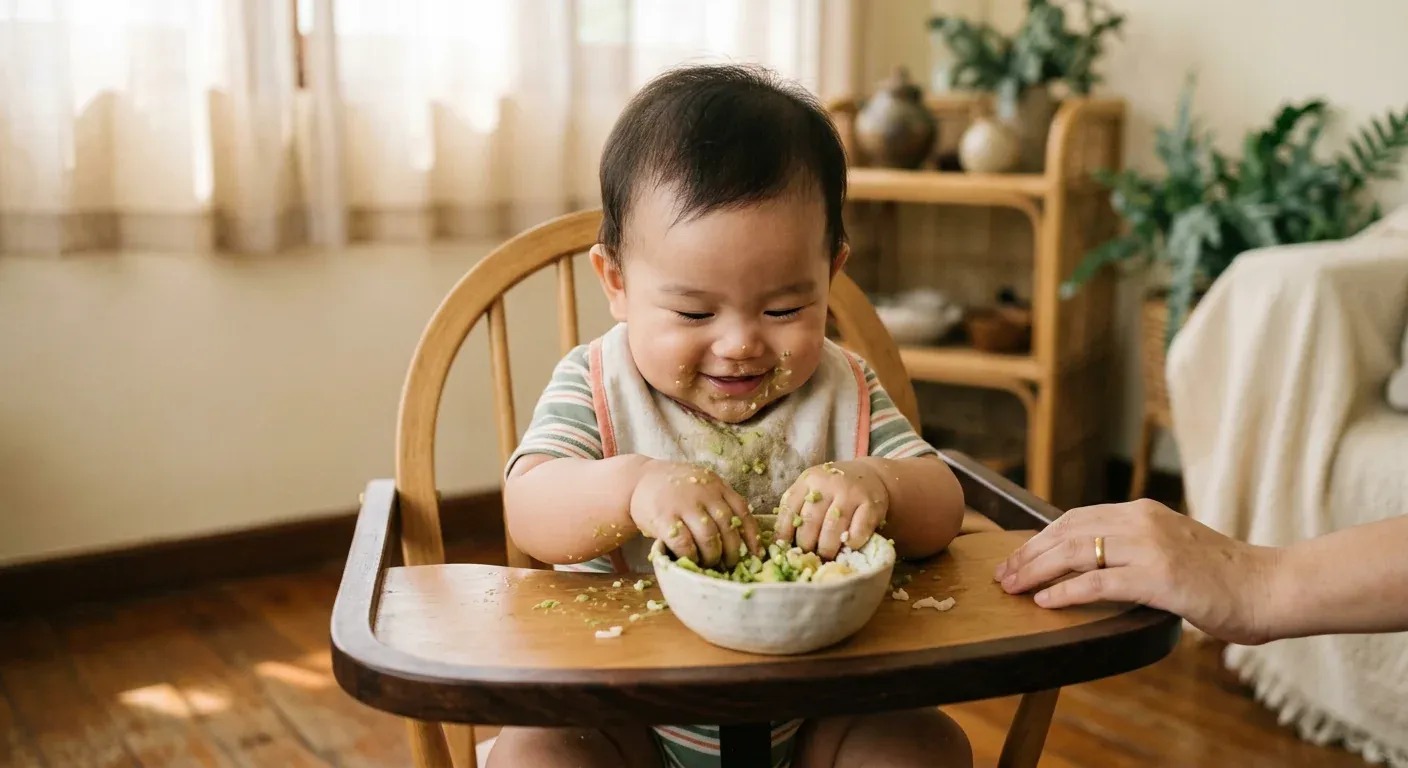
Month 7: sits up, tries new foods, calls for you. The month your baby starts having opinions — about toys, about people, about what's on the spoon.
By 7 months, your baby sits steadily without help, watches every bite you take with real interest, and is putting more colour and rhythm into their babble. Reach has become aim. Sound has become conversation in miniature.
This article draws on guidance from AAP [1], WHO on complementary feeding [2], NHS [3], CDC [4], the Thai Department of Health [5], and the Royal Thai College of Pediatricians [6].
What to look for at 7 months
Motor milestones
- Sits without support — back straight, hands free to reach and play.
- Rolls easily both ways and may roll right across a bed if unwatched.
- Pushes up on hands and knees — getting ready to crawl.
- Transfers objects from one hand to the other.
- Picks up small objects more accurately, still palm-grasping (no thumb-and-forefinger pincer yet).
Communication
- Repeated-syllable babbling — "ba-ba", "ma-ma", "da-da". Not yet a true word for "mum" or "dad" — your baby is practising sounds and listening to themself.
- Pitch and rhythm — copies the up-and-down music of your speech.
- Turns to their name clearly by this stage.
- Pauses at "no" — many start to react to a firm tone.
Social
- Loves peek-a-boo — beginning to grasp that hidden things still exist.
- Clear emotions — joy, frustration, excitement, protest.
- Prefers familiar people — wants to be held by Mum or the primary caregiver; may go quiet or cry around strangers.
- Recognises names of familiar things — Mum, Dad, a favourite toy.
Feeding: expanding safely
If your baby started solids at 6 months, this is the month to add texture and variety, per WHO complementary feeding guidance [2]. Breast milk or formula is still the main source of energy; solids are supplementary.
How to introduce new foods
- One new food at a time, three days apart — watch for rashes, diarrhoea, vomiting.
- Move from smooth purée → thicker mash → finely chopped → soft lumps.
- Solids before milk at main meals; milk afterwards.
- No salt, sugar, or seasoning before age 1.
- No honey before age 1 — risk of infant botulism.
Foods that suit a 7-month-old
Per the Thai Department of Health [5] and AAP guidance on starting solid foods [7]:
- Rice congee with broth — slightly thicker than month one of solids.
- Leafy greens — finely puréed and stirred into rice.
- Soft vegetables and ripe fruit — pumpkin, carrot, sweet potato, ripe papaya, banana, avocado.
- Animal protein — well-cooked liver, soft fish, shredded chicken — important iron sources.
- Egg yolk is fine; whole egg (including white) becomes fine around 7-8 months.
- Pulses and tofu — soft, well-mashed.
- Plain unsweetened yoghurt and small amounts of cheese can start now.
Why iron matters this month
Between 6 and 9 months, iron stores from birth begin to run out. AAP recommends first foods that supply iron and zinc, such as meat-based purées or iron-fortified infant cereal [7]. In Thailand, common iron sources include chicken or pork liver, red meat, egg yolk, and dark leafy greens.
Foods to avoid
- Choking hazards — whole nuts, whole grapes, popcorn, hard candy, whole cherry tomatoes.
- Honey — strictly no, before age 1.
- Cow's milk as a drink — fine in cooking, but not as the main milk until age 1.
- Fruit juice — not necessary, and not a substitute for milk or water.
- High-mercury fish — shark, swordfish, yellowfin tuna.
Rough portions
- 2-3 solid meals/day, 2-4 tablespoons each (let your baby guide the amount).
- Breast milk on demand or formula 600-900 ml/day.
- Sips of water between meals are fine; don't force it.
Sleep: settling into a rhythm
By 7 months many babies fall into a steadier pattern:
- 10-12 hours overnight, sometimes with 1-2 night feeds.
- 2-3 daytime naps totalling 2-4 hours.
Safe sleep — still the ABCs
Per AAP [8]:
- A — Alone in their own crib.
- B — Back to start; if your baby rolls independently, they can settle in their preferred position.
- C — Crib — firm, flat, no pillows, blankets, soft toys, or bumpers.
By this age babies roll freely. Do not swaddle — pinned arms can't move the face away from a soft surface.
Play and stimulation
7 months is the month of cause and effect — press a button, something happens; drop a toy, it falls.
- Toys that respond to touch — squeezy rubber animals, small wooden blocks that knock together.
- Containers and objects to drop in and pull out — practises grasp, release, transfer.
- Baby-safe mirror — your baby loves their own reflection.
- Cloth or board books — read 2-3 short sessions a day.
- Songs and gentle clap-and-pat games — rhythm and turn-taking.
The most important toy is still a parent who talks — narrate what you're doing, name everything, read picture books, answer their babbles like real conversation.
When to call your paediatrician
Per CDC [4] and the Royal Thai College of Pediatricians [6], check in if your 7-month-old:
- Is not sitting with or without support.
- Doesn't babble or has gone quieter than they were.
- Doesn't respond to their own name or turn to sounds.
- Doesn't smile back, make eye contact, or laugh.
- Doesn't reach for objects or transfer from hand to hand.
- Feels floppy or unusually stiff.
- Hasn't gained weight in the past 2 months.
- Has lost a skill — this is always worth a prompt call.
Same-day care
- Fever above 39°C that doesn't come down with paracetamol or cool sponging.
- Fast or laboured breathing, ribs pulling in, blue lips.
- Listless, hard to wake, refusing to feed.
- Repeated forceful or green/bloody vomiting.
- Watery diarrhoea, dry mouth, sunken eyes, fewer wet nappies.
- Severe allergic reaction — full-body rash, facial swelling, trouble breathing — emergency.
- Seizure or loss of consciousness.
Summary
Month 7 is the month your baby sits up and looks around — both hands free, mouth tasting new things, opinions of their own.
The things that matter most this month:
- One new food at a time, 3 days apart — to spot allergies.
- Iron-rich foods — liver, red meat, egg yolk, dark leafy greens.
- No honey, salt, or sugar before age 1.
- Back to sleep, alone, in their own crib — the ABCs every time.
- Talk to your baby all day — language is built in back-and- forth moments.
A baby who sits up and surveys the room, answers your voice with their own, and wants to taste everything is a baby right on track. When something doesn't feel right — not sitting, not babbling, not responding — your paediatrician would always rather hear from you early than late.
แหล่งอ้างอิง
- AAP HealthyChildren — Ages & Stages: Baby
- WHO — Complementary feeding
- NHS — Start for Life: Baby development
- CDC — Helping parents of infants
- Thai Department of Health (กรมอนามัย) — Early-childhood development guide
- Royal Thai College of Pediatricians
- AAP HealthyChildren — Starting Solid Foods
- AAP HealthyChildren — A Parent's Guide to Safe Sleep