
Baby at 11 Months: First Steps Are Coming, First Real Words Too
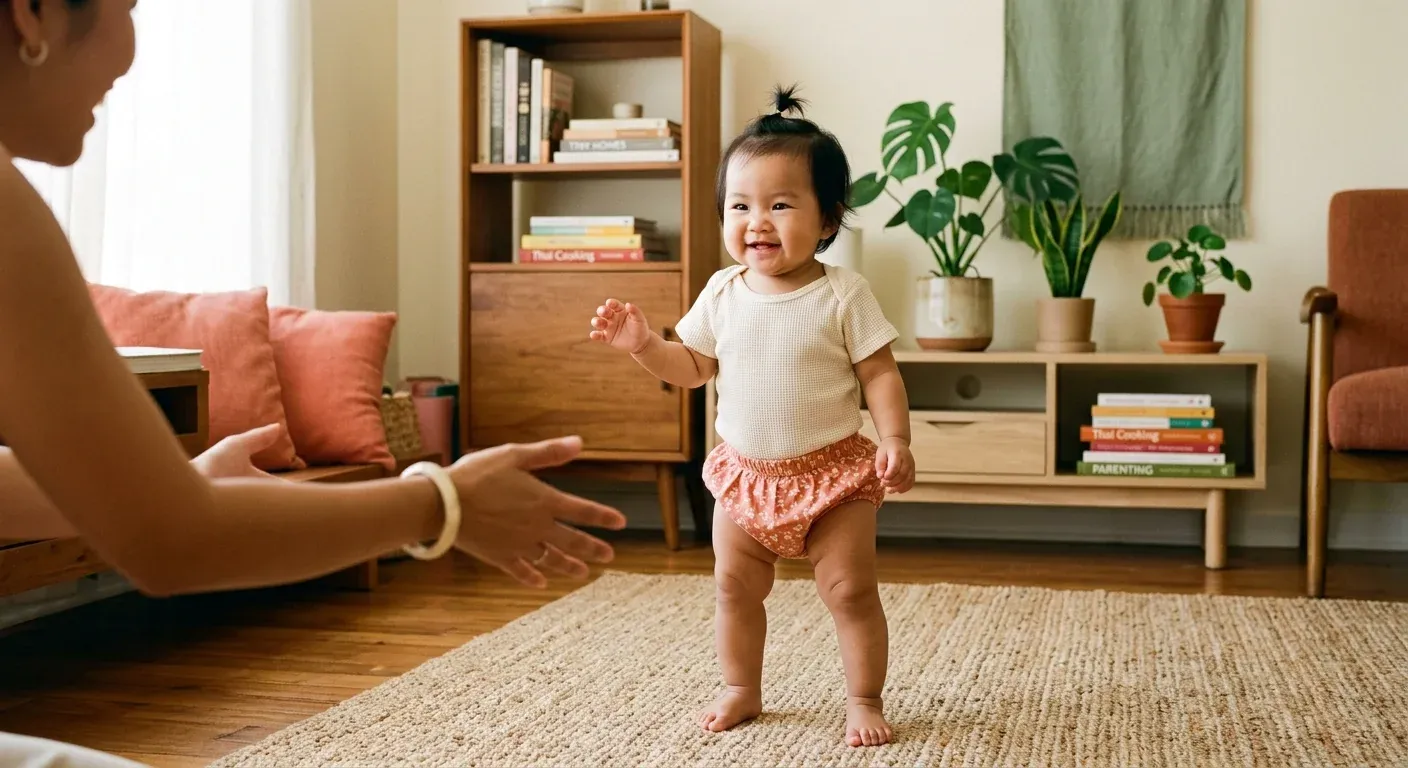
Month 11: nearly walking, nearly talking, nearly one. Everything they've practised for eleven months is about to arrive — sometimes all in the same week.
By 11 months, your baby is on the brink of walking — some let go and stand for several seconds, and a first independent step may land this month or next. Language is starting to mean something: "papa" and "mama" begin to point at specific people. Problem-solving shows up in everything they touch.
This article draws on guidance from AAP [1], WHO on complementary feeding [2], NHS [3], CDC [4], the Thai Department of Health [5], and the Royal Thai College of Pediatricians [6].
What to look for at 11 months
Motor
- Stands alone for several seconds without support.
- First independent steps may appear — most babies walk somewhere between 9 and 15 months, all of which is normal.
- Cruises confidently between pieces of furniture; some let go for short stretches.
- Squats to pick something up then stands back up.
- Climbs onto sofas and low steps — supervise closely.
Communication and language
- First meaningful words — "papa", "mama" used for specific people. Some babies have no clear word yet at 11 months — also fine.
- Understands simple instructions — "give it to mum", "sit down", "kiss".
- Many gestures — waving, clapping, blowing kisses, pointing, arms-up to be picked up.
- Shakes head "no" — often.
- Imitates sounds and words — tries to copy.
Cognitive and problem-solving
- Object permanence is solid — finds objects hidden under cloth.
- Stacks two blocks.
- Drops objects into a container, dumps them out — practising grasp, release, and planning.
- Uses tools — pulls a string to bring a toy closer.
- Imitates household actions — sweeping, using a spoon, feeding a doll.
Social
- Personality shows — bold or cautious, social or shy.
- Still prefers trusted people — stranger awareness can persist.
- Parallel play — happy beside another child, not yet playing with them.
- Clear emotions — joy, frustration, jealousy, indignation.
First steps: why some babies walk later than others
Most babies walk between 9 and 15 months — a wide normal range [1]. A late walker is not a less intelligent baby. Factors that matter:
- Genetics — late-walking parents tend to have late-walking babies.
- Body weight — heavier babies sometimes walk later.
- Temperament — cautious babies often walk later.
- Time on the floor — babies who are carried constantly may walk later.
- A bad fall — some become hesitant after a hard fall.
If your 12-month-old is not pulling to stand, cruising, crawling, or moving in any way, that's a reason to talk to your paediatrician [4].
First shoes
- Indoors, barefoot is best — practises balance and weight-bearing.
- Outdoors, soft-soled shoes that fit the foot.
- No need for shoes before independent walking; "training shoes" are unnecessary.
Feeding: nearly family meals
WHO complementary feeding [2] puts 9-11 month babies at 3-4 meals plus 1-2 healthy snacks, with textures close to family food.
How meals look this month
- 3-4 main meals + 1-2 snacks — fruit, yoghurt, soft bread.
- Pieces over purée — the baby chews and self-feeds.
- Practise cup and spoon consistently — mess is part of the learning.
- Eat together when possible — your baby learns mealtime by watching.
Foods that suit an 11-month-old
Per the Thai Department of Health [5] and AAP guidance on starting solid foods [7]:
- Soft rice in small pieces.
- Protein — liver, red meat, fish, chicken, egg — chopped or shredded.
- Vegetables — leafy greens, pumpkin, carrot, beans — cooked soft, chopped small.
- Soft fruit — banana, ripe mango, ripe papaya, soft apple, watermelon triangles.
- Plain unsweetened yoghurt and cheese.
- Soft tofu and well-mashed pulses.
Still avoid before age 1
- Honey — risk of infant botulism.
- Cow's milk as the main drink — fine in cooking; switch can begin after age 1.
- Salt, sugar, seasoning.
- Choking hazards — whole grapes, cherries, whole nuts, popcorn, hard candy, whole sausage rounds.
Preparing for the milk transition after age 1
This month is a good time to introduce drinking from a training cup — preparing for the shift from bottle to cup after age 1. AAP recommends weaning off the bottle by 18 months.
Sleep at 11 months
Many babies are now sleeping 10-12 hours overnight with 0-1 night feeds, and 1-2 daytime naps.
Safe sleep — still the ABCs [8]
- A — Alone in their own crib.
- B — Back to start; let your baby settle in their preferred position once they move freely.
- C — Crib — firm, flat, no pillows, blankets, soft toys, or bumpers.
If your baby is trying to climb out of the crib, lower the mattress to the lowest setting — falls from height are the main risk now.
Getting ready for the first birthday
In a few weeks your baby will turn 1. Good time to:
- Schedule the 12-month check-up and EPI vaccines per the Thai national schedule.
- Phase out bottles, encourage cup drinking consistently.
- Start brushing — soft cloth or baby brush, a rice-grain-sized smear of children's toothpaste.
- Re-survey home safety — a walking baby reaches a whole new level of shelves.
- Make bedtime stories a routine — daily reading sets the habit.
When to call your paediatrician
Per CDC [4] and the Royal Thai College of Pediatricians [6], check in if your 11-month-old:
- Doesn't sit alone steadily.
- Doesn't crawl or move around in any way.
- Doesn't pull to stand.
- Doesn't babble or has gone quieter than they were.
- Doesn't respond to their own name.
- Doesn't use any gestures — waving, clapping, pointing.
- Doesn't make eye contact, smile back, or laugh.
- Has lost a skill — most important sign of all.
Same-day care
- Fever above 39°C that doesn't come down.
- Fast or laboured breathing, ribs pulling in, blue lips.
- Listless, hard to wake, refusing to feed.
- Repeated forceful or green/bloody vomiting.
- Watery diarrhoea, dry mouth, sunken eyes, fewer wet nappies.
- Swallowed a foreign object and choking — emergency.
- Seizure or loss of consciousness.
Summary
Month 11 is the month of "almost" — almost walking, almost a real word, almost one year old. Everything your baby has been practising is about to land all at once.
The things that matter most this month:
- 3-4 main meals + healthy snacks with family-style textures.
- No honey, salt, sugar, or cow's milk as a main drink before age 1.
- Barefoot indoors — balance and weight-bearing develop best without shoes.
- Childproof for a walker — table edges, kitchen knives, cleaning products.
- Read books, talk all day, answer their sounds — language builds in real conversation.
A baby who lets go of the sofa and stands, calls their parents by sound, and tries to fix small problems on their own is a baby right on track. When in doubt — not moving, not babbling, not gesturing — your paediatrician would always rather hear from you early.
แหล่งอ้างอิง
- AAP HealthyChildren — Ages & Stages: Baby
- WHO — Complementary feeding
- NHS — Start for Life: Baby development
- CDC — Learn the Signs. Act Early. (If You're Concerned About Your Child's Development)
- Thai Department of Health (กรมอนามัย) — Early-childhood development guide
- Royal Thai College of Pediatricians
- AAP HealthyChildren — Starting Solid Foods
- AAP HealthyChildren — A Parent's Guide to Safe Sleep